Results by title
366 books match the query 'International' and 23 start with a
A Critical History of Poverty Finance
Colonial Roots and Neoliberal FailuresNick
Pluto Press, 2022
A comprehensive historical tracing of how the contemporary finance-poverty-development nexus emerged.
'The definitive account of the history of poverty finance' - Susanne Soederberg
Finance, mobile, and digital technologies - or 'fintech' - are being heralded in the world of development by the likes of the IMF and World Bank as a silver bullet in the fight against poverty. But should we believe the hype?
A Critical History of Poverty Finance demonstrates how newfangled 'digital financial inclusion' efforts suffer from the same essential flaws as earlier iterations of neoliberal 'financial inclusion.' Relying on artificially created markets that simply aren't there among the world's most disadvantaged economic actors, they also reinforce existing patterns of inequality and uneven development, many of which date back to the colonial era.
Bernards offers an astute analysis of the current fintech fad, contextualized through a detailed colonial history of development finance, that ultimately reveals the neoliberal vision of poverty alleviation for the pipe dream it is.
A History of Corporate Governance around the World
Family Business Groups to Professional ManagersEdited by Randall K. Morck
University of Chicago Press, 2005
In this volume, some of the brightest minds in the field of economics present new empirical research that suggests that each side of the debate has something to offer the other. Free enterprise and well-developed financial systems are proven to produce growth in those countries that have them. But research also suggests that in some other capitalist countries, arrangements truly do concentrate corporate ownership in the hands of a few wealthy families.
A History of Corporate Governance around the World provides historical studies of the patterns of corporate governance in several countries-including the large industrial economies of Canada, France, Germany, Italy, Japan, the United Kingdom, and the United States; larger developing economies like China and India; and alternative models like those of the Netherlands and Sweden.
A Monetary and Fiscal History of Latin America, 1960–2017
Timothy J. Kehoe
University of Minnesota Press, 2021
A major, new, and comprehensive look at six decades of macroeconomic policies across the region
What went wrong with the economic development of Latin America over the past half-century? Along with periods of poor economic performance, the region’s countries have been plagued by a wide variety of economic crises. This major new work brings together dozens of leading economists to explore the economic performance of the ten largest countries in South America and of Mexico. Together they advance the fundamental hypothesis that, despite different manifestations, these crises all have been the result of poorly designed or poorly implemented fiscal and monetary policies.
Each country is treated in its own section of the book, with a lead chapter presenting a comprehensive database of the country’s fiscal, monetary, and economic data from 1960 to 2017. The chapters are drawn from one-day academic conferences—hosted in all but one case, in the focus country—with participants including noted economists and former leading policy makers. Cowritten with Nobel Prize winner Thomas J. Sargent, the editors’ introduction provides a conceptual framework for analyzing fiscal and monetary policy in countries around the world, particularly those less developed. A final chapter draws conclusions and suggests directions for further research.
A vital resource for advanced undergraduate and graduate students of economics and for economic researchers and policy makers, A Monetary and Fiscal History of Latin America, 1960–2017 goes further than any book in stressing both the singularities and the similarities of the economic histories of Latin America’s largest countries.
Contributors: Mark Aguiar, Princeton U; Fernando Alvarez, U of Chicago; Manuel Amador, U of Minnesota; Joao Ayres, Inter-American Development Bank; Saki Bigio, UCLA; Luigi Bocola, Stanford U; Francisco J. Buera, Washington U, St. Louis; Guillermo Calvo, Columbia U; Rodrigo Caputo, U of Santiago; Roberto Chang, Rutgers U; Carlos Javier Charotti, Central Bank of Paraguay; Simón Cueva, TNK Economics; Julián P. Díaz, Loyola U Chicago; Sebastian Edwards, UCLA; Carlos Esquivel, Rutgers U; Eduardo Fernández Arias, Peking U; Carlos Fernández Valdovinos (former Central Bank of Paraguay); Arturo José Galindo, Banco de la República, Colombia; Márcio Garcia, PUC-Rio; Felipe González Soley, U of Southampton; Diogo Guillen, PUC-Rio; Lars Peter Hansen, U of Chicago; Patrick Kehoe, Stanford U; Carlos Gustavo Machicado Salas, Bolivian Catholic U; Joaquín Marandino, U Torcuato Di Tella; Alberto Martin, U Pompeu Fabra; Cesar Martinelli, George Mason U; Felipe Meza, Instituto Tecnológico Autónomo de México; Pablo Andrés Neumeyer, U Torcuato Di Tella; Gabriel Oddone, U de la República; Daniel Osorio, Banco de la República; José Peres Cajías, U of Barcelona; David Perez-Reyna, U de los Andes; Fabrizio Perri, Minneapolis Fed; Andrew Powell, Inter-American Development Bank; Diego Restuccia, U of Toronto; Diego Saravia, U de los Andes; Thomas J. Sargent, New York U; José A. Scheinkman, Columbia U; Teresa Ter-Minassian (formerly IMF); Marco Vega, Pontificia U Católica del Perú; Carlos Végh, Johns Hopkins U; François R. Velde, Chicago Fed; Alejandro Werner, IMF.
A Region among States
Law and Non-sovereignty in the CaribbeanLee Cabatingan
University of Chicago Press, 2023
How is it that a great swath of the independent, English-speaking Caribbean continues to accept the judicial oversight of their former colonizer via the British institution of the Privy Council? And what possibilities might the Caribbean Court of Justice—a judicial institution responsive to the region, not to any single nation—offer for untangling sovereignty and regionhood, law and modernity, and postcolonial Caribbean identity?
Joining the Court as an intern, Lee Cabatingan studied its work up close: she attended each court hearing and numerous staff meetings, served on committees, assisted with the organization of conferences, and helped prepare speeches and presentations for the judges. She now offers insight into not only how the Court positions itself vis-à-vis the Caribbean region and the world but also whether the Court—and, perhaps, the region itself as an overarching construct—might ever achieve a real measure of popular success. In their quest for an accepting, eager constituency, the Court is undertaking a project of extrajudicial region building that borrows from the toolbox of the nation-state. In each chapter, Cabatingan takes us into an analytical dimension familiar from studies of nation and state building—myth, territory, people, language, and brand—to help us understand not only the Court and its ambitions but also the regionalist project, beset as it is with false starts and disappointments, as a potential alternative to the sovereign state.
A Retrospective on the Bretton Woods System
Lessons for International Monetary ReformEdited by Michael D. Bordo and Barry Eichengreen
University of Chicago Press, 1993
The contributors explore adjustment, liquidity, and transmission under the System; the way it affected developing countries; and the role of the International Monetary Fund in maintaining a stable rate. The authors examine the reasons for the System's success and eventual collapse, compare it to subsequent monetary regimes, such as the European Monetary System, and address the possibility of a new fixed exchange rate for today's world.
A Study of Crisis
Michael Brecher and Jonathan Wilkenfeld
University of Michigan Press, 2000
The culmination of more than twenty years of research by Michael Brecher and Jonathan Wilkenfeld, the book analyzes crucial themes about crisis, conflict, and war and presents systematic knowledge about more than 400 crises, thirty-one protracted conflicts and almost 900 state participants. The authors explore many aspects of conflict, including the ethnic dimension, the effect of different kinds of political regimes--notably the question whether democracies are more peaceful than authoritarian regimes, and the role of violence in crisis management. They employ both case studies and aggregate data analysis in a Unified Model of Crisis to focus on two levels of analysis--hostile interactions among states, and the behavior of decision-makers who must cope with the challenge posed by a threat to values, time pressure, and the increased likelihood that military hostilities will engulf them.
This book will appeal to scholars in history, political science, sociology, and economics as well as policy makers interested in the causes and effects of crises in international relations. The rich data sets will serve researchers for years to come as they probe additional aspects of crisis, conflict and war in international relations.
Michael Brecher is R. B. Angus Professor of Political Science, McGill University. Jonathan Wilkenfeld is Professor and Chair of the Department of Government and Politics, University of Maryland. They are the coauthors of Crises in the Twentieth Century: A Handbook of International Crisis, among other books and articles.
Affective Justice
The International Criminal Court and the Pan-Africanist PushbackKamari Maxine Clarke
Duke University Press, 2019

African Entrepreneurship
Muslim Fula Merchants in Sierra LeoneAlusine Jalloh
Ohio University Press, 1999
Departing from the prevailing scholarship, Jalloh characterizes the Fula businesses as independent, rather than appendages of Western expatriate commerce. In addition to establishing successful businesses, Fula merchants established Islamic educational institutions for propogating the Muslim faith and promoting Islamic scholarship.
This study also examines the evolution of Fula chieftaincy from the colonial era to the postcolonial period and documents the importance of mercantile wealth and networks in the election of Fula chiefs in Freetown. African Entrepreneurship makes an important contribution to the understudied role of African business in Sierra Leone.

After Neoliberalism
What Next for Latin America?Lance Taylor, Editor
University of Michigan Press, 1999
This book offers an intellectual and historical background for these policy choices, specifically in Argentina, Brazil, Chile, Colombia, Mexico, and Peru. The contributors detail the structural reform and economic policies in Latin America and discuss the various and often contradictory effects neoliberalism, such as fluctuating growth rates and saving-investment balances, worsened corruption, growth of exports, falling wages, and rising unemployment. In addition, each case study forecasts the effects of neoliberal policies on future growth and income distribution in the respective countries. Finally, it offers policy alternatives to neoliberalism.
The essays in this volume are: an introduction by Lance Taylor; "The Argentine Experience with Stabilization and Structural Reform," by José María Fanelli and Roberto Frenkel; "Opening, Stabilization, and Macroeconomic Sustainability in Brazil," by Edward Amadeo, "An Ongoing Structural Transformation: The Colombian Economy, 1986-96," by José Antonio Ocampo; "Economic Reforms, Stabilization Policies, and the 'Mexican Disease,'" by Nora Claudia Lustig and Jaime Ros; and "Structural Reforms and Macroeconomic Policy in Peru: 1990-96," by Oscar Dancourt.
Lance Taylor is the Arnhold Professor of International Cooperation and Development, New School for Social Research.
Aggressive Unilateralism
America's 301 Trade Policy and the World Trading SystemJagdish Bhagwati and Hugh T. Patrick, Editors
University of Michigan Press, 1990
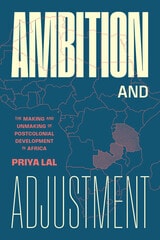
Ambition and Adjustment
The Making and Unmaking of Postcolonial Development in AfricaPriya Lal
University of Chicago Press, 2026
How the best intentions of African socialism became the useful tools of capitalism.
In the mid-twentieth century, skilled labor was seen as the key to national development. For newly independent African countries, this posed a formidable challenge: to build thriving economies, they needed to rapidly educate workers. As it turns out, that wasn’t their only obstacle.
Ambition and Adjustment reveals how responses to this human capital problem from the political left and right converged in unlikely ways to block Africa’s postcolonial progress. Focusing on nation-building projects in Zambia and Tanzania, Priya Lal recounts how the first generations of Africa’s professional class faced pressures on all sides—from foreign planners prioritizing economic growth and from local socialists decrying higher education and professionalization as wasteful and elitist. When African development stalled, international institutions like the World Bank took up parts of both approaches, justifying structural adjustment programs that defunded African universities and hospitals in the name of social equity. Indeed, Lal shows that neoliberal austerity in the 1990s was packaged in Africa’s socialist narratives from the 1960s.
By unearthing this forgotten history, Ambition and Adjustment upends traditional accounts of postcolonial development, exposing how socialism and capitalism both conflicted and overlapped to shape Africa’s trajectory since independence.

American Gamelan and the Ethnomusicological Imagination
Elizabeth A. Clendinning
University of Illinois Press, 2020
American Universities in a Global Market
Edited by Charles T. Clotfelter
University of Chicago Press, 2010
Analytical and Negotiating Issues in the Global Trading System
Alan Deardorff and Robert M. Stern, Editors
University of Michigan Press, 1994
Anti-Drug Policies in Colombia
Successes, Failures, and Wrong TurnsAlejandro Gaviria
Vanderbilt University Press, 2017
The book covers many topics: the economics of drug production, the policies to reduce consumption and decrease supply during the Plan Colombia, the effects of the drug problem on Colombia's international relations, the prevention of money laundering, the connection between drug trafficking and paramilitary politics, and strategies against organized crime. Beyond the diversity in topics, there is a common thread running through all the chapters: the need to analyze objectively what works and what does not, based on empirical evidence. Presented here for the first time to an English-speaking audience, this book is a contribution to a debate that urgently needs to transcend ideology and preconceived opinions.

Antidumping Law and Practice
A Comparative StudyJohn H. Jackson and Edwin A. Vermulst, Editors
University of Michigan Press, 1990
Antidumping Law
Policy and ImplementationJohn H. Jackson, Editor
University of Michigan Press, 1979

Antidumping
How It Works and Who Gets HurtJ. Michael Finger
University of Michigan Press, 1993

Apocalyptic Crimes
Why Nuclear Weapons Are Illegal and Must Be AbolishedRonald C. Kramer
Rutgers University Press, 2025
Kramer argues that any country holding on to its nuclear arsenal—including the United States—is committing a criminal act. Offering a sharp rebuke to the common claim that nuclear stockpiles serve to deter the escalation of conflict, Apocalyptic Crimes emphasizes the harm caused by the mere possession of these deadly weapons. It further considers the culpability of political officials, acting as representatives of the state, whose threatening statements about nuclear weapons contain actions or omissions that violate specific international laws. But Kramer also shows how a nuclear apocalypse might be averted and offers a pathway to disarmament. Through critical analysis and a specific criminology of nuclear weapons, Kramer outlines the political actions necessary to rewind the Doomsday Clock and pull the world back from the brink of destruction—before the clock strikes midnight.

Asian Legal Revivals
Lawyers in the Shadow of EmpireYves Dezalay and Bryant G. Garth
University of Chicago Press, 2010
More than a decade ago, before globalization became a buzzword, Yves Dezalay and Bryant G. Garth established themselves as leading analysts of how that process has shaped the legal profession. Drawing upon the insights of Pierre Bourdieu, Asian Legal Revivals explores the increasing importance of the positions of the law and lawyers in South and Southeast Asia.
Dezalay and Garth argue that the current situation in many Asian countries can only be fully understood by looking to their differing colonial experiences—and in considering how those experiences have laid the foundation for those societies’ legal profession today. Deftly tracing the transformation of the relationship between law and state into different colonial settings, the authors show how nationalist legal elites in countries such as India, Indonesia, Malaysia, the Philippines, Singapore, and South Korea came to wield political power as agents in the move toward national independence. Including fieldwork from over 350 interviews, Asian Legal Revivals illuminates the more recent past and present of these legally changing nations and explains the profession’s recent revival of influence, as spurred on by American geopolitical and legal interests.
Assessing the Value of Law in Transition Economies
Peter Murrell, Editor
University of Michigan Press, 2001
At Home and Abroad
U.S. Labor Market Performance in International PerspectiveFrancine D. Blau
Russell Sage Foundation, 2002
Automobiles and the Future
Competition, Cooperation, and ChangeRobert E. Cole, Editor
University of Michigan Press, 1983