Results by title
123 books match the query 'Internet' and 5 start with a
A Social Edition of the Devonshire Manuscript (BL MS Add 17,492)
Edited by Raymond Siemens, Karin Armstrong, and Constance Crompton
Iter Press, 2015
Algorithmic Worldmaking
The Rhetorical Craft of Networked OrderJeremy David Johnson
University of Alabama Press, 2025
Illuminates how algorithms, intertwined with human biases, damage political discourse and civic engagement.
Algorithmic Worldmaking is an urgent exploration of the dynamic relationship between algorithms that encode their human creators’ assumptions and the humans whose choices are shaped by these algorithms in search engines, social media, and other digital spaces. Transcending discussions of one or the other, Jeremy David Johnson traces the corrupting political and social influences that arise from their mutual interaction.
Johnson uses the concept of kosmos in its sense of a dynamic order to frame the interplay between algorithms, humans, and their environments. He first shows how algorithms, far from being objective or unbiased, perpetuate human errors. Johnson then suggests a framework of four parts—navigation, exploration, maintenance, and monetization—to map the variety of political consequences to a society influenced by these four factors.
Citing controversies at major platforms such as Google, YouTube, and Facebook, Johnson demonstrates how algorithms limit and shape human thought. He makes several persuasive arguments. First, algorithms and humans share agency but humans have exceptional responsibility. Second, the algorithmic kosmos mirrors and shapes social oppression. Third, algorithms incentivize capitalist exploitation. Last, these influences damage democratic deliberation.
This landmark study is essential for scholars and students of political science, media studies, and those interested in the perilous implications of algorithmic systems on civic and political life.

Analog Hunger in a Digital World
Confronting Today's Identity CrisisPaul Vitz
St. Augustine's Press, 2024
Vitz argues that the "special digital way in which technology is destroying our well-being will require some new vocabulary… [while] making the case that analog experience is the only reliable source of meaning in our lives and that its loss has led to the growth of meaninglessness and especially to the loss of [personal identity." This book is written for those who are enthralled by the digital realm and tech advancements, but also for those who are affected by contemporary crises in culture and identity. Vitz's approach is far-reaching and concise. "After describing the nature of analog and digital codes in chapters 1 and 2, I then note the great importance of the right and left brain hemispheres to analog and digital differences in chapters 3 and 4. Chapter 5 introduces the cultural crisis of today as analog hunger in a digital world. Chapters 6 and 7 identify the problem as extreme uncontrolled digitalism, with a focus on transhumanism. Chapter 8 presents ways to recover analog life and chapter 9 makes clear we need both codes. Chapter 10 provides a solution involving the integration of the two codes in the service of the analog from a distinctly religious perspective."
Artificial Intelligence and the Internet of Things
UK Policy Opportunities and ChallengesMercedes Bunz and Laima Janciute
University of Westminster Press, 2018
Through algorithms and artificial intelligence (AI), objects and digital services now demonstrate new skills they did not have before, right up to replacing human activity through pre-programming or by making their own decisions. As part of the internet of things, AI applications are already widely used today, for example in language processing, image recognition and the tracking and processing of data.
This policy brief illustrates the potential negative and positive impacts of AI and reviews related policy strategies adopted by the UK, US, EU, as well as Canada and China. Based on an ethical approach that considers the role of AI from a democratic perspective and considering the public interest, the authors make policy recommendations that help to strengthen the positive impact of AI and to mitigate its negative consequences.
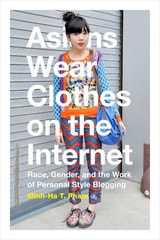
Asians Wear Clothes on the Internet
Race, Gender, and the Work of Personal Style BloggingMinh-ha T. Pham
Duke University Press, 2015