104 books match the query 'Japanese' and 3 start with a
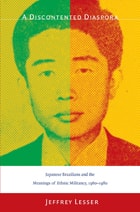
cover of A Discontented Diaspora: Japanese Brazilians and the Meanings of Ethnic Militancy, 1960–1980

A Discontented Diaspora

Japanese Brazilians and the Meanings of Ethnic Militancy, 1960–1980

Jeffrey Lesser

Duke University Press, 2007

In A Discontented Diaspora, Jeffrey Lesser investigates broad questions of ethnicity, the nature of diasporic identity, and Brazilian culture. He does so by exploring particular experiences of young Japanese Brazilians who came of age in São Paulo during the 1960s and 1970s, an intensely authoritarian period of military rule. The most populous city in Brazil, São Paulo was also the world’s largest “Japanese” city outside of Japan by 1960. Believing that their own regional identity should be the national one, residents of São Paulo constantly discussed the relationship between Brazilianness and Japaneseness. As second-generation Nikkei (Brazilians of Japanese descent) moved from the agricultural countryside of their immigrant parents into various urban professions, they became the “best Brazilians” in terms of their ability to modernize the country and the “worst Brazilians” because they were believed to be the least likely to fulfill the cultural dream of whitening. Lesser analyzes how Nikkei both resisted and conformed to others’ perceptions of their identity as they struggled to define and claim their own ethnicity within São Paulo during the military dictatorship.

Lesser draws on a wide range of sources, including films, oral histories, wanted posters, advertisements, newspapers, photographs, police reports, government records, and diplomatic correspondence. He focuses on two particular cultural arenas—erotic cinema and political militancy—which highlight the ways that Japanese Brazilians imagined themselves to be Brazilian. As he explains, young Nikkei were sure that their participation in these two realms would be recognized for its Brazilianness. They were mistaken. Whether joining banned political movements, training as guerrilla fighters, or acting in erotic films, the subjects of A Discontented Diaspora militantly asserted their Brazilianness only to find that doing so reinforced their minority status.
[more]
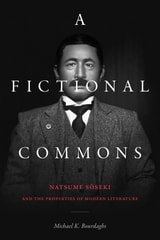
cover of A Fictional Commons: Natsume Soseki and the Properties of Modern Literature

A Fictional Commons

Natsume Soseki and the Properties of Modern Literature

Michael K. Bourdaghs

Duke University Press, 2021
Modernity arrived in Japan, as elsewhere, through new forms of ownership. In A Fictional Commons, Michael K. Bourdaghs explores how the literary and theoretical works of Natsume Sōseki (1867–1916), widely celebrated as Japan's greatest modern novelist, exploited the contradictions and ambiguities that haunted this new system. Many of his works feature narratives about inheritance, thievery, and the struggle to obtain or preserve material wealth while also imagining alternative ways of owning and sharing. For Sōseki, literature was a means for thinking through—and beyond—private property. Bourdaghs puts Sōseki into dialogue with thinkers from his own era (including William James and Mizuno Rentarō, author of Japan’s first copyright law) and discusses how his work anticipates such theorists as Karatani Kōjin and Franco Moretti. As Bourdaghs shows, Sōseki both appropriated and rejected concepts of ownership and subjectivity in ways that theorized literature as a critical response to the emergence of global capitalism.
[more]
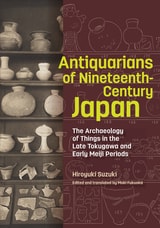
cover of Antiquarians of Nineteenth-Century Japan: The Archaeology of Things in the Late Tokugawa and Early Meiji Periods

Antiquarians of Nineteenth-Century Japan

The Archaeology of Things in the Late Tokugawa and Early Meiji Periods

Hiroyuki Suzuki

J. Paul Getty Trust, The, 2022

This volume explores the changing process of evaluating objects during the period of Japan’s rapid modernization.
 
Originally published in Japanese, Antiquarians of Nineteenth-Century Japan looks at the approach toward object-based research across the late Tokugawa and early Meiji periods, which were typically kept separate, and elucidates the intellectual continuities between these eras. Focusing on the top-down effects of the professionalizing of academia in the political landscape of Meiji Japan, which had advanced by attacking earlier modes of scholarship by antiquarians, Suzuki shows how those outside the government responded, retracted, or challenged new public rules and values. He explores the changing process of evaluating objects from the past in tandem with the attitudes and practices of antiquarians during the period of Japan’s rapid modernization. He shows their roots in the intellectual sphere of the late Tokugawa period while also detailing how they adapted to the new era. Suzuki also demonstrates that Japan’s antiquarians had much in common with those from Europe and the United States.

Art historian Maki Fukuoka provides an introduction to the English translation that highlights the significance of Suzuki’s methodological and intellectual analyses and shows how his ideas will appeal to specialists and nonspecialists alike.
[more]