Results by title
50 books match the query 'Justice, Administration of' and 6 start with a
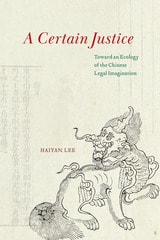
A Certain Justice
Toward an Ecology of the Chinese Legal ImaginationHaiyan Lee
University of Chicago Press, 2023
To many outsiders, China has an image as a realm of Oriental despotism where law is at best window dressing and at worst an instrument of coercion and tyranny. In this highly original contribution to the interdisciplinary field of law and humanities, Haiyan Lee contends that this image arises from a skewed understanding of China’s political-legal culture, particularly the failure to distinguish what she calls high justice and low justice.
In the Chinese legal imagination, Lee shows, justice is a vertical concept, with low justice between individuals firmly subordinated to the high justice of the state. China’s political-legal culture is marked by a mistrust of law’s powers, and as a result, it privileges substantive over procedural justice. Calling on a wide array of narratives—stories of crime and punishment, subterfuge and exposé, guilt and redemption—A Certain Justice helps us recognize the fight for justice outside the familiar arenas of liberal democracy and the rule of law.
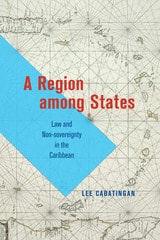
A Region among States
Law and Non-sovereignty in the CaribbeanLee Cabatingan
University of Chicago Press, 2023
How is it that a great swath of the independent, English-speaking Caribbean continues to accept the judicial oversight of their former colonizer via the British institution of the Privy Council? And what possibilities might the Caribbean Court of Justice—a judicial institution responsive to the region, not to any single nation—offer for untangling sovereignty and regionhood, law and modernity, and postcolonial Caribbean identity?
Joining the Court as an intern, Lee Cabatingan studied its work up close: she attended each court hearing and numerous staff meetings, served on committees, assisted with the organization of conferences, and helped prepare speeches and presentations for the judges. She now offers insight into not only how the Court positions itself vis-à-vis the Caribbean region and the world but also whether the Court—and, perhaps, the region itself as an overarching construct—might ever achieve a real measure of popular success. In their quest for an accepting, eager constituency, the Court is undertaking a project of extrajudicial region building that borrows from the toolbox of the nation-state. In each chapter, Cabatingan takes us into an analytical dimension familiar from studies of nation and state building—myth, territory, people, language, and brand—to help us understand not only the Court and its ambitions but also the regionalist project, beset as it is with false starts and disappointments, as a potential alternative to the sovereign state.
A Year in the Life of the Supreme Court
Rodney A. Smolla, ed.
Duke University Press, 1995
The cases heard by the Supreme Court are, first and foremost, disputes involving real people with actual stories. The accidents and twists of circumstance that have brought these people to the last resort of litigation can make for compelling drama. The contributors to this volume bring these dramatic stories to life, using them as a backdrop for the larger issues of law and social policy that constitute the Court’s business: abortion, separation of church and state, freedom of speech, the right of privacy, crime, violence, discrimination, and the death penalty. In the course of these narratives, the authors describe the personalities and jurisprudential leanings of the various Justices, explaining how the interplay of these characters and theories about the Constitution interact to influence the Court’s decisions.
Highly readable and richly informative, this book offers an unusually clear and comprehensive portrait of one of the most influential institutions in modern American life.
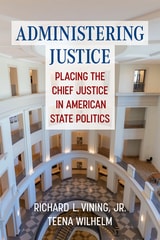
Administering Justice
Placing the Chief Justice in American State PoliticsRichard L. Vining Jr. and Teena Wilhelm
University of Michigan Press, 2023
Administering Justice examines the leadership role of chief justices in the American states, including how those duties require chief justices to be part of the broader state political environment. Vining and Wilhelm focus extensively on the power of chief justices as public spokespersons, legislative liaisons, and reform leaders. In contrast to much existing research on chief justices in the states, this study weighs their extrajudicial responsibilities rather than intracourt leadership. By assessing the content of State of the Judiciary remarks delivered over a period of sixty years, Vining and Wilhelm are able to analyze the reform agendas advanced by chief justices and determine what factors influence the likelihood of success. These analyses confirm that chief justices engage with state politics in meaningful ways and that reactions to their proposals are influenced by ideological congruence with other political elites and the scope of their requests. Administering Justice also examines the chief justice position as an institution, provides a collective profile of its occupants, and surveys growing diversity among court leaders.
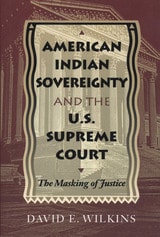
American Indian Sovereignty and the U.S. Supreme Court
The Masking of JusticeBy David E. Wilkins
University of Texas Press, 1997
"Like the miner's canary, the Indian marks the shift from fresh air to poison gas in our political atmosphere; and our treatment of Indians, even more than our treatment of other minorities, reflects the rise and fall in our democratic faith," wrote Felix S. Cohen, an early expert in Indian legal affairs.
In this book, David Wilkins charts the "fall in our democratic faith" through fifteen landmark cases in which the Supreme Court significantly curtailed Indian rights. He offers compelling evidence that Supreme Court justices selectively used precedents and facts, both historical and contemporary, to arrive at decisions that have undermined tribal sovereignty, legitimated massive tribal land losses, sanctioned the diminishment of Indian religious rights, and curtailed other rights as well.
These case studies—and their implications for all minority groups—make important and troubling reading at a time when the Supreme Court is at the vortex of political and moral developments that are redefining the nature of American government, transforming the relationship between the legal and political branches, and altering the very meaning of federalism.
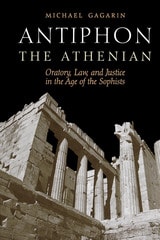
Antiphon the Athenian
Oratory, Law, and Justice in the Age of the SophistsBy Michael Gagarin
University of Texas Press, 2002
Winner, Friends of the Dallas Public Library Award from the Texas Institute of Letters, 2003
Antiphon was a fifth-century Athenian intellectual (ca. 480-411 BCE) who created the profession of speechwriting while serving as an influential and highly sought-out adviser to litigants in the Athenian courts. Three of his speeches are preserved, together with three sets of Tetralogies (four hypothetical paired speeches), whose authenticity is sometimes doubted. Fragments also survive of intellectual treatises on subjects including justice, law, and nature (physis), which are often attributed to a separate Antiphon the Sophist. Were these two Antiphons really one and the same individual, endowed with a wide-ranging mind ready to tackle most of the diverse intellectual interests of his day?
Through an analysis of all these writings, this book convincingly argues that they were composed by a single individual, Antiphon the Athenian. Michael Gagarin sets close readings of individual works within a wider discussion of the fifth-century Athenian intellectual climate and the philosophical ferment known as the sophistic movement. This enables him to demonstrate the overall coherence of Antiphon's interests and writings and to show how he was a pivotal figure between the sophists and the Attic orators of the fourth century. In addition, Gagarin's argument allows us to reassess the work of the sophists as a whole, so that they can now be seen as primarily interested in logos (speech, argument) and as precursors of fourth-century rhetoric, rather than in their usual role as foils for Plato.