169 books match the query 'Juvenile Nonfiction' and 9 start with a
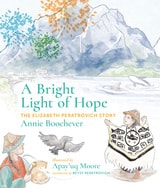
cover of A Bright Light of Hope: The Elizabeth Peratrovich Story

A Bright Light of Hope

The Elizabeth Peratrovich Story

Annie Boochever

University of Alaska Press, 2026

No one expected the girl from a small town in Alaska to make history, but Elizabeth Peratrovich saw discrimination and refused to stay silent. Fairness became the driving force of her life. She helped change Alaska so everyone, no matter what race, would be treated equally under the law. This is her story.

A Bright Light of Hope: The Elizabeth Peratrovich Story is the first picture biography for young people that tells the true story of the remarkable Alaska Native woman whose fight, alongside other Alaska leaders, guaranteed equal treatment under Alaska law, regardless of race. It was a right that took the rest of the country nearly twenty more years to realize with the US Civil Rights Act of 1964. Beautifully illustrated by Yup’ik artist Apay’uq Moore and adapted from Fighter in Velvet Gloves: Alaska Civil Rights Hero Elizabeth Peratrovich for grade school students, A Bright Light of Hope is just that—a light of hope. Published at a time when stories of Indigenous people are being actively suppressed by the federal government, the Elizabeth Peratrovich story brings hope to young people that they can make real change in their communities.

An accompanying study guide that features a scripted theatrical adaptation of the book intended for student performance as well as a variety of classroom activities is also available.
[more]
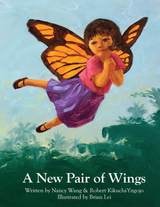
cover of A New Pair of Wings

A New Pair of Wings

Nancy Wang & Robert Kikuchi-Yngojo

Parkhurst Brothers, Inc., 2016

This delightful children’s book, based on a story originally told by Delores Yngojo Kikuchi, Robert’s mother, recounts her tale of immigration to America. Young Delores finds resolve between East and West, through courage, imagination, and a little bit of myth to discover her “new pair of wings”. The book is beautifully illustrated by Brian Lei
[more]
cover of A Recipe for Success: Lizzie Kander and Her Cookbook

A Recipe for Success

Lizzie Kander and Her Cookbook

Bob Kann

Wisconsin Historical Society Press, 2007

A Recipe for Success: Lizzie Kander and her Cookbook celebrates the life of Milwaukee’s early twentieth-century culinary wonder. This new addition to the Badger Biography series will introduce young readers to a remarkable young woman who made a difference in the lives of the early immigrants in Wisconsin. Kander originally created The Settlement Cookbook to assist young Jewish immigrant girls in cooking nutritious "American-style" meals for their families. Since its publication, several generations of household cooks have been raised on the delicious recipes of the cookbook. Proceeds from the sale of the original cookbook helped build Milwaukee’s first settlement house and later the city’s Jewish Community Center. The century-old cookbook is still in print today. This is a delightful biography, filled with humorous asides, wonderful period illustrations, and of course recipes!
[more]
cover of A Tallgrass Prairie Alphabet

A Tallgrass Prairie Alphabet

Claudia McGehee

University of Iowa Press, 2004
[more]
cover of A Woodland Counting Book

A Woodland Counting Book

Claudia McGehee

University of Iowa Press, 2006
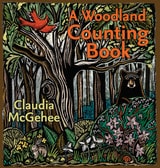
Towering oak and hickory woodlands once fringed the tallgrass prairie of the Midwest. In a wondrous mixture of plant and animal life, big mammals like black bears and cougars thrived alongside gray foxes and ovenbirds. But as more people arrived, the woodlands, like the tallgrass prairie, were cleared with amazing speed. Now only small portions of this special habitat remain, and many of its animals and plants are endangered or extinct. Despite the great loss, many people are working to restore and enlarge what remains so that woodlands can continue to support a rich wildlife community. And so we can all enjoy a walk in the woods. A Woodland Counting Book helps children learn about the woodland family. From one splendid white oak to fifty busy carpenter ants, illustrator Claudia McGehee counts the wonders of the woodlands in this beautifully illustrated companion to her previous children’s book, A Tallgrass Prairie Alphabet. As she follows spring to summer to fall to winter, returning at the book’s end to springtime in “one woodland community,” McGehee introduces more than twenty species of plants and animals. From the white oaks that tower overhead to shelter the woodland citizens to the delicate showy lady’s-slipper orchid and from the barred owls with distinctive hoots and calls to tiny evening bats which roost in hollow trees, we meet a wild world of woodland life. We find luna moths and serviceberries, shagbark hickories, blue spotted salamanders, wild turkeys, red squirrels, orchard orioles, and a host of other familiar and not-so-familiar plants and animals. A section of woodland notes gives common and scientific names of and interesting information about all featured species. These vibrantly colored scratchboard illustrations reveal the beauty of our woodland communities, guiding nature lovers and children of all ages through a much-loved landscape.
[more]
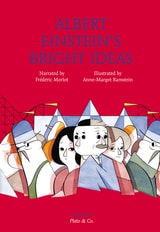
cover of Albert Einstein's Bright Ideas

Albert Einstein's Bright Ideas

Frédéric Morlot and Anne-Margot Ramstein

Diaphanes, 2017

At its most basic, philosophy is about learning how to think about the world around us. It should come as no surprise, then, that children make excellent philosophers! Naturally inquisitive, pint-size scholars need little prompting before being willing to consider life’s “big questions,” however strange or impractical. Plato & Co. introduces children—and curious grown-ups—to the lives and work of famous philosophers, from Socrates to Descartes, Einstein, Marx, and Wittgenstein. Each book in the series features an engaging—and often funny—story that presents basic tenets of philosophical thought alongside vibrant color illustrations.
          
In Albert Einstein’s Flashes of Inspiration, the young Albert Einstein has a very important job: he must deliver electricity to the big Oktoberfest celebration in Munich. As he hurries from one merry-go-round to another, nothing seems to be going as planned. With his sister, Maja, Heinrich the dog, and Niels Bohr, a qualified dwarf-thrower, can he win a battle against the laws of the universe? The key just may lie in the question of whether a dumpling can fly faster than light?
 
[more]
cover of An Arkansas History for Young People: Fourth Edition

An Arkansas History for Young People

Fourth Edition

Shay E. Hopper

University of Arkansas Press, 2008
Adopted by the State of Arkansas for 2008 Once again, the State of Arkansas has adopted An Arkansas History for Young People as an official textbook for middle-level and/or junior-high-school Arkansas-history classes. This fourth edition incorporates new research done after extensive consultations with middle-level and junior-high teachers from across the state, curriculum coordinators, literacy coaches, university professors, and students themselves. It includes a multitude of new features and is now full color throughout. This edition has been completely redesigned and now features a modern format and new graphics suitable for many levels of student readers. The completely revised fourth edition includes new unit, chapter, and section divisions as well as five brand-new chapters: an introductory chapter with information on the symbols, flag, and songs of Arkansas; chapter 2, which covers the geography of Arkansas; chapter 3, on state and local government; chapter four, on economics and tourism; and a “modern” chapter on the Arkansas of today and the future, which completes the learning adventure. This edition also has two “special features”: one on the Central High School crisis of 1957 and another on the William J. Clinton Presidential Library. It also has new and interesting features for students like the “Guide to Reading” (at the beginning of each chapter, there is a list of important terms, people, places and events for the student to keep in mind as he or she reads [corresponding to blue vocabulary words in the text, which are define in the margin]), “County Quest,” “I Am an Arkansan,” “Did You Know?” “Only in Arkansas,” “A Day in the Life,” “Chapter Reflection” questions and activities, over forty-five new content maps, and a comprehensive new map atlas.
[more]
cover of Animal Signs

Animal Signs

Debbie Slier

Gallaudet University Press, 1995

Charming, full-color photographs of basic animals plus illustrations of their corresponding signs offer children ages 1 to 4 a fun way to learn their first signs and vocabulary words. 

Studies have shown that babies who learn to sign can communicate at an earlier age than those who learn verbal communication alone. Other research indicates that children strengthen their grammar and vocabulary skills by learning sign language.

Animal Signs and its companion book, Word Signs, offer children exciting new worlds describing favorite things and animals while also making learning language skills fun!
[more]
cover of Animals at Play: Rules of the Game

Animals at Play

Rules of the Game

Marc Bekoff

Temple University Press, 2008

What can we learn from watching animals play?  Dogs chase each other and wrestle. Cats pounce and bite. These animals may look like they are fighting, but if you pay close attention— as world-renowned biologist Marc Bekoff does—you can see they are playing and learning the rules of their games. In Animals at Play, Bekoff shows us how animals behave when they play, with full-color illustrations showing animals in action and having fun—from squirrels climbing up a tree to polar bears somersaulting in the snow. 

Bekoff emphasizes how animals communicate, cooperate and learn to play fair and what happens when they break the rules. He uses lively illustrations and simple explanations of what it means when a sea lion swims with kelp in its mouth or when two dogs bow to each other. Bekoff also describes what happens when animals become too aggressive and how they apologize, forgive and learn to trust one another.  This entertaining and informative book will delight every child and show readers how animals—and humans—interact when they are having fun.
 

[more]