144 books match the query 'Juvenile literature' and 11 start with a

cover of A Captive Audience: Voices of Japanese American Youth in World War II Arkansas

A Captive Audience

Voices of Japanese American Youth in World War II Arkansas

Ali Welky

Butler Center for Arkansas Studies, 2015

Using archival primary material such as photographs, yearbooks, artwork, and first-person written accounts, A Captive Audience gives an inside look at the experiences of young people at the Rohwer and Jerome Relocation Centers in Arkansas during the forced incarceration of Japanese Americans during World War II. Many young internees at the camps saw their families lose their homes, businesses, and possessions on the West Coast when the U.S. government rounded up people of Japanese descent after the bombing of Pearl Harbor. Yet through all the chaos and heartbreak of the internment experience, young people often brought a unique perspective of hope and resiliency.
Intended for young-adult readers, this book explores important dimensions of Arkansas and U.S. history, including human rights and what it means to be an American.
[more]
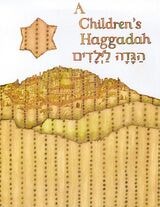
cover of A Children's Haggadah

A Children's Haggadah

Rabbi Howard Bogot

Central Conference of American Rabbis, 1996

This unique Haggadah, designed especially for young people, is a delightful asset for any seder table: home, religious schools, or community centers. Through special foods, prayers, and songs, children come to a personalized understanding of the miraculous event that is the Exodus. The beautiful, original illustrations render the text a meaningful work of art for all those who read it. This 8-1/2" x 11" volume includes art on every page and a vibrant accordion fold-out of the seder plate.
[more]
cover of A Recipe for Success: Lizzie Kander and Her Cookbook

A Recipe for Success

Lizzie Kander and Her Cookbook

Bob Kann

Wisconsin Historical Society Press, 2007

A Recipe for Success: Lizzie Kander and her Cookbook celebrates the life of Milwaukee’s early twentieth-century culinary wonder. This new addition to the Badger Biography series will introduce young readers to a remarkable young woman who made a difference in the lives of the early immigrants in Wisconsin. Kander originally created The Settlement Cookbook to assist young Jewish immigrant girls in cooking nutritious "American-style" meals for their families. Since its publication, several generations of household cooks have been raised on the delicious recipes of the cookbook. Proceeds from the sale of the original cookbook helped build Milwaukee’s first settlement house and later the city’s Jewish Community Center. The century-old cookbook is still in print today. This is a delightful biography, filled with humorous asides, wonderful period illustrations, and of course recipes!
[more]
cover of A Tallgrass Prairie Alphabet

A Tallgrass Prairie Alphabet

Claudia McGehee

University of Iowa Press, 2004
[more]
cover of A Woodland Counting Book

A Woodland Counting Book

Claudia McGehee

University of Iowa Press, 2006
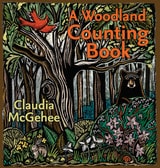
Towering oak and hickory woodlands once fringed the tallgrass prairie of the Midwest. In a wondrous mixture of plant and animal life, big mammals like black bears and cougars thrived alongside gray foxes and ovenbirds. But as more people arrived, the woodlands, like the tallgrass prairie, were cleared with amazing speed. Now only small portions of this special habitat remain, and many of its animals and plants are endangered or extinct. Despite the great loss, many people are working to restore and enlarge what remains so that woodlands can continue to support a rich wildlife community. And so we can all enjoy a walk in the woods. A Woodland Counting Book helps children learn about the woodland family. From one splendid white oak to fifty busy carpenter ants, illustrator Claudia McGehee counts the wonders of the woodlands in this beautifully illustrated companion to her previous children’s book, A Tallgrass Prairie Alphabet. As she follows spring to summer to fall to winter, returning at the book’s end to springtime in “one woodland community,” McGehee introduces more than twenty species of plants and animals. From the white oaks that tower overhead to shelter the woodland citizens to the delicate showy lady’s-slipper orchid and from the barred owls with distinctive hoots and calls to tiny evening bats which roost in hollow trees, we meet a wild world of woodland life. We find luna moths and serviceberries, shagbark hickories, blue spotted salamanders, wild turkeys, red squirrels, orchard orioles, and a host of other familiar and not-so-familiar plants and animals. A section of woodland notes gives common and scientific names of and interesting information about all featured species. These vibrantly colored scratchboard illustrations reveal the beauty of our woodland communities, guiding nature lovers and children of all ages through a much-loved landscape.
[more]
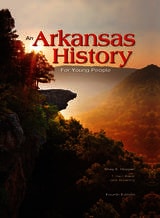
cover of An Arkansas History for Young People: Fourth Edition

An Arkansas History for Young People

Fourth Edition

Shay E. Hopper

University of Arkansas Press, 2008

Adopted by the State of Arkansas for 2008 Once again, the State of Arkansas has adopted An Arkansas History for Young People as an official textbook for middle-level and/or junior-high-school Arkansas-history classes. This fourth edition incorporates new research done after extensive consultations with middle-level and junior-high teachers from across the state, curriculum coordinators, literacy coaches, university professors, and students themselves. It includes a multitude of new features and is now full color throughout. This edition has been completely redesigned and now features a modern format and new graphics suitable for many levels of student readers. The completely revised fourth edition includes new unit, chapter, and section divisions as well as five brand-new chapters: an introductory chapter with information on the symbols, flag, and songs of Arkansas; chapter 2, which covers the geography of Arkansas; chapter 3, on state and local government; chapter four, on economics and tourism; and a “modern” chapter on the Arkansas of today and the future, which completes the learning adventure. This edition also has two “special features”: one on the Central High School crisis of 1957 and another on the William J. Clinton Presidential Library. It also has new and interesting features for students like the “Guide to Reading” (at the beginning of each chapter, there is a list of important terms, people, places and events for the student to keep in mind as he or she reads [corresponding to blue vocabulary words in the text, which are define in the margin]), “County Quest,” “I Am an Arkansan,” “Did You Know?” “Only in Arkansas,” “A Day in the Life,” “Chapter Reflection” questions and activities, over forty-five new content maps, and a comprehensive new map atlas.
[more]
cover of Animal Shenanigans

Animal Shenanigans

Rob Reid

American Library Association, 2015
[more]
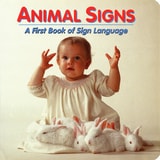
cover of Animal Signs

Animal Signs

Debbie Slier

Gallaudet University Press, 1995

Charming, full-color photographs of basic animals plus illustrations of their corresponding signs offer children ages 1 to 4 a fun way to learn their first signs and vocabulary words. 

Studies have shown that babies who learn to sign can communicate at an earlier age than those who learn verbal communication alone. Other research indicates that children strengthen their grammar and vocabulary skills by learning sign language.

Animal Signs and its companion book, Word Signs, offer children exciting new worlds describing favorite things and animals while also making learning language skills fun!
[more]
cover of Animals at Play: Rules of the Game

Animals at Play

Rules of the Game

Marc Bekoff

Temple University Press, 2008

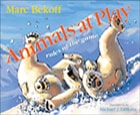
What can we learn from watching animals play?  Dogs chase each other and wrestle. Cats pounce and bite. These animals may look like they are fighting, but if you pay close attention— as world-renowned biologist Marc Bekoff does—you can see they are playing and learning the rules of their games. In Animals at Play, Bekoff shows us how animals behave when they play, with full-color illustrations showing animals in action and having fun—from squirrels climbing up a tree to polar bears somersaulting in the snow. 

Bekoff emphasizes how animals communicate, cooperate and learn to play fair and what happens when they break the rules. He uses lively illustrations and simple explanations of what it means when a sea lion swims with kelp in its mouth or when two dogs bow to each other. Bekoff also describes what happens when animals become too aggressive and how they apologize, forgive and learn to trust one another.  This entertaining and informative book will delight every child and show readers how animals—and humans—interact when they are having fun.

 

[more]
cover of Anna Atkins: Photographer, Naturalist, Innovator

Anna Atkins

Photographer, Naturalist, Innovator

Corey Keller

J. Paul Getty Trust, The, 0

Learn about the life of Anna Atkins, the pioneering photographer who combined art and science to create the first photographically illustrated book.

Step into the world of Anna Atkins (1799–1871), perhaps the world’s first female photographer and a pioneer of the medium. She lived an existence full of heartache and triumph, from her mother’s death when Atkins was an infant to her publication of multiple photographic books as an adult. After the passing of her mother, Atkins was raised primarily by her father and grandfather, who placed an emphasis on both her emotional and intellectual growth. As a result, she spent her life surrounded by some of the brightest minds of Victorian England during the Industrial Revolution.

Despite societal gender norms of the time, which typically limited women to a life within the home, Atkins gained the respect of the scientific community with her ambitious multivolume album Photographs of British Algae: Cyanotype Impressions, now recognized as the world’s first photographically illustrated book. Her cyanotypes, in addition to their scientific accuracy, lent artistic beauty to her publications, setting the stage for new uses of this experimental technology. In an era replete with state-of-the-art inventions and innovative ideas, Atkins pushed photography forward in its earliest days with courage, creativity, and brilliance.

Ages thirteen and up.

Please note that this title is sold and distributed in North America by ABRAMS, New York.
[more]
cover of Apun: The Arctic Snow

Apun

The Arctic Snow

Matthew Sturm

University of Alaska Press, 2009

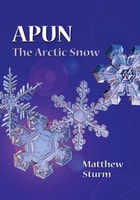
There are some twenty-five words for “snow” in the Inupiaq language. Each word denotes a different kind of snow—fresh powder snow, hard pack, soft snow, very wet snow, or just snow. Such fine distinction is reasonable, for over the centuries, Natives of the Arctic have had to rely on their knowledge of the snow to survive. Now Matthew Sturm has prepared an educational children’s book designed to teach a new generation of Arctic residents the importance of Arctic snow cover. Fully illustrated to demonstrate the cycle of the snow cover, Apun covers each phase of the “snow year.” Geared towards grades 3–4, this is a must read for elementary science classes.

[more]