72 books match the query 'Korea (South)' and 2 start with a

cover of A Morning in June: Defending Outpost Harry

A Morning in June

Defending Outpost Harry

James W. Evans, with a foreword by John S. D. Eisenhower

University of Alabama Press, 2010

Exploring the strategic and human dimensions of the defense of Outpost Harry.

By June 1953 the Korean War, marked at the outset by extremely fluid advances and retreats up and down the peninsula, had settled into position warfare very near the original pre-war demarcation line between North and South Korea. At this point both sides were fighting to win a peace, to achieve incremental advantages that could be translated into gains at the peace negotiations in Panmunjom. The battle at Outpost Harry devolved into hand-to-hand combat during a period of constant, intense fighting that lasted two days. The author, although seriously wounded that night, refused evacuation and remained on the hill to successfully lead his company in defense of the outpost. It wasn’t romantic; it wasn’t chivalrous; and many died or were badly wounded. Some of the survivors never fully overcame the mental and physical damage they suffered during the nightmare.

With this book, one of those scarred by that experience recounts the events of the battle and his lifelong efforts to deal with the residual horrors. The Korean Conflict may be called "the forgotten war" by some, but not by those who were on the front lines.
[more]
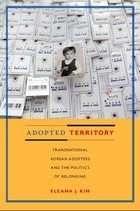
cover of Adopted Territory: Transnational Korean Adoptees and the Politics of Belonging

Adopted Territory

Transnational Korean Adoptees and the Politics of Belonging

Eleana J. Kim

Duke University Press, 2010

Since the end of the Korean War, an estimated 200,000 children from South Korea have been adopted into white families in North America, Europe, and Australia. While these transnational adoptions were initiated as an emergency measure to find homes for mixed-race children born in the aftermath of the war, the practice grew exponentially from the 1960s through the 1980s. At the height of South Korea’s “economic miracle,” adoption became an institutionalized way of dealing with poor and illegitimate children. Most of the adoptees were raised with little exposure to Koreans or other Korean adoptees, but as adults, through global flows of communication, media, and travel, they have come into increasing contact with each other, Korean culture, and the South Korean state. Since the 1990s, as Korean children have continued to leave to be adopted in the West, a growing number of adult adoptees have been returning to Korea to seek their cultural and biological origins. In this fascinating ethnography, Eleana J. Kim examines the history of Korean adoption, the emergence of a distinctive adoptee collective identity, and adoptee returns to Korea in relation to South Korean modernity and globalization. Kim draws on interviews with adult adoptees, social workers, NGO volunteers, adoptee activists, scholars, and journalists in the U.S., Europe, and South Korea, as well as on observations at international adoptee conferences, regional organization meetings, and government-sponsored motherland tours.
[more]