Results by title
88 books match the query 'Lawyers' and 6 start with a

A Life of Albert Pike
Walter Lee Brown
University of Arkansas Press, 1997
Drawing on original documents, Pike’s copious writings, and interviews with Pike’s descendants, Walter Lee Brown presents a fascinating personal history that also serves as a rich compendium of Arkansas’s antebellum history.
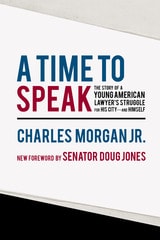
A Time to Speak
The Story of a Young American Lawyer's Struggle for His City—and HimselfCharles Morgan Jr., With a New Foreword by Senator Doug Jones
University of Alabama Press, 2022
Brings back into print a classic account of courage and calamity in the long march toward racial justice in the South, and the nation
On September 15, 1963, a bomb exploded at the Sixteenth Street Baptist Church in Birmingham, Alabama, killing four young Black girls. The very next day, a prominent white lawyer named Charles Morgan Jr. was scheduled to speak at a luncheon held by the Young Men’s Business Club of Birmingham. A well-regarded figure in the city’s legal and business establishment, Morgan had been mentioned frequently as a candidate for political office. To the shock of his longtime friends and associates, Morgan deviated from his planned remarks, instead using his platform to place the blame for the murder of the four young girls squarely on the shoulders of the city’s white middle-class establishment, those seated before him.
As much as his stand was admired nationally, in Birmingham the results were destructive for him personally. Threats against his life and the lives of his family poured in daily by phone and mail, his political career was finished, and he was faced with financial ruin. Within weeks, he moved his family out of the state, and thenceforward committed himself to legal action in the name of racial justice. In 1964, he established the regional office of the ACLU in Atlanta. In the 1964 Supreme Court case Reynolds v. Sims, Morgan successfully argued that districts in state legislatures needed to be of nearly equal size, establishing the principle of “one man, one vote” to effectively end the use of gerrymandering.
A Time to Speak was originally published in 1964, a mere year after Morgan and his family fled Birmingham. The memoir recounts not only his speech, but his entire upbringing and the political, cultural, and social milieus in which he was raised and which gave rise to the cowardice, institutional silence, fear, and hate that those conditions nursed. This new edition features a foreword from US Senator Doug Jones.
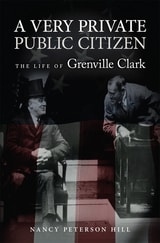
A Very Private Public Citizen
The Life of Grenville ClarkNancy Peterson Hill
University of Missouri Press, 2016
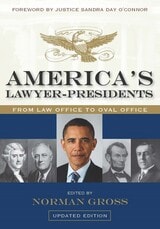
America’s Lawyer-Presidents
From Law Office to Oval OfficeNorman Gross
Northwestern University Press, 2009
The historic election of Barack Obama was rife with references to Abraham Lincoln, perhaps the greatest lawyer-president, whose legal career spanned 25 years and 5,100 cases. President Obama’s ties to Lincoln are part of a great tradition begun by John Adams, the first lawyer-president, who combined a twenty-year law practice with major contributions to our nation’s founding charters. His son, John Quincy Adams, argued landmark U.S. Supreme Court cases both before and after his presidency, one of eight lawyer-presidents to appear as counsel before the highest court in the land. And Rutherford B. Hayes and Benjamin Harrison were among those lawyer-presidents who handled notable high-profile cases, including sensational murder trials.
These are but a few of the fascinating—yet still largely unknown—stories about America’s lawyer-presidents. Now available in an updated, expanded paperback edition, America’s Lawyer-Presidents sheds light on the legal backgrounds of each of these chief executives and how their experiences as lawyers impacted and shaped their presidencies. Written by historians and presidential scholars and featuring an engaging and image-rich presentation, America’s Lawyer-Presidents provides unique insights into our national leaders and their lives and times, from colonial days to the present.
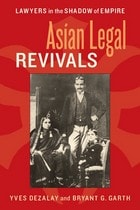
Asian Legal Revivals
Lawyers in the Shadow of EmpireYves Dezalay and Bryant G. Garth
University of Chicago Press, 2010
More than a decade ago, before globalization became a buzzword, Yves Dezalay and Bryant G. Garth established themselves as leading analysts of how that process has shaped the legal profession. Drawing upon the insights of Pierre Bourdieu, Asian Legal Revivals explores the increasing importance of the positions of the law and lawyers in South and Southeast Asia.
Dezalay and Garth argue that the current situation in many Asian countries can only be fully understood by looking to their differing colonial experiences—and in considering how those experiences have laid the foundation for those societies’ legal profession today. Deftly tracing the transformation of the relationship between law and state into different colonial settings, the authors show how nationalist legal elites in countries such as India, Indonesia, Malaysia, the Philippines, Singapore, and South Korea came to wield political power as agents in the move toward national independence. Including fieldwork from over 350 interviews, Asian Legal Revivals illuminates the more recent past and present of these legally changing nations and explains the profession’s recent revival of influence, as spurred on by American geopolitical and legal interests.

Attorney for the Frontier
Enos StutsmonDale Gibson
University of Manitoba Press, 1983