101 books match the query 'Liberty' and 5 start with a

cover of A history of the French in London: liberty, equality, opportunity

A history of the French in London

liberty, equality, opportunity

Volume editor Debra Kelly and Martyn Cornick

University of London Press, 2013

This book examines, for the first time, the history of the social, cultural, political and economic presence of the French in London, and explores the multiple ways in which this presence has contributed to the life of the city. The capital has often provided a place of refuge, from the Huguenots in the 17th century, through the period of the French Revolution, to various exile communities during the 19th century, and on to the Free French in the Second World War.It also considers the generation of French citizens who settled in post-war London, and goes on to provide insights into the contemporary French presence by assessing the motives and lives of French people seeking new opportunities in the late 20th and early 21st centuries. It analyses the impact that the French have had historically, and continue to have, on London life in the arts, gastronomy, business, industry and education, manifest in diverse places and institutions from the religious to the political via the educational, to the commercial and creative industries.
[more]
cover of Alexis de Tocqueville: Threats to Freedom in Democracy

Alexis de Tocqueville

Threats to Freedom in Democracy

Michael Hereth

Duke University Press, 1986
This first English translation of Alexis de Tocqueville shows the continuing relevance of Tocqueville's thought to the present.
[more]
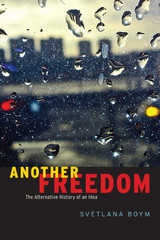
cover of Another Freedom: The Alternative History of an Idea

Another Freedom

The Alternative History of an Idea

Svetlana Boym

University of Chicago Press, 2010

The word “freedom” is so overly used—and frequently abused—that it is always in danger of becoming nothing but a cliché. In Another Freedom, Svetlana Boym offers us a refreshing new portrait of the age-old concept. Exploring the rich cross-cultural history of the idea of freedom, from its origins in ancient Greece to the present day, she argues that our attempts to imagine freedom should occupy the space of not only “what is” but also “what if.” Beginning with notions of sacrifice and the emergence of a public sphere for politics and art, Boym expands her account to include the relationships between freedom and liberation, modernity and terror, and political dissent and creative estrangement. While depicting a world of differences, she affirms lasting solidarities based on the commitment to the passionate thinking that reflections on freedom require. To do so, Boym assembles a remarkable cast of characters: Aeschylus and Euripides, Kafka and Mandelstam, Arendt and Heidegger, and a virtual encounter between Dostoevsky and Marx on the streets of Paris.

By offering a fresh look at the strange history of this idea, Another Freedom delivers a nuanced portrait of freedom, one whose repercussions will be felt well into the future.
[more]
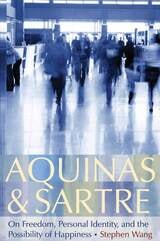
cover of Aquinas and Sartre: On Freedom, Personal Identity, and the Possibility of Happiness

Aquinas and Sartre

On Freedom, Personal Identity, and the Possibility of Happiness

Stephen Wang

Catholic University of America Press, 2009
Thomas Aquinas and Jean-Paul Sartre are usually identified with completely different philosophical traditions: intellectualism and voluntarism. In this original study, Stephen Wang shows, instead, that there are some profound similarities in their understanding of freedom and human identity.
[more]
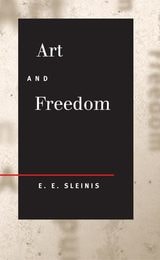
cover of Art and Freedom

Art and Freedom

E. E. Sleinis

University of Illinois Press, 2002

What does a life with art offer that a life without art does not? Art and Freedom asserts that the fundamental point of the enterprise of art is the creation and delivery of values that are not singularly available in the nonart world.

E. E. Sleinis discusses visual art, literature, music, theater, and other art forms, arguing that as art both liberates and provides new points of focus and awareness, the art enterprise depends on a positive freeing from the nonart world, rather than on mere addition to it.

Art and Freedom introduces a novel classificatory system for representation, expression, and formalist theories of art. Sleinis argues that a characteristic defect of contemporary theories of art is their neglect of the issue of value. Challenging these reductive, formalist notions of art, he emphasizes the potential, and the need, for art to evolve and make progress in ways comparable to the sciences, albeit on a very different model.

A smart blend of incisive commentary and illuminating philosophy, Art and Freedom provides a useful context for transforming a sometimes baffling medium into a means of fostering personal growth and creating and sharing values.

[more]