Results by title
78 books match the query 'Light' and 7 start with a
A Culture of Light
Cinema and Technology in 1920s GermanyFrances Guerin
University of Minnesota Press, 2005
A Deed to the Light
Poems by Jeanne Murray Walker
University of Illinois Press, 2004

A History of Light
Jan Nemec
Seagull Books, 2024
Have you ever wondered what a story written by a beam of light would be like? The story would be ordinary, but the course of events extraordinary. Its hero would be a photographer, a guardian of light. And, naturally, the tale would be full of shadow.
A History of Light delves into the fascinating life of František Drtikol (1883–1961), an important figure in early-twentieth-century photography who is all but forgotten in contemporary times. A dandy from a small mining town, a world-famous photographer whose business went bankrupt, a master of the nude who never had much luck with women, a mystic and a Buddhist who believed in communism—a man whose numerous contradictions were evident externally and synthesized internally.
A unique blend of fiction and biography, this novel vividly portrays Drtikol’s life, tracing the diverse stages of his career and offering detailed, almost encyclopedic insights into the times and places pivotal to his journey. Acclaimed Czech author Jan Němec narrates the story in the uncommon second-person singular, speaking directly to his subject. Fresco-like, this novel is an artistic and spiritual Bildungsroman that covers over half a century, bringing to life the silver mines of Príbram, Jugendstil Munich, and the Bohemianism of the First Czechoslovak Republic. Drtikol’s role as a photographer is set against the turbulent history of Central Europe through the two World Wars, and the events of those five decades form a riveting backdrop for an exploration of the artist’s work.
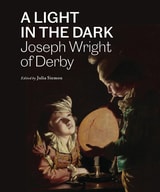
A Light in the Dark
Joseph Wright of DerbyJulia Siemon
J. Paul Getty Trust, The, 0
A timely reexamination of Joseph Wright’s captivating “candlelight” paintings, featuring the recently rediscovered Two Boys with a Bladder.
The dramatic “candlelight” paintings of Joseph Wright of Derby (1734–1797) cast a spell, enthralling viewers with striking scenes that portray human curiosity, the quiet intensity of domestic life, and the excitement of scientific discovery. With a variety of brushstrokes—dabbed here, whiskered there, and dragged elsewhere—Wright pushed boundaries with the transformative power of light. In 2020, the Getty Museum acquired the newly rediscovered Two Boys with a Bladder (1767), a luminous study of innovation, intimacy, and artistic brilliance that challenged established assumptions about Wright and sparked renewed interest in his experiments with light.
A Light in the Dark presents new research to uncover the origins of Two Boys and expand our understanding of Wright's early candlelights, tracing the invention and initial development of his distinctive style. Whereas recent scholarship has maintained an outward approach that ties the artist’s oeuvre to places that he visited, this volume returns the focus to Wright himself—his biography, technique, and hometown of Derby—in a much-needed reexamination. Complete with fresh historical and technical evidence, this is a fascinating look into the inspirations, aspirations, and experiments behind some of the most remarkable paintings in the history of British art.
This volume is published to accompany an exhibition on view at the J. Paul Getty Museum at the Getty Center from November 24, 2026, to March 14, 2027.
A Ray of Light in a Sea of Dark Matter
Keeton, Charles
Rutgers University Press, 2015
The answer turns out to be surprising and rich. The space between stars is filled with an exotic substance called “dark matter” that exerts gravity but does not emit, absorb, or reflect light. The space between galaxies is rife with “dark energy” that creates a sort of cosmic antigravity causing the expansion of the universe to accelerate. Together, dark matter and dark energy account for 95 percent of the content of the universe. News reporters and science journalists routinely talk about these findings using terms that they assume we have a working knowledge of, but do you really understand how astronomers arrive at their findings or what it all means?
Cosmologists face a conundrum: how can we study substances we cannot see, let alone manipulate? A powerful approach is to observe objects whose motion is influenced by gravity. Einstein predicted that gravity can act like a lens to bend light. Today we see hundreds of cases of this—instances where the gravity of a distant galaxy distorts our view of a more distant object, creating multiple images or spectacular arcs on the sky. Gravitational lensing is now a key part of the international quest to understand the invisible substance that surrounds us, penetrates us, and binds the universe together.
A Ray of Light in a Sea of Dark Matter offers readers a concise, accessible explanation of how astronomers probe dark matter. Readers quickly gain an understanding of what might be out there, how scientists arrive at their findings, and why this research is important to us. Engaging and insightful, Charles Keeton gives everyone an opportunity to be an active learner and listener in our ever-expanding universe.
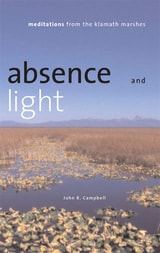
Absence And Light
Meditations From The Klamath MarshesJohn R. Campbell
University of Nevada Press, 2002
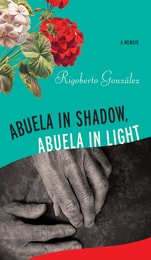
Abuela in Shadow, Abuela in Light
Rigoberto González
University of Wisconsin Press, 2022
González travels to his abuela’s birthplace, Michoacán, Mexico, and along the way recovers his memories of a past he had tried to leave behind. A complex woman who was forced to take on maternal roles and suffered years of abuse, his grandmother simultaneously resisted traditional gender roles; she was kind yet unaffectionate, and she kept many secrets in a crowded household with little personal space. Sifting through family histories and anecdotes, González pieces together the puzzling life story of a woman who was present in her grandson’s life yet absent during his emotional journey as a young man discovering his sexuality and planning his escape from a toxic and abusive environment.
From fragments of memory and story, González ultimately creates a portrait of an unconventional yet memorable grandmother, a hard-working Indigenous Mexican woman who remained an enigma while she was alive. A grandmother, he shows, is more than what her descendants remember; she is also all that has been forgotten or never known. Through this candid exploration of his own family, González explores how we learn to remember and honor those we’ve lost.