Results by title
99 books match the query 'Local' and 7 start with a
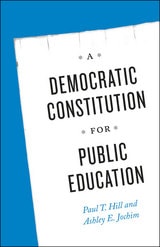
A Democratic Constitution for Public Education
Paul T. Hill and Ashley E. Jochim
University of Chicago Press, 2014
Most reformers focus on who should control education, but Hill and Jochim show that who governs is less important than determining what powers they have. They propose a Civic Education Council—a democratic body subject to checks and balances that would define the boundaries of its purview as well as each school’s particular freedoms. They show how such a system would prevent regulations meant to satisfy special interests and shift the focus to the real task at hand: improving school performance. Laying out the implications of such a system for parents, students, teachers, unions, state and federal governments, and courts, they offer a vision of educational governance that stays true to—and draws on the strengths of—one of the greatest democratic tools we have ever created.
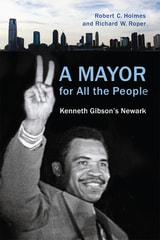
A Mayor for All the People
Kenneth Gibson's NewarkRobert C. Holmes
Rutgers University Press, 2020
In 1970, Kenneth Gibson was elected as Newark, New Jersey’s first African-American mayor, a position he held for an impressive sixteen years. Yet even as Gibson served as a trailblazer for black politicians, he presided over a troubled time in the city’s history, as Newark’s industries declined and its crime and unemployment rates soared.
This book offers a balanced assessment of Gibson’s leadership and his legacy, from the perspectives of the people most deeply immersed in 1970s and 1980s Newark politics: city employees, politicians, activists, journalists, educators, and even fellow big-city mayors like David Dinkins. The contributors include many of Gibson’s harshest critics, as well as some of his closest supporters, friends, and family members—culminating in an exclusive interview with Gibson himself, reflecting on his time in office.
Together, these accounts provide readers with a compelling inside look at a city in crisis, a city that had been rocked by riots three years before Gibson took office and one that Harper’s magazine named “America’s worst city” at the start of his second term. At its heart, it raises a question that is still relevant today: how should we evaluate a leader who faced major structural and economic challenges, but never delivered all the hope and change he promised voters?
Accountability in State Legislatures
Steven Rogers
University of Chicago Press, 2023
A troubling portrait of democracy in US state legislatures.
State legislatures hold tremendous authority over key facets of our lives, ranging from healthcare to marriage to immigration policy. In theory, elections create incentives for state legislators to produce good policies. But do they?
Drawing on wide-ranging quantitative and qualitative evidence, Steven Rogers offers the most comprehensive assessment of this question to date, testing different potential mechanisms of accountability. His findings are sobering: almost ninety percent of American voters do not know who their state legislator is; over one-third of incumbent legislators run unchallenged in both primary and general elections; and election outcomes have little relationship with legislators’ own behavior.
Rogers’s analysis of state legislatures highlights the costs of our highly nationalized politics, challenging theories of democratic accountability and providing a troubling picture of democracy in the states.
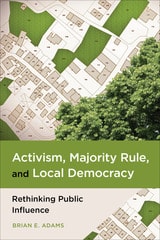
Activism, Majority Rule, and Local Democracy
Rethinking Public InfluenceBrian E. Adams
Temple University Press, 2026
Local democracy doesn’t work as it should, declares Brian Adams in Activism, Majority Rule, and Local Democracy. Local politics is where citizens have the most opportunity for direct participation, control, and influence, but that activism doesn’t necessarily translate into majority rule.
While greater local engagement can produce policy that better reflects activists’ strong preferences, Adams explains that activists are not representative of the public-at-large and states that a reconceptualization of how the public should be able to influence local officials is required. Based on interviews with activists in San Diego, California, Adams concludes that activism can be beneficial, but we need to view it as distinct from majority rule, with a focus on managing the tension between the two.
Improving local democracy is not just a matter of generating more activism. It requires articulating when we want policy to reflect majority preferences and when we want activists to hold sway.
Alaska Politics and Public Policy
The Dynamics of Beliefs, Institutions, Personalities, and PowerEdited by Clive S. Thomas, with Laura Savatgy and Kristina Klimovich
University of Alaska Press, 2016
This book, the most comprehensive on the subject to date, focuses on the question of how beliefs, institutions, personalities, and power interact to shape Alaska politics and public policy. Drawing on these interactions, the contributors explain how and why certain issues get dealt with successfully and others unsuccessfully, and why some issues are taken up quickly while others are not addressed at all. This comprehensive guide to the political climate of Alaska will be essential to anyone studying the politics of America’s largest—and in some ways most unusual—state.
Arresting Citizenship
The Democratic Consequences of American Crime ControlAmy E. Lerman and Vesla M. Weaver
University of Chicago Press, 2014

Asian Port Cities, 1600-1800
Local and Foreign Cultural InteractionsHaneda Masashi
National University of Singapore Press, 2009