Results by title
58 books match the query 'Loss' and 7 start with a
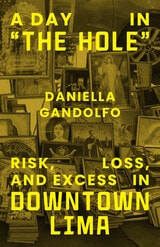
A Day in "The Hole"
Risk, Loss, and Excess in Downtown LimaDaniella Gandolfo
University of Chicago Press, 2025
A single day in a semilegal market in Lima, Peru, reveals a social world that defies conventional economic logic.
In the heart of Lima’s historic center, the markets of El Hueco (“The Hole”) and sprawling Mesa Redonda pulse with life, with thousands of vendors selling everything from knockoff electronics to religious icons. In A Day in “The Hole,” anthropologist Daniella Gandolfo immerses readers in a single, tumultuous day—the thirty-fourth anniversary of a vendors’ cooperative—while examining the dynamics that sustain these marketplaces.
Through a blend of cinematic storytelling and incisive anthropological insight, Gandolfo reveals a world with its own unique codes. She inspects how vendors embrace expenditure over profit and instability over order, and moving through the sights and sounds of El Hueco and Mesa Redonda, she finds a dissident economy that is as much about survival as it is about spectacle. Gandolfo redefines how we think about urban economies and the unexpected ways these defiant communities thrive in this textured portrait of Lima’s markets and the people who animate them.
A Quality of Loss
Mcinerny
St. Augustine's Press, 2025
The world in the 1970s was a cultural upheaval in many respects. This novel is a story of the deepest disruption but in the quietest and most hidden of places––namely, a monk living in isolation who is turned upside down by recent developments in the Catholic Church motivated by post-modern plans.
Brother Martin journals what he doesn't identify as confusion in D.Q. McInerny's debut novel that paints the portrait of a period in history that many are only now taking more seriously. What happened before the turn into the new millennium, and why are the effects of Vatican Council II more obvious and influential now than they were in the immediate wake of this council? The story of Brother Martin is a time capsule for many readers, but for others it is an insight into life that was stubbornly resistant to modern thinking in favor of the transcendent and eternal with respect to spirituality. McInerny shows through story-telling how much the institution was anything but a hinderance to the human soul and how much we may have lost by rejecting old forms on the sole basis of not having come up with them ourselves. This story is a generational bridge and reveals religious life in a truthful and still generous light.
Abacus of Loss
A Memoir in VerseSholeh Wolpé
University of Arkansas Press, 2022
lbert Einstein said, “Not everything that can be counted counts, and not everything that counts can be counted.” It is in this vein that Sholeh Wolpé’s mesmerizing memoir in verse unfolds. In this lyrical and candid work, her fifth collection of poems, Wolpé invokes the abacus as an instrument of remembering. Through different countries and cultures, she carries us bead by bead on a journey of loss and triumph, love and exile. In the end, the tally is insight, not numbers, and we arrive at a place where nothing is too small for gratitude.
Aesthetics in Grief and Mourning
Philosophical Reflections on Coping with LossKathleen Marie Higgins
University of Chicago Press, 2024
In Aesthetics of Grief and Mourning, philosopher Kathleen Marie Higgins reflects on the ways that aesthetics aids people experiencing loss. Some practices related to bereavement, such as funerals, are scripted, but many others are recursive, improvisational, mundane—telling stories, listening to music, and reflecting on art or literature. Higgins shows how these grounding, aesthetic practices can ease the disorienting effects of loss, shedding new light on the importance of aesthetics for personal and communal flourishing.
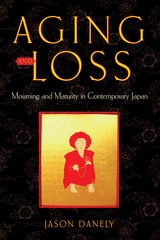
Aging and Loss
Mourning and Maturity in Contemporary JapanDanely, Jason
Rutgers University Press, 2015
Based on nearly a decade of research, Aging and Loss examines how the landscape of aging is felt, understood, and embodied by older adults themselves. In detailed portraits, anthropologist Jason Danely delves into the everyday lives of older Japanese adults as they construct narratives through acts of reminiscence, social engagement and ritual practice, and reveals the pervasive cultural aesthetic of loss and of being a burden.
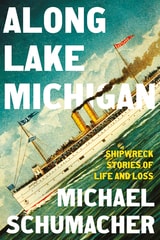
Along Lake Michigan
Shipwreck Stories of Life and LossMichael Schumacher
University of Minnesota Press, 2025
Notable shipwrecks of Lake Michigan throughout a century of enterprise, industry, heroism, and disaster on the Great Lakes
The Great Lakes are graveyards of a vast number of shipwrecks (30,000 by some estimates), and Lake Michigan has more than the other four lakes combined. The stories of those wrecks tell the history of that mighty lake in its endless, mercurial challenge to human endeavor.
Surveying the wreckage throughout the decades, from the fiery end of the twin propeller–driven Phoenix in 1847 to the failure of the Anna Minch to outrun the infamous 1940 Armistice Day storm, Michael Schumacher charts the course of shipping disasters great and small on Lake Michigan. He illuminates the details of maritime weather and shipcraft, the lives devoted to and lost on the water, and the mistakes and monumental failures that led to these ships’ watery ends.
Schumacher’s deft storytelling, drawing from deep research and comprehensive knowledge, brings forth the vivid details of the last minutes of these doomed ships, along with the circumstances surrounding their voyages. Here are tragic tales like that of the Eastland, the deadliest shipwreck in Great Lakes history, lost while docked in the Chicago River; the Rouse Simmons, a wooden schooner loaded with Christmas trees; the train ferry Milwaukee and the Wisconsin, a package freighter, gone within one week of each other in October 1929; and the passenger vessel the Lady Elgin, a devastating loss met with incredible heroism.
Liberally illustrated with historical photographs, the stories of these shipwrecks, spanning a full century of commercial traffic on Lake Michigan, document the myriad forms of bravery and misfortune that mark our encounters with the Great Lakes.
Artifacts of Loss
Crafting Survival in Japanese American Concentration CampsDusselier, Jane E
Rutgers University Press, 2008
In Artifacts of Loss, Jane E. Dusselier looks at the lives of these internees through the lens of their art. These camp-made creations included flowers made with tissue paper and shells, wood carvings of pets left behind, furniture made from discarded apple crates, gardens grown next to their housingùanything to help alleviate the visual deprivation and isolation caused by their circumstances. Their crafts were also central in sustaining, re-forming, and inspiring new relationships. Creating, exhibiting, consuming, living with, and thinking about art became embedded in the everyday patterns of camp life and helped provide internees with sustenance for mental, emotional, and psychic survival.
Dusselier urges her readers to consider these often overlooked folk crafts as meaningful political statements which are significant as material forms of protest and as representations of loss. She concludes briefly with a discussion of other displaced people around the globe today and the ways in which personal and group identity is reflected in similar creative ways.