Results by title
138 books match the query 'Meaning' and 8 start with a

A Book of Consolation
Seeing Our Quests for Love, Success, and Meaning in a New LightAndrew Stark
University of Chicago Press, 2027
An invitation to rest in the mystery that there is no single route to fulfillment, but many—often contradictory, unpredictable, endlessly available.
Our lives are restless. Though we strive for meaning, we are often unfulfilled: our loves fail, our careers stall, and our purpose eludes us. We may temporarily ease our frustration by blaming our methods or embracing our limitations, and we may even embrace the self-defeating lie that we must discover the one, linear path for success in love, work, or life. In A Book of Consolation, Andrew Stark offers a liberating third way between self-abandonment and complacency, revealed through a simple mystery: for each road where someone found fulfillment, someone else walked the opposite path to the same end.
Drawing on literature, popular culture, philosophy, and more, A Book of Consolation invites us to appreciate, even marvel at, the possibility that the routes to love, success, and meaning are so various that even inverse lives can satisfy us. Stark holds up a series of opposing journeys for consideration—from the contradictory loves in modern romantic comedies, to the regrets of Dolly Parton and Ernest Hemingway, to the mindsets behind Tiger Woods and Richard Nixon’s success. In juxtaposing these lives, Stark expands our sense of what counts as fulfillment and what alternatives may be available when our own paths falter. Rich in possibility but without prescription, A Book of Consolation encourages us to navigate the frustrations of our finitude by cultivating a faith that the paths to fulfillment are far more pluralized—and often more contradictory—than we know.
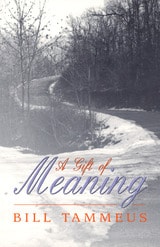
A Gift of Meaning
Bill Tammeus
University of Missouri Press, 2001
Because of the peculiar momentary nature of journalism, not every column can stand the test of time. But many—even those about events nearly gone from the public consciousness--contain lasting truths. A Gift of Meaning is a collection of those lasting truths from Bill Tammeus, a columnist for the Kansas City Star.
Each piece reveals Tammeus's attempt to wrestle eternal meaning from the events and experiences that sweep us along day by day.
I stopped by a homeless shelter the other day to see someone I know. As I waited, I felt rather conspicuous in my suit and tie. In fact, the friendly man at the information desk asked me if I was a pastor. I chuckled.
But as I sat in the lobby waiting to see the man I came to check on, I was struck again by what may be the most difficult of all human tasks: empathy. That is, the challenge of really putting ourselves in the shoes of others.
In the end, A Gift of Meaning is not just a presentation of found meaning, but also a call to readers to stop and think for themselves. This book is an invitation to breathe deeply and seek out the meaning of what the world heaves at us each day. It is an offering of insights that will provide fresh ways of comprehending things readers thought they already understood.
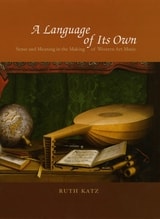
A Language of Its Own
Sense and Meaning in the Making of Western Art MusicRuth Katz
University of Chicago Press, 2009
The Western musical tradition has produced not only music, but also countless writings about music that remain in continuous—and enormously influential—dialogue with their subject. With sweeping scope and philosophical depth, A Language of Its Own traces the past millennium of this ongoing exchange.
Ruth Katz argues that the indispensible relationship between intellectual production and musical creation gave rise to the Western conception of music. This evolving and sometimes conflicted process, in turn, shaped the art form itself. As ideas entered music from the contexts in which it existed, its internal language developed in tandem with shifts in intellectual and social history. Katz explores how this infrastructure allowed music to explain itself from within, creating a self-referential and rational foundation that has begun to erode in recent years.
A magisterial exploration of a frequently overlooked intersection of Western art and philosophy, A Language of Its Own restores music to its rightful place in the history of ideas.
A Life of Meaning
Embracing Reform Judaism's Sacred PathRabbi Dana Evan Kaplan, PHD
Central Conference of American Rabbis, 2018
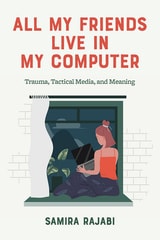
All My Friends Live in My Computer
Trauma, Tactical Media, and MeaningSamira Rajabi
Rutgers University Press, 2021
American Empire and the Politics of Meaning
Elite Political Cultures in the Philippines and Puerto Rico during U.S. ColonialismJulian Go
Duke University Press, 2007
American Empire and the Politics of Meaning is an examination of how these efforts to provide the elite of Puerto Rico and the Philippines a practical education in self-government played out on the ground in the early years of American colonial rule, from 1898 until 1912. It is the first systematic comparative analysis of these early exercises in American imperial power. The sociologist Julian Go unravels how American authorities used “culture” as both a tool and a target of rule, and how the Puerto Rican and Philippine elite received, creatively engaged, and sometimes silently subverted the Americans’ ostensibly benign intentions. Rather than finding that the attempt to transplant American-style democracy led to incommensurable “culture clashes,” Go assesses complex processes of cultural accommodation and transformation. By combining rich historical detail with broader theories of meaning, culture, and colonialism, he provides an innovative study of the hidden intersections of political power and cultural meaning-making in America’s earliest overseas empire.

American Value
Migrants, Money, and Meaning in El Salvador and the United StatesDavid Pedersen
University of Chicago Press, 2012

Anthropology and the Will to Meaning
A Postcolonial CritiqueVassos Argyrou
Pluto Press, 2002