Results by title
70 books match the query 'Mexican American authors' and 6 start with a
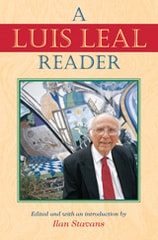
A Luis Leal Reader
Luis Leal
Northwestern University Press, 2007
Instrumental in establishing Mexican literary studies in the United States, Leal’s writings on the topic are especially instructive, ranging from essays on the significance of symbolism, culture, and history in early Chicano literature to studies of the more recent use of magical realism and of individual New Mexican, Tejano, and Mexican authors such as Juan Rulfo, Carlos Fuentes, José Montoya, and Mariano Azuela. Clearly and cogently written, these writings bring to bear an encyclopedic knowledge, a deep understanding of history and politics, and an unparalleled command of the aesthetics of storytelling, from folklore to theory. This collection affords readers the opportunity to consider—or reconsider—Latino literature under the deft guidance of its greatest reader.
A User's Guide to Postcolonial and Latino Borderland Fiction
By Frederick Luis Aldama
University of Texas Press, 2009
Why are so many people attracted to narrative fiction? How do authors in this genre reframe experiences, people, and environments anchored to the real world without duplicating "real life"? In which ways does fiction differ from reality? What might fictional narrative and reality have in common—if anything?
By analyzing novels such as Arundhati Roy's The God of Small Things, Amitav Ghosh's The Glass Palace, Zadie Smith's White Teeth, and Hari Kunzru's The Impressionist, along with selected Latino comic books and short fiction, this book explores the peculiarities of the production and reception of postcolonial and Latino borderland fiction. Frederick Luis Aldama uses tools from disciplines such as film studies and cognitive science that allow the reader to establish how a fictional narrative is built, how it functions, and how it defines the boundaries of concepts that appear susceptible to limitless interpretations.
Aldama emphasizes how postcolonial and Latino borderland narrative fiction authors and artists use narrative devices to create their aesthetic blueprints in ways that loosely guide their readers' imagination and emotion. In A User's Guide to Postcolonial and Latino Borderland Fiction, he argues that the study of ethnic-identified narrative fiction must acknowledge its active engagement with world narrative fictional genres, storytelling modes, and techniques, as well as the way such fictions work to move their audiences.
A Xicana Codex of Changing Consciousness
Writings, 2000-2010Cherríe L. Moraga
Duke University Press, 2011
Thirty years after the publication of Anzaldúa and Moraga’s collection This Bridge Called My Back, a landmark of women-of-color feminism, Moraga’s literary and political praxis remains motivated by and intertwined with indigenous spirituality and her identity as Chicana lesbian. Yet aspects of her thinking have changed over time. A Xicana Codex of Changing Consciousness reveals key transformations in Moraga’s thought; the breadth, rigor, and philosophical depth of her work; her views on contemporary debates about citizenship, immigration, and gay marriage; and her deepening involvement in transnational feminist and indigenous activism. It is a major statement from one of our most important public intellectuals.
Accessible Citizenships
Disability, Nation, and the Cultural Politics of Greater MexicoJulie Avril Minich
Temple University Press, 2013
A volume in the American Literatures Initiative
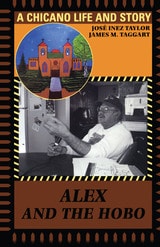
Alex and the Hobo
A Chicano Life and StoryBy José Inez Taylor and James M. Taggart
University of Texas Press, 2003
When a ten-year-old boy befriends a mysterious hobo in his southern Colorado hometown in the early 1940s, he learns about evil in his community and takes his first steps toward manhood by attempting to protect his new friend from corrupt officials. Though a fictional story, Alex and the Hobo is written out of the life experiences of its author, José Inez (Joe) Taylor, and it realistically portrays a boy's coming-of-age as a Spanish-speaking man who must carve out an honorable place for himself in a class-stratified and Anglo-dominated society.
In this innovative ethnography, anthropologist James Taggart collaborates with Joe Taylor to explore how Alex and the Hobo sprang from Taylor's life experiences and how it presents an insider's view of Mexicano culture and its constructions of manhood. They frame the story (included in its entirety) with chapters that discuss how it encapsulates notions that Taylor learned from the Chicano movement, the farmworkers' union, his community, his father, his mother, and his religion. Taggart gives the ethnography a solid theoretical underpinning by discussing how the story and Taylor's account of how he created it represent an act of resistance to the class system that Taylor perceives as destroying his native culture.
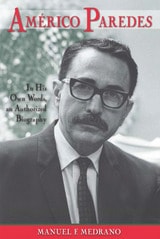
Americo Paredes
In His Own Words, an Authorized BiographyManuel F. Medrano
University of North Texas Press, 2010