Results by title
321 books match the query 'Mexican Americans' and 17 start with a
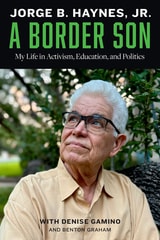
A Border Son
My Life in Activism, Education, and PoliticsJorge B. Haynes, Jr.with Denise Gamino and Benton Graham
University of Texas Press, 2026
Behind the success of every great politician, inspiring activist, or business titan, there is a staffer; Jorge B. Haynes was that staffer for some of the most influential leaders in Texas, Florida, and California.
Jorge B. Haynes had a knack for finding his way into the rooms where history was being made. From his work boycotting farmworker conditions alongside Cesar Chavez and Dolores Huerta as a young man in California to his role in President Bill Clinton’s NAFTA war room in the 1990s, he was the man advising some of the country’s most influential leaders and he left an imprint on the monumental moments that defined their time. His career spanned almost five decades, beginning with his decision to leave home in Laredo to serve in the US Air Force. But his service to the country took many different forms. Haynes worked for the Bureau of the Census the first year Latinos were allowed to declare their Hispanic heritage. He wrote speeches and orchestrated pivotal meetings for top political leadership in Texas and later Florida. In the final years of his career, he fought to make college a more accessible path for under-represented students in California.
As his paternal grandmother used to say, “Cuando vas a un lugar donde nunca has estado, finge que has estado allí,” which means, “When you go somewhere that you've never been, pretend like you've been there before.” By the end of his career, there weren’t many places that Haynes hadn’t been.
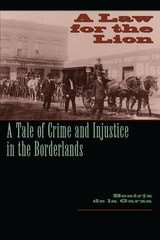
A Law for the Lion
A Tale of Crime and Injustice in the BorderlandsBy Beatriz de la Garza
University of Texas Press, 2003
"Esto no es cosa de armas" (this is not a matter for weapons). These were the last words of Don Francisco Gutiérrez before Alonzo W. Allee shot and killed him and his son, Manuel Gutiérrez. What began as a simple dispute over Allee's unauthorized tenancy on a Gutiérrez family ranch near Laredo, Texas, led not only to the slaying of these two prominent Mexican landowners but also to a blatant miscarriage of justice.
In this engrossing account of the 1912 crime and the subsequent trial of Allee, Beatriz de la Garza delves into the political, ethnic, and cultural worlds of the Texas-Mexico border to expose the tensions between the Anglo minority and the Mexican majority that propelled the killings and their aftermath. Drawing on original sources, she uncovers how influential Anglos financed a first-class legal team for Allee's defense and also discusses how Anglo-owned newspapers helped shape public opinion in Allee's favor. In telling the story of this long-ago crime and its tragic results, de la Garza sheds new light on the interethnic struggles that defined life on the border a century ago, on the mystique of the Texas Rangers (Allee was said to be a Ranger), and on the legal framework that once institutionalized violence and lawlessness in Texas.
A Mexican State of Mind
New York City and the New Borderlands of CultureMelissa Castillo-Garsow
Rutgers University Press, 2020

A Promising Problem
The New Chicana/o HistoryEdited by Carlos Kevin Blanton
University of Texas Press, 2016
Chicana/o history has reached an intriguing juncture. While academic and intellectual studies are embracing new, highly nuanced perspectives on race, class, gender, education, identity, and community, the field itself continues to be viewed as a battleground, subject to attacks from outside academia by those who claim that the discipline promotes racial hatred and anti-Americanism. Against a backdrop of deportations and voter suppression targeting Latinos, A Promising Problem presents the optimistic voices of scholars who call for sophisticated solutions while embracing transnationalism and the reality of multiple, overlapping identities.
Showcasing a variety of new directions, this anthology spans topics such as growth and reassessment in Chicana/o history manifested in a disruption of nationalism and geographic essentialism, the impact of legal history, interracial relations and the experiences of Latino subpopulations in the US South, race and the politics of religious history, transborder feminism in the early twentieth century, and aspirations for a field that increasingly demonstrates the relational dynamics of cultural production. As they reflect on the state of their field, the contributors offer significant insights into sociology, psychology, anthropology, political science, education, and literature, while tracing the history of activism throughout the last century and debating the very concepts of “Chicano” and “Chicano history.” Although the political landscape is fraught with closed-off rhetoric, A Promising Problem encourages diversity of thought and opens the possibilities of historical imagination.
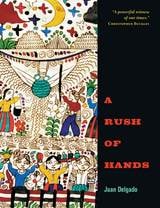
A Rush of Hands
Juan Delgado
University of Arizona Press, 2003
These poems deal honestly with the realities of urban life, whether dramatizing the effects of drive-by shootings, unfolding a labor protest that "spreads across the city like a prayer," or summoning a ghostlike immigrant damned to retrace his journey across the border. Daily and historical struggles are elevated to the level of myth. Yet, amid these poems there are images of life and love: a girl leaving hickeys rich as chocolate, a boy pledging to rescue his mother from poverty, a man studying the desert ground for tracks signaling immigrants in distress.
Delgado is unflinching in showing us the harshness surrounding the lives he cherishes, and with resonant details and lyrical language he urges us to examine those lives-and ultimately our own. A Rush of Hands is a spellbinding book that will captivate both the ear and the heart.
A Texas-Mexican Cancionero
Folksongs of the Lower BorderBy Américo Paredes
University of Texas Press, 1995
The folksongs of Texas's Mexican population pulsate with the lives of folk heroes, gringos, smugglers, generals, jailbirds, and beautiful women. In his cancionero, or songbook, Américo Paredes presents sixty-six of these songs in bilingual text—along with their music, notes on tempo and performance, and discography. Manuel Peña's new foreword situates these songs within the main currents of Mexican American music.
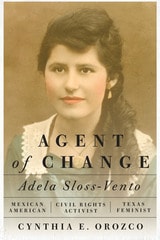
Agent of Change
Adela Sloss-Vento, Mexican American Civil Rights Activist and Texas FeministBy Cynthia E. Orozco
University of Texas Press, 2020
Liz Carpenter Award for Research in the History of Women, Texas State Historical Association
The essayist Adela Sloss-Vento (1901–1998) was a powerhouse of activism in South Texas’s Lower Rio Grande Valley throughout the Mexican American civil rights movement beginning in 1920 and the subsequent Chicano movement of the 1960s and 1970s. At last presenting the full story of Sloss-Vento’s achievements, Agent of Change revives a forgotten history of a major female Latina leader.
Bringing to light the economic and political transformations that swept through South Texas in the 1920s as ranching declined and agribusiness proliferated, Cynthia E. Orozco situates Sloss-Vento’s early years within the context of the Jim Crow/Juan Crow era. Recounting Sloss-Vento’s rise to prominence as a public intellectual, Orozco highlights a partnership with Alonso S. Perales, the principal founder of the League of United Latin American Citizens. Agent of Change explores such contradictions as Sloss-Vento’s tolerance of LULAC’s gender-segregated chapters, even though the activist was an outspoken critic of male privilege in the home and a decidedly progressive wife and mother. Inspiring and illuminating, this is a complete portrait of a savvy, brazen critic who demanded reform on both sides of the US-Mexico border.

Agua Santa / Holy Water
Pat Mora
University of Arizona Press, 2007
Alex and the Hobo
A Chicano Life and StoryBy José Inez Taylor and James M. Taggart
University of Texas Press, 2003
When a ten-year-old boy befriends a mysterious hobo in his southern Colorado hometown in the early 1940s, he learns about evil in his community and takes his first steps toward manhood by attempting to protect his new friend from corrupt officials. Though a fictional story, Alex and the Hobo is written out of the life experiences of its author, José Inez (Joe) Taylor, and it realistically portrays a boy's coming-of-age as a Spanish-speaking man who must carve out an honorable place for himself in a class-stratified and Anglo-dominated society.
In this innovative ethnography, anthropologist James Taggart collaborates with Joe Taylor to explore how Alex and the Hobo sprang from Taylor's life experiences and how it presents an insider's view of Mexicano culture and its constructions of manhood. They frame the story (included in its entirety) with chapters that discuss how it encapsulates notions that Taylor learned from the Chicano movement, the farmworkers' union, his community, his father, his mother, and his religion. Taggart gives the ethnography a solid theoretical underpinning by discussing how the story and Taylor's account of how he created it represent an act of resistance to the class system that Taylor perceives as destroying his native culture.
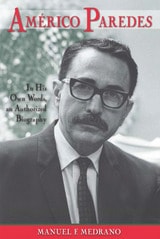
Americo Paredes
In His Own Words, an Authorized BiographyManuel F. Medrano
University of North Texas Press, 2010

Amor Eterno
Eleven Lessons in LovePatricia Preciado Martin
University of Arizona Press, 2000
América Is Her Name
Luis J. Rodriguez
Northwestern University Press, 1998
An Impossible Living in a Transborder World
Culture, Confianza, and Economy of Mexican-Origin PopulationsCarlos G. Vélez-Ibáñez
University of Arizona Press, 2010
Central to the ROSCA is the cultural concept of mutual trust, or confianza. This is the cultural glue that holds the reciprocal relationship together. As Vélez-Ibáñez explains, confianza “shapes the expectations for relationships within broad networks of interpersonal links, in which intimacies, favors, goods, services, emotion, power, or information are exchanged.” In a border region where migration, class movement, economic changes, and institutional inaccessibility produce a great deal of uncertainty, Mexican-origin populations rely on confianza and ROSCAs to maintain a sense of security in daily life. How do transborder people adapt these common practices to meet the demands of a global economy? That is precisely what Vélez-Ibáñez investigates.
Anglos and Mexicans in the Making of Texas, 1836-1986
By David Montejano
University of Texas Press, 1987
Winner, Frederick Jackson Turner Award, Organization Of American Historians, 1988
American Historical Association, Pacific Branch Book Award, 1989
Texas Institute of Letters Friends Of The Dallas Public Library Award, 1987
Texas Historical Commission T. R. Fehrenbach Award, Best Ethnic, Minority, And Women's History Publication, 1987
At the Core and in the Margins
Incorporation of Mexican Immigrants in Two Rural Midwestern CommunitiesJulia Albarracín
Michigan State University Press, 2016
Based on 260 surveys and 47 in-depth interviews, this study combines quantitative and qualitative research to explore the level and characteristics of immigrant incorporation in Beardstown and Monmouth. It assesses the advancement of immigrants in the immigration/ residency/citizenship process, the immigrants’ level of cultural integration (via language, their connectedness with other members of society, and their relationships with neighbors), the degree and characteristics of discrimination against immigrants in these two towns, and the extent to which immigrants participate in different social and political activities and trust government institutions.
Immigrants in new destinations are likely to be poorer, to be less educated, and to have weaker English-language skills than immigrants in traditional destinations. Studying how this population negotiates the obstacles to and opportunities for incorporation is crucial.
Aztec Music and Dance in California
Kristina F. Nielsen
University of Illinois Press, 2026
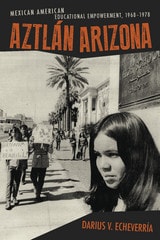
Aztlán Arizona
Mexican American Educational Empowerment, 1968–1978Darius V. Echeverría
University of Arizona Press, 2014
The word Aztlán, originally meaning the legendary ancestral home of the Nahua peoples of Mesoamerica, was adopted as a symbol of independence by Chicano/a activists during the movement of the 1960s and 1970s. In an era when poverty, prejudice, and considerable oppositional forces blighted the lives of roughly one-fifth of Arizonans, the author argues that understanding those societal realities is essential to defining the rise and power of the Chicano Movement.
The book illustrates how Mexican American communities fostered a togetherness that ultimately modified larger Arizona society by revamping the educational history of the region. The concluding chapter outlines key Mexican American individuals and organizations that became politically active in order to address Chicano educational concerns. This Chicano unity, reflected in student, parent, and community leadership organizations, helped break barriers, dispel the Mexican American inferiority concept, and create educational change that benefited all Arizonans.
No other scholar has examined the emergence of Chicano Movement politics and its related school reform efforts in Arizona. Echeverría’s thorough research, rich in scope and interpretation, is coupled with detailed and exact endnotes. The book helps readers understand the issues surrounding the Chicano Movement educational reform and ethnic identity. Equally important, the author shows how residual effects of these dynamics are still pertinent today in places such as Tucson.