Results by title
53 books match the query 'Mignolo, Walter D.' and 6 start with a

A Narrative of Events, since the First of August, 1834, by James Williams, an Apprenticed Labourer in Jamaica
James Williams
Duke University Press, 2001
Describing the hard working conditions on plantations and the harsh treatment of apprentices unjustly incarcerated, Williams argues that apprenticeship actually worsened the conditions of Jamaican ex-slaves: former owners, no longer legally permitted to directly punish their workers, used the Jamaican legal system as a punitive lever against them. Williams’s story documents the collaboration of local magistrates in this practice, wherein apprentices were routinely jailed and beaten for both real and imaginary infractions of the apprenticeship regulations.
In addition to the complete text of Williams’s original Narrative, this fully annotated edition includes nineteenth-century responses to the controversy from the British and Jamaican press, as well as extensive testimony from the Commission of Enquiry that heard evidence regarding the Narrative’s claims. These fascinating and revealing documents constitute the largest extant body of direct testimony by Caribbean slaves or apprentices.
After Spanish Rule
Postcolonial Predicaments of the AmericasMark Thurner and Andrés Guerrero, eds.
Duke University Press, 2003
Challenging the universalizing tendencies of postcolonial theory as it has developed in the Anglophone academy, the contributors are attentive to the crucial ways in which the histories of Latin American countries—with their creole elites, hybrid middle classes, subordinated ethnic groups, and complicated historical relationships with Spain and the United States—differ from those of other former colonies in the southern hemisphere. Yet, while acknowledging such differences, the volume suggests a host of provocative, critical connections to colonial and postcolonial histories around the world.
Contributors
Thomas Abercrombie
Shahid Amin
Jorge Cañizares-Esguerra
Peter Guardino
Andrés Guerrero
Marixa Lasso
Javier Morillo-Alicea
Joanne Rappaport
Mauricio Tenorio-Trillo
Mark Thurner
Against War
Views from the Underside of ModernityNelson Maldonado-Torres
Duke University Press, 2008
Considering Levinas’s critique of French liberalism and Nazi racial politics, and the links between them, Maldonado-Torres identifies a “master morality” of dominion and control at the heart of western modernity. This master morality constitutes the center of a warring paradigm that inspires and legitimizes racial policies, imperial projects, and wars of invasion. Maldonado-Torres refines the description of modernity’s war paradigm and the Levinasian critique through Fanon’s phenomenology of the colonized and racial self and the politics of decolonization, which he reinterprets in light of the Levinasian conception of ethics. Drawing on Dussel’s genealogy of the modern imperial and warring self, Maldonado-Torres theorizes race as the naturalization of war’s death ethic. He offers decolonial ethics and politics as an antidote to modernity’s master morality and the paradigm of war. Against War advances the de-colonial turn, showing how theory and ethics cannot be conceived without politics, and how they all need to be oriented by the imperative of decolonization in the modern/colonial and postmodern world.
Another Face of Empire
Bartolomé de Las Casas, Indigenous Rights, and Ecclesiastical ImperialismDaniel Castro
Duke University Press, 2007
Separating historical reality from myth, Daniel Castro provides a nuanced, revisionist assessment of the friar’s career, writings, and political activities. Castro argues that Las Casas was very much an imperialist. Intent on converting the Indians to Christianity, the religion of the colonizers, Las Casas simply offered the natives another face of empire: a paternalistic, ecclesiastical imperialism. Castro contends that while the friar was a skilled political manipulator, influential at what was arguably the world’s most powerful sixteenth-century imperial court, his advocacy on behalf of the natives had little impact on their lives. Analyzing Las Casas’s extensive writings, Castro points out that in his many years in the Americas, Las Casas spent very little time among the indigenous people he professed to love, and he made virtually no effort to learn their languages. He saw himself as an emissary from a superior culture with a divine mandate to impose a set of ideas and beliefs on the colonized. He differed from his compatriots primarily in his antipathy to violence as the means for achieving conversion.
Aníbal Quijano
Foundational Essays on the Coloniality of PowerAnibal Quijano. Edited by Walter D. Mignolo, Rita Segato, and Catherine E. Walsh
Duke University Press, 2024
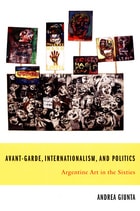
Avant-Garde, Internationalism, and Politics
Argentine Art in the SixtiesAndrea Giunta
Duke University Press, 2007
The renowned Argentine art historian and critic Andrea Giunta analyzes projects specifically designed to internationalize Argentina’s art and avant-garde during the 1960s: the importation of exhibitions of contemporary international art, the sending of Argentine artists abroad to study, the organization of prize competitions involving prestigious international art critics, and the export of exhibitions of Argentine art to Europe and the United States. She looks at the conditions that made these projects possible—not least the Alliance for Progress, a U.S. program of “exchange” and “cooperation” meant to prevent the spread of communism through Latin America in the wake of the Cuban Revolution—as well as the strategies formulated to promote them. She describes the influence of Romero Brest, prominent art critic, supporter of abstract art, and director of the Centro de Artes Visuales del Instituto Tocuato Di Tella (an experimental art center in Buenos Aires); various group programs such as Nueva Figuración and Arte Destructivo; and individual artists including Antonio Berni, Alberto Greco, León Ferrari, Marta Minujin, and Luis Felipe Noé. Giunta’s rich narrative illuminates the contentious postwar relationships between art and politics, Latin America and the United States, and local identity and global recognition.