125 books match the query 'Migration' and 5 start with a

cover of A Suitable Enemy: Racism, Migration and Islamophobia in Europe

A Suitable Enemy

Racism, Migration and Islamophobia in Europe

Liz Fekete

Pluto Press, 2009

Liz Fekete is a leading authority on issues of racism, Islamophobia and national security legislation. A Suitable Enemy draws on sixteen years of research to present a comprehensive overview of EU immigration, asylum, race and security policies.

Fekete argues that at the same time as the EU introduces selective migration policies, it closes its borders against asylum seekers who were the first victims of the growth of the security state which now embraces Muslims. She explores the way in which anti-terrorist legislation has been used to evict undesirable migrants, how deportation policies commodify and de-humanise the most vulnerable and how these go hand in hand with evolving forms of racism, particularly Islamophobia.

At the heart of the book is an examination of xeno-racism -- a non-colour coded form of institutionalised racism -- where migrants who do not assimilate, or who are believed to be incapable of assimilation, are excluded.
[more]
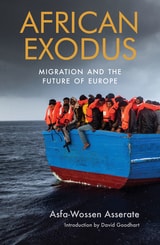
cover of African Exodus: Migration and the Future of Europe

African Exodus

Migration and the Future of Europe

Asfa-Wossen Asserate

Haus Publishing, 2018

In 2015, an unprecedented number of people from Africa and the Near East took flight and sought refuge in Europe. By the end of that year, some 1.8 million migrants had arrived in the EU, the vast majority having come across the Mediterranean. Since then, despite measures to host some of the people fleeing the Syrian war in Turkey and concurrent attempts to physically seal off some borders in Eastern Europe, the numbers of refugees traveling to Europe has continued to top half a million annually.  A mass migration on a scale not witnessed in modern times is underway, and it has presented Europe with its greatest challenge of the twenty-first century.

Asfa-Wossen Asserate argues here that building higher fences or finding more effective methods of integration will only, in the long term, perpetuate rather than solve the problems associated with these large numbers of displaced refugees. We need to realize that we are only treating the symptoms of an oncoming catastrophe and that, if we are to respond to mass migration, we will ultimately have to understand its causes. African Exodus places its emphasis firmly on the causes of the refugee crisis, which are to be found not least in Europe itself, and charts ways in which we might deal with it effectively in the long term.

In the course of this analysis, Asserate asks why our view of Africa—a troubled continent, but rich in so many ways—is so distorted. How can we combat the corrupt, authoritarian regimes that stymie progress and development? Why are millions fleeing to Europe? How is the EU complicit in the migration crisis? And finally, in practical terms: what can be done, and what prospects does the future hold?
 
[more]
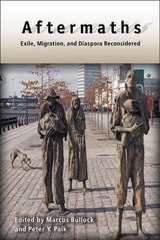
cover of Aftermaths: Exile, Migration, and Diaspora Reconsidered

Aftermaths

Exile, Migration, and Diaspora Reconsidered

Bullock, Marcus

Rutgers University Press, 2008

Aftermaths is a collection of essays offering compelling new ideas on exile, migration, and diaspora that have emerged in the global age. The ten contributors—well-established scholars and promising new voices—work in different disciplines and draw from diverse backgrounds as they present rich case studies from around the world. In seeking fresh perspectives on the movement of people and ideas, the essays included here look to the power of the aesthetic experience, especially in literature and film, to unsettle existing theoretical paradigms and enable the rethinking of conventionalized approaches.

Marcus Bullock and Peter Y. Paik, in bringing this collection together, show we have reached a moment in history when it is imperative to question prevailing intellectual models. The interconnectedness of the world's economies, the contributors argue, can exacerbate existing antagonisms or create new ones. With essays by Ihab Hassan, Paul Brodwin, and Helen Fehervary, among others, Aftermaths engages not only with important academic topics but also with the leading political issues of the day.
 

[more]
cover of Architecture of Migration: The Dadaab Refugee Camps and Humanitarian Settlement

Architecture of Migration

The Dadaab Refugee Camps and Humanitarian Settlement

Anooradha Iyer Siddiqi

Duke University Press, 2024
Environments associated with migration are often seen as provisional, lacking both history and architecture. As Anooradha Iyer Siddiqi demonstrates in Architecture of Migration, a refugee camp’s aesthetic and material landscapes—even if born out of emergency—reveal histories, futures, politics, and rhetorics. She identifies forces of colonial and humanitarian settlement, tracing spatial and racial politics in the Dadaab refugee camps established in 1991 on the Kenya-Somalia border—at once a dense setting that manifests decades of architectural, planning, and design initiatives and a much older constructed environment that reflects its own ways of knowing. She moves beyond ahistorical representations of camps and their inhabitants by constructing a material and visual archive of Dadaab, finding long migratory traditions in the architecture, spatial practices, landscapes, and iconography of refugees and humanitarians. Countering conceptualizations of refugee camps as sites of border transgression, criminality, and placelessness, Siddiqi instead theorizes them as complex settlements, ecologies, and material archives created through histories of partition, sedentarization, domesticity, and migration.
[more]
cover of Asian Americans in Dixie: Race and Migration in the South

Asian Americans in Dixie

Race and Migration in the South

Edited by Jigna Desai and Khyati Y. Joshi

University of Illinois Press, 2013

Extending the understanding of race and ethnicity in the South beyond the prism of black-white relations, this interdisciplinary collection explores the growth, impact, and significance of rapidly growing Asian American populations in the American South. Avoiding the usual focus on the East and West Coasts, several essays attend to the nuanced ways in which Asian Americans negotiate the dominant black and white racial binary, while others provoke readers to reconsider the supposed cultural isolation of the region, reintroducing the South within a historical web of global networks across the Caribbean, Pacific, and Atlantic.
 
Contributors are Vivek Bald, Leslie Bow, Amy Brandzel, Daniel Bronstein, Jigna Desai, Jennifer Ho, Khyati Y. Joshi, ChangHwan Kim, Marguerite Nguyen, Purvi Shah, Arthur Sakamoto, Jasmine Tang, Isao Takei, and Roy Vu.

[more]