Results by title
94 books match the query 'Miscellanea' and 8 start with a
A Catechism For Business
Andrew V. Abela
Catholic University of America Press, 2014
A Catechism for Business presents the teachings of the Catholic Church as they relate to more than one hundred specific and challenging moral questions that have been asked by business leaders. Andrew V. Abela and Joseph E. Capizzi have assembled the relevant quotations from recent Catholic social teaching as responses to these questions. Questions and answers are grouped under major topics such as marketing, finance, and investment. Business ethics questions can be too subtle for definitive yes / no answers, so the book offers no more and no less than church teaching on each particular question. Where the church has offered definitive answers, the book provides them. When the church has not, the book offers guidelines for reflection and insights into what one should consider in given situations.
[more]
A Catechism for Business
Andrew V. Abela
Catholic University of America Press, 2016
This second edition streamlines some of the editing from the first addition, and more importantly, includes material from Pope Francis's encyclical, Laudato Si, and his apostolic exhortation, Evangelii Gaudium. A Catechism for Business presents the teachings of the Catholic Church as they relate to more than one hundred specific and challenging moral questions as they have been asked by business leaders. Andrew V. Abela and Joseph E. Capizzi have assembled the relevant quotations from recent Catholic social teaching as responses to these questions. Questions and answers are grouped together under major topics such as marketing, finance and investment. The book's easy-to-use question and answer approach invites quick reference for tough questions and serves as a basis for reflection and deeper study in the rich Catholic tradition of social doctrine.
[more]
A Catechism for Family Life
Sarah Bartel
Catholic University of America Press, 2018
The purpose of A Catechism for Family Life: Insights from Catholic Teaching on Love, Marriage, Sex, and Parenting is to present the teachings of the Catholic Church as they relate to specific questions in marriage and family life. Many Catholics are under-catechized and have trouble both understanding and articulating Church teaching on sexuality and marriage to an increasingly challenging culture. Pope Francis, along with the fathers of the two recent Synods on the Family, have called for better formation for those who work in the area of marriage and family life (see Amoris Laetitia, 202).
To address this need, we gathered pertinent questions facing men, women, and pastoral workers in marriage and family life. We then found passages relevant to these questions by researching Church documents on marriage and family from the past one hundred years. These include papal encyclicals, apostolic exhortations, and addresses, Vatican II documents, and the Catechism of the Catholic Church.
Mainstream media coverage of Church events and Church teaching leads many to misunderstand Catholic positions on marriage and family life. While the Catholic Church has developed a rich, detailed, and positive teaching on marriage, family, and sexuality, many Catholics do not have access to this teaching, buried as it is in lengthy Church documents which many find intimidating. Finding the relevant teaching to address specific questions is not always a simple task, either. This book’s main contribution is to present Church teaching relevant to marriage and family in one volume clearly organized by topic and question.
[more]
A Catechism for Health Care
Insights from Catholic Teaching on Human Life, Medical Ethics, and Love of NeighborStephen Napier
Catholic University of America Press, 2024
The Catholic Church’s teachings on ethical issues arising in healthcare delivery and biomedical science are distributed across a plethora of different places ranging from papal allocutions, encyclicals, instructions by the Congregation for the Doctrine of the Faith, and guidance documents authored by various congregations of bishops. Furthermore, they are distributed throughout time ranging from, for example, the Didache (or teaching of the 12 apostles, circa 1st Century), to Pope Pius XII’s address in 1954 addressing ethical issues in transplantation, and onto the 2009 instruction entitled Dignitas personae. It is difficult for a wider audience to make sense of these sources on the various issues arising in healthcare delivery and scientific research, but the editors of A Catechism for Health Care have collated them in a way that makes them easier to understand
The purpose of this book is to present the teachings of the Catholic Church as they pertain to ethical issues arising in the healthcare and biomedical sciences. The premise of the project is that the Catholic Church’s teaching speaks in an accessible way to a wide range of people concerned about healthcare ethics. It is important to present these teachings concisely. The book is ordered around numerous questions concerning the most common practices in health care that have ethical dimensions. It then provides concise answers to these questions as are found in various magisterial Church documents. These answers are refreshingly clear and to the point.
[more]
A Year with Nature
An AlmanacMarty Crump
University of Chicago Press, 2018
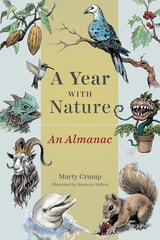
A Year with Nature is an almanac like none you’ve ever seen: combining science and aesthetics, it is a daily affirmation of the extraordinary richness of biodiversity and our enduring beguilement by its beauty. With a text by herpetologist and natural history writer Marty Crump and a cornucopia of original illustrations by Bronwyn McIvor, this quirky quotidian reverie gazes across the globe, media, and time as it celebrates date-appropriate natural topics ranging from the founding of the National Park Service to annual strawberry, garlic, shrimp, hummingbird, and black bear festivals.
With Crump, we mark the publication of classics like Carson’s Silent Spring and White’s Charlotte’s Web, and even the musical premiere of Tchaikovsky’s Swan Lake. We note the discovery of the structure of DNA and the mountain gorilla, the rise of citizen science projects, and the work of people who’ve shaped how we view and protect nature—from Aristotle to E. O. Wilson. Some days feature US celebrations, like National Poinsettia Day and National Cat Day; others highlight country-specific celebrations, like Australia’s Wombat Day and Thailand’s Monkey Buffet Festival, during which thousands of macaques feast on an ornately arranged spread of fruits and vegetables. Crump also highlights celebrations that span borders, from World Wildlife Conservation Day to International Mountain Day and global festivities for snakes, sea turtles, and chocolate. Interweaving fascinating facts on everything from jellyfish bodies to monthly birth flowers with folkloric entries featuring the Loch Ness Monster, unicorns, and ancient Greek, Roman, and Egyptian mythology, the almanac is as exhaustive as it is enchanting.
A Year with Nature celebrates the wonder and beauty of our natural world as we have expressed it in visual arts, music, literature, science, natural history, and everyday experience. But more than this, the almanac’s vignettes encourage us to contemplate how we can help ensure that future generations will be able to enjoy the landscapes and rich biodiversity we so deeply cherish.
[more]
Aircraft Stories
Decentering the Object in TechnoscienceJohn Law
Duke University Press, 2002
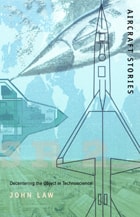
In Aircraft Stories noted sociologist of technoscience John Law tells “stories” about a British attempt to build a military aircraft—the TSR2. The intertwining of these stories demonstrates the ways in which particular technological projects can be understood in a world of complex contexts.
Law works to upset the binary between the modernist concept of knowledge, subjects, and objects as having centered and concrete essences and the postmodernist notion that all is fragmented and centerless. The structure and content of Aircraft Stories reflect Law’s contention that knowledge, subjects, and—particularly— objects are “fractionally coherent”: that is, they are drawn together without necessarily being centered. In studying the process of this particular aircraft’s design, construction, and eventual cancellation, Law develops a range of metaphors to describe both its fractional character and the ways its various aspects interact with each other. Offering numerous insights into the way we theorize the working of systems, he explores the overlaps between singularity and multiplicity and reveals rich new meaning in such concepts as oscillation, interference, fractionality, and rhizomatic networks.
The methodology and insights of Aircraft Stories will be invaluable to students in science and technology studies and will engage others who are interested in the ways that contemporary paradigms have limited our ability to see objects in their true complexity.
[more]
American Values, Religious Voices
100 Days. 100 LettersAndrea L. Weiss and Lisa M. Weinberger
University of Minnesota Press, 2018
In the aftermath of the 2016 presidential election, many Americans questioned how to respond to the results and the deep divisions in our country exposed by the campaign. Many people of faith turned to their religious communities for guidance and support. Many looked for ways to take action. In November 2016, biblical scholar Andrea L. Weiss and graphic designer Lisa M. Weinberger teamed up to create an innovative response: a national nonpartisan campaign that used letters and social media to highlight core American values connected to our diverse religious traditions.
American Values, Religious Voices: 100 Days, 100 Letters is a collection of letters written by some of America’s most accomplished and thoughtful scholars of religion during the first 100 days of the Trump presidency. While the letters are addressed to the president, vice president, and members of the 115th Congress and Trump administration, they speak to a broad audience of Americans looking for wisdom and encouragement at this tumultuous time in our nation’s history.
This unique volume assembles the 100 letters, plus four new supplemental essays and many of the graphic illustrations that enhanced the campaign.
Published near the midway point of the Trump presidency, this book showcases a wide range of ancient sacred texts that pertain to our most pressing contemporary issues. At a time of great division in our country, this post-election project models how people of different backgrounds can listen to and learn from one another. The letters offer insight and inspiration, reminding us of the enduring values that make our nation great.
[more]
American Vaudeville
Geoffrey Hilsabeck
West Virginia University Press, 2021
A dreamlike, evocative reckoning with a lost epoch in popular culture—and with old, weird America.
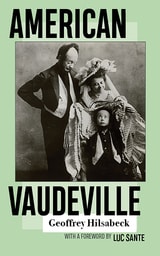
At the heart of American Vaudeville is one strange, unsettling fact: for nearly fifty years, from the late nineteenth century to the 1930s, vaudeville was everywhere—then, suddenly, it was nowhere. This book tells the story of what was once the most popular form of entertainment in the country using lists, creation myths, thumbnail biographies, dreams, and obituaries. A lyric history—part social history, part song—American Vaudeville sits at the nexus between poetry, experimental nonfiction, and, because it includes historic images, art books.
Geoffrey Hilsabeck’s book grows out of extensive archival research. Rather than arranging that research—the remains of vaudeville—into a realistic picture or tidy narrative, Hilsabeck dreams vaudeville back into existence, drawing on photographs, letters, joke books, reviews, newspaper stories, anecdotes, and other material gathered from numerous archives, as well as from memoirs by vaudeville performers like Buster Keaton, Eva Tanguay, and Eddie Cantor. Some of this research is presented as-is, a letter from a now forgotten vaudeville performer to her booking agent, for example; some is worked up into brief scenes and biographies; and some is put to even more imaginative uses, finding new life in dialogues and prose poems.
American Vaudeville pulls the past into the present and finds in the beauty and carnivalesque grotesqueness of vaudeville a fitting image of American life today.
[more]