Results by title
54 books match the query 'Money & Monetary Policy' and 7 start with a
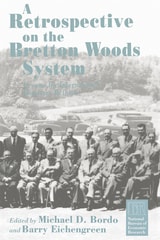
A Retrospective on the Bretton Woods System
Lessons for International Monetary ReformEdited by Michael D. Bordo and Barry Eichengreen
University of Chicago Press, 1993
The contributors explore adjustment, liquidity, and transmission under the System; the way it affected developing countries; and the role of the International Monetary Fund in maintaining a stable rate. The authors examine the reasons for the System's success and eventual collapse, compare it to subsequent monetary regimes, such as the European Monetary System, and address the possibility of a new fixed exchange rate for today's world.
A Retrospective on the Classical Gold Standard, 1821-1931
Edited by Michael D. Bordo and Anna J. Schwartz
University of Chicago Press, 1984
The volume includes a review of the literature on the classical gold standard; studies the experience with gold in England, Germany, Italy, Sweden, and Canada; and perspectives on international linkages and the stability of price-level trends under the gold standard. The articles and commentaries reflect strong, conflicting views among hte participants on issues of central bank behavior, purchasing-power an interest-rate parity, independent monetary policies, economic growth, the "Atlantic economy," and trends in commodity prices and long-term interest rates. This is a thoughtful and provocative book.
A Search for Solvency
Bretton Woods and the International Monetary System, 1941-1971By Alfred E. Eckes, Jr.
University of Texas Press, 1975
Diverted by the dramatic military and political events of July 1944, few Americans realized the significance of an international conference taking place at Bretton Woods, a mountain resort in New Hampshire, far from the battle zones. There United Nations experts were completing plans for a world monetary and financial system that they hoped would create a prosperous, efficient global economy and avert economic tensions that might lead to another world war. Until the dollar crisis of 1971, decisions made at Bretton Woods provided the institutions and rules for international finance. The conference ushered in an era of unprecedented expansion of world trade and prosperity.
Based on extensive research in previously unavailable sources, A Search for Solvency relates intriguing and often complicated issues of economic analysis and diplomatic history. It offers a succinct and comprehensive survey of international monetary development from the collapse of the pre–World War I gold standard to the devaluation of the dollar in 1971. In effect, it explains the origins of late twentieth-century global inflation and currency problems.
The author details how the ghost of the Great Depression, the failure of monetary reconstruction efforts after World War I, and the memory of the nineteenth-century gold standard guided efforts to construct the Bretton Woods system. This preoccupation with the past, as well as political constraints, produced a monetary system protected against past dangers—fluctuating currencies, controls, and deflation—but dangerously vulnerable to inflationary pressures. The weaknesses of Bretton Woods, a system geared to an era in which economic power was concentrated in the United States, became visible in the 1960s and painfully apparent by the mid-1970s.
Against Money
J. W. Mason and Arjun Jayadev
University of Chicago Press, 2026
A powerful deconstruction of humanity’s most influential invention, from the acclaimed economists J. W. Mason and Arjun Jayadev.
Money is everywhere in our daily lives. It lurks in the swipe of a card at the grocery store, in looming student-loan debts, in the prices of things we want, and in our subconscious navigation of the modern world. Money is an invisible convenience that saves us, as a society, the hassle of bartering for goods and services—a reflection, in our pockets and on our phones, of the hard facts of scarcity and desire. Or is it something more?
In this revelatory book, economists J. W. Mason and Arjun Jayadev explain how and why money is so deeply misunderstood by the world it dominates—as well as the dangerous social implications of this misunderstanding. Against Money tackles the most dearly held “truths” of economics, arguing that the world of money has never been an impartial representation of the world of things. Instead, its existence in different forms—debt, capital, liquidity, and interest—increasingly shapes events in the real world rather than just reflecting them. Sometimes money enables new forms of cooperation; more oftenit facilitates domination. Human existence is not just facilitated by money but also governed by it.
In the tradition of works by Thomas Piketty and David Graeber, Against Money is an erudite, disruptive exposé of the illusions and tyrannies of money. Mason and Jayadev present a radically different way of thinking about money—imagining a hopeful future in which it no longer dictates the possibilities of our collective existence.
Against Money
J. W. Mason and Arjun Jayadev
University of Chicago Press, 2026
A powerful deconstruction of humanity’s most influential invention, from the acclaimed economists J. W. Mason and Arjun Jayadev.
Money is everywhere in our daily lives. It lurks in the swipe of a card at the grocery store, in looming student-loan debts, in the prices of things we want, and in our subconscious navigation of the modern world. Money is an invisible convenience that saves us, as a society, the hassle of bartering for goods and services—a reflection, in our pockets and on our phones, of the hard facts of scarcity and desire. Or is it something more?
In this revelatory book, economists J. W. Mason and Arjun Jayadev explain how and why money is so deeply misunderstood by the world it dominates—as well as the dangerous social implications of this misunderstanding. Against Money tackles the most dearly held “truths” of economics, arguing that the world of money has never been an impartial representation of the world of things. Instead, its existence in different forms—debt, capital, liquidity, and interest—increasingly shapes events in the real world rather than just reflecting them. Sometimes money enables new forms of cooperation; more oftenit facilitates domination. Human existence is not just facilitated by money but also governed by it.
In the tradition of works by Thomas Piketty and David Graeber, Against Money is an erudite, disruptive exposé of the illusions and tyrannies of money. Mason and Jayadev present a radically different way of thinking about money—imagining a hopeful future in which it no longer dictates the possibilities of our collective existence.
Asset Prices and Monetary Policy
Edited by John Y. Campbell
University of Chicago Press, 2008
The contributors examine how central bankers determine their policy prescriptions with reference to the fluctuating housing market, the balance of debt and credit, changing beliefs of investors, the level of commodity prices, and other factors. At a time when the public has never been more involved in stocks, retirement funds, and real estate investment, this insightful book will be useful to all those concerned with the current state of the economy.
Asymmetric Information, Corporate Finance, and Investment
Edited by R. Glenn Hubbard
University of Chicago Press, 1990
In this volume, specialists from traditionally separate areas in economics and finance investigate issues at the conjunction of their fields. They argue that financial decisions of the firm can affect real economic activity—and this is true for enough firms and consumers to have significant aggregate economic effects. They demonstrate that important differences—asymmetries—in access to information between "borrowers" and "lenders" ("insiders" and "outsiders") in financial transactions affect investment decisions of firms and the organization of financial markets. The original research emphasizes the role of information problems in explaining empirically important links between internal finance and investment, as well as their role in accounting for observed variations in mechanisms for corporate control.