Results by title
100 books match the query 'Monographs' and 6 start with a

A Light in the Dark
Joseph Wright of DerbyJulia Siemon
J. Paul Getty Trust, The, 0
A timely reexamination of Joseph Wright’s captivating “candlelight” paintings, featuring the recently rediscovered Two Boys with a Bladder.
The dramatic “candlelight” paintings of Joseph Wright of Derby (1734–1797) cast a spell, enthralling viewers with striking scenes that portray human curiosity, the quiet intensity of domestic life, and the excitement of scientific discovery. With a variety of brushstrokes—dabbed here, whiskered there, and dragged elsewhere—Wright pushed boundaries with the transformative power of light. In 2020, the Getty Museum acquired the newly rediscovered Two Boys with a Bladder (1767), a luminous study of innovation, intimacy, and artistic brilliance that challenged established assumptions about Wright and sparked renewed interest in his experiments with light.
A Light in the Dark presents new research to uncover the origins of Two Boys and expand our understanding of Wright's early candlelights, tracing the invention and initial development of his distinctive style. Whereas recent scholarship has maintained an outward approach that ties the artist’s oeuvre to places that he visited, this volume returns the focus to Wright himself—his biography, technique, and hometown of Derby—in a much-needed reexamination. Complete with fresh historical and technical evidence, this is a fascinating look into the inspirations, aspirations, and experiments behind some of the most remarkable paintings in the history of British art.
This volume is published to accompany an exhibition on view at the J. Paul Getty Museum at the Getty Center from November 24, 2026, to March 14, 2027.
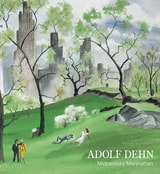
Adolf Dehn
Midcentury ManhattanAdolf Dehn
The Artist Book Foundation, 2017
Adolf Dehn (1895–1968), American painter in multimedia and acclaimed master lithographer, left his Minnesota hometown after formal training at the Minneapolis Art Institute to study at the Art Students League in New York. He toured Europe in the early 1920s, quickly acclimating to the continental lifestyle and adeptly depicting its nuances and idiosyncrasies with prolific lithographs and sketches. His critical and satirical renderings of the political movements, social conventions, and governmental policies in post-World War I Europe during "Le Crazy Years" gave the Midwestern artist ample material for his growing body of work.
Sailing back to the United States in 1929, Dehn survived the Great Depression with commercial artwork and contributions to popular magazines such as The New Yorker, Vogue, and Vanity Fair. His clever drawings that reflected the Jazz Age's culture and fashionable society made him a favorite of Frank Crowninshield, Vanity Fair's renowned editor.
During this time, while Dehn captured the heyday of Manhattan's burlesque theaters, lively Harlem nightclubs, impressive skyline, and busy harbor, he was continuously drawn to Central Park—his predilection for the city's magnificent green space was a sustaining source of inspiration and subject matter. Adolf Dehn: Midcentury Manhattan candidly examines the life and work of this exceptional, adventurous, and intrepid artist as he moved skillfully and capably between lithography, ink-wash drawings, gouache, casein painting, and watercolors. Combining numerous vintage photographs with newly discovered, Manhattan-inspired prints and drawings from the collections of, among others, the Whitney Museum of American Art, MoMA, and The Metropolitan Mesuem of Art, Adolf Dehn: Midcentury Manhattan traces how Dehn's art reflected the spirit, pulse, and uniquely American tonalities of The City of Dreams.
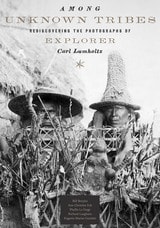
Among Unknown Tribes
Rediscovering the Photographs of Explorer Carl LumholtzBy Bill Broyles
University of Texas Press, 2014
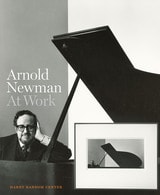
Arnold Newman
At WorkBy Roy Flukinger
University of Texas Press, 2013
A driven perfectionist with inexhaustible curiosity about people, Arnold Newman was one of the twentieth century’s greatest and most prolific photographers. In a career that spanned nearly seven decades and produced many iconic works, Newman became renowned for making “pictures of people” (he objected to the term “portraits”) in the places where they worked and lived—the spaces that were most expressive of their inner lives. Refusing the label of “art photographer,” Newman also accepted magazine and advertising commissions and executed them to the same exacting standards that characterized all of his work. He spent countless hours training aspiring photographers, sharing his own vast experience, but allowing them the freedom to experiment and discover.
Rich with materials from Newman’s extensive archive in the Harry Ransom Center at the University of Texas at Austin, Arnold Newman offers unprecedented, firsthand insights into the evolution of the photographer’s creativity. Reproduced here are not only many of Newman’s signature images, but also contact sheets, Polaroids, and work prints with his handwritten notes, which allow us to see the process by which he produced the images. Pages from his copious notebooks and calendars reveal Newman’s meticulous preparation and exhausting schedule. Adsheets and magazine covers from Holiday, LIFE, Newsweek, Look, Esquire, Seventeen, Time, and Sports Illustrated show the range of Newman’s largely unknown editorial work. Roy Flukinger provides a contextual overview of the archive, and Marianne Fulton’s introduction highlights the essential moments in the development of Newman’s life and work.
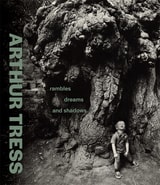
Arthur Tress
Rambles, Dreams, and ShadowsJames A. Ganz
J. Paul Getty Trust, The, 2023
Arthur Tress (b. 1940) is a singular figure in the landscape of postwar American photography. His seminal series, The Dream Collector, depicts Tress’s interests in dreams, nightmares, fantasies, and the unconscious and established him as one of the foremost proponents of magical realism at a time when few others were doing staged photography.
This volume presents the first critical look at Tress’s early career, contextualizing the highly imaginative, fantastic work he became known for while also examining his other interrelated series: Appalachia: People and Places; Open Space in the Inner City; Shadow; and Theater of the Mind. James A. Ganz, Mazie M. Harris, and Paul Martineau plumb Tress’s work and archives, studying ephemera, personal correspondence, unpublished notes, diaries, contact sheets, and more to uncover how he went from earning his living as a social documentarian in Appalachia to producing surreal work of “imaginative fiction.” This abundantly illustrated volume imparts a fuller understanding of Tress’s career and the New York photographic scene of the 1960s and 1970s.
This volume is published to accompany an exhibition on view at the J. Paul Getty Museum at the Getty Center from October 31, 2023, to February 18, 2024.
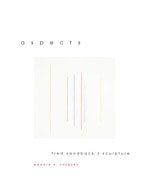
Aspects
Fred Sandback's SculptureEdward A. Vazquez
University of Chicago Press, 2017
Drawing on Sandback’s substantial archive, Edward A. Vazquez demonstrates that the artist’s work—with all its physical slightness and attentiveness to place, as well as its relationship to minimal and conceptual art of the 1960s—creates a link between viewers and space that is best understood as sculptural even as it almost surpasses physical form. At the same time, the economy of Sandback’s site-determined practice draws viewers’ focus to their connection to space and others sharing it. As Vazquez shows, Sandback’s art aims for nothing less than a total recalibration of the senses, as the spectator is caught on neither one side nor the other of an object or space, but powerfully within it.