126 books match the query 'New England' and 9 start with a

cover of A Building History of Northern New England

A Building History of Northern New England

James L. Garvin

University Press of New England, 2002
This is a book about understanding old buildings. In an era in which much of the US landscape has been littered by unimaginative, prefabricated structures, James L. Garvin tells owners and would-be owners of old buildings in Maine, New Hampshire, and Vermont what they need to know before they begin the restoration process. In wonderfully lucid prose, Garvin describes the production of the materials from which the buildings of northern New England were built, outlines the stylistic evolution of the region's structures from the early 1700s to World War II, and offers guidelines for dating old buildings. Focusing on domestic architecture, but including examples of public, commercial, religious, and industrial buildings, he offers custodians of buildings an understanding of the technologies embodied in these structures, answers questions about stylistic changes, and allows the architecture of northern New England to be understood for the first time with a technical depth that is already available for buildings in better-studied parts of the US. Written for both homeowners and those responsible for public and museum structures, this volume provides an understanding of the region's building history even as it specifically answers questions that most often perplex architects and preservationists. By offering all custodians of northern New England buildings a richer understanding of architectural style and structure, the book encourages the use of appropriate methods and materials in building conservation and rehabilitation. Generously illustrated throughout, the book is also an essential resource for anyone who is interested in American and New England architecture and the building trades, and for anyone who has ever wondered about the secrets and stories of old buildings.
[more]
cover of A History in Indigenous Voices: Menominee, Ho-Chunk, Oneida, Stockbridge, and Brothertown Interactions in the Removal Era

A History in Indigenous Voices

Menominee, Ho-Chunk, Oneida, Stockbridge, and Brothertown Interactions in the Removal Era

Carol Cornelius

Wisconsin Historical Society Press, 2023

A history of Wisconsin’s Indigenous past, present, and future—in Native peoples’ own words.  

Treaties made in the 1800s between the United States and the Indigenous nations of what is now Wisconsin have had profound influence on the region’s cultural and political landscape. Yet few people realize that in the early part of that century, the Menominee and Ho-Chunk Nations of Wisconsin signed land treaties with several Indigenous nations from New York State. At the onset of the removal era, these eastern nations, including the Oneida Nation and the Six Nations Confederacy, were under constant pressure from the federal government and land speculators to move to lands around Green Bay and Lake Winnebago.

In this groundbreaking book, Carol A. Cornelius has compiled a careful account of these nation-to-nation treaties, in large part in the words of those Indigenous leaders who served as the voices and representatives of their nations. Drawing on a rich collection of primary sources, Cornelius walks readers through how, why, and for whom these treaties were made and how the federal government’s failure and unwillingness to acknowledge their legitimacy led to the further loss of Indigenous lands. The living documents transcribed here testify to the complexity and sovereignty of Indigenous governance then and now, making this volume a vital resource for historians and an accessible introduction to Indigenous treatymaking in Wisconsin.

Winner of the 2024 Wisconsin Historical Society’s Book of Merit Award 

Finalist for the 2023 Foreword INDIES Book of the Year Award for Adult Nonfiction History 
[more]
cover of A Long, Deep Furrow: Three Centuries of Farming in New England

A Long, Deep Furrow

Three Centuries of Farming in New England

Howard S. Russell

Brandeis University Press, 1982
A selection of the History Book Club.
[more]
cover of After Frost: An Anthology of Poetry from New England

After Frost

An Anthology of Poetry from New England

Henry Lyman

University of Massachusetts Press, 1996

Robert Frost has long dominated the public's image of New England poetry, but who are the poets who follow him in time and how have they expressed their visions of the landscape, the individual, and the community? This volume brings together the work of thirty distinguished poets to convey the vitality and variety of the region's poetic creation during much of the twentieth century.

After Frost is published in association with the New England Foundation for the Humanities, which has sponsored a program of reading and discussion groups with poets across the region using this anthology.
[more]
cover of After King Philip’s War: Presence and Persistence in Indian New England

After King Philip’s War

Presence and Persistence in Indian New England

Edited by Colin G. Calloway

Dartmouth College Press, 1997
The 1676 killing of Metacomet, the tribal leader dubbed "King Philip" by colonists, is commonly seen as a watershed event, marking the end of a bloody war, dissolution of Indian society in New England, and even the disappearance of Native peoples from the region. This collection challenges that assumption, showing that Indians adapted and survived, existing quietly on the fringes of Yankee society, less visible than before but nonetheless retaining a distinct identity and heritage. While confinement on tiny reservations, subjection to increasing state regulation, enforced abandonment of traditional dress and means of support, and racist policies did cause dramatic changes, Natives nonetheless managed to maintain their Indianness through customs, kinship, and community.
[more]
cover of After the Digging

After the Digging

Alan Shapiro

University of Chicago Press, 1998

After the Digging provides an exceptional look at the early work of acclaimed poet Alan Shapiro. His first collection of poems allows readers to realize his strong sense of historical narrative and gives them reference on how to read his later poems. Inspired by his time at Stanford in the late seventies, the book is divided into two parts: the first is a sequence on the Irish Famine in the mid-nineteenth century; the second, a series on demonic possession in late seventeenth-century New England. These poems give voice to the pain and delusion of those from other periods and inevitably recall the many evils of our own century.

"Powerful. . . . That a young poet can handle this subject so well in a first book is . . . a pleasure in itself."—Robert von Hallberg, Contemporary Literature, 1981
[more]
cover of Alice Morse Earle and the Domestic History of Early America

Alice Morse Earle and the Domestic History of Early America

Susan Reynolds Williams

University of Massachusetts Press, 2013

Author, collector, and historian Alice Morse Earle (1851–1911) was among the most important and prolific writers of her day. Between 1890 and 1904, she produced seventeen books as well as numerous articles, pamphlets, and speeches about the life, manners, customs, and material culture of colonial New England. Earle's work coincided with a surge of interest in early American history, genealogy, and antique collecting, and more than a century after the publication of her first book, her contributions still resonate with readers interested in the nation's colonial past.

An intensely private woman, Earle lived in Brooklyn, New York, with her husband and four children and conducted much of her research either by mail or at the newly established Long Island Historical Society. She began writing on the eve of her fortieth birthday, and the impressive body of scholarship she generated over the next fifteen years stimulated new interest in early American social customs, domestic routines, foodways, clothing, and childrearing patterns. 

Written in a style calculated to appeal to a wide readership, Earle's richly illustrated books recorded the intimate details of what she described as colonial “home life.” These works reflected her belief that women had played a key historical role, helping to nurture communities by constructing households that both served and shaped their families. It was a vision that spoke eloquently to her contemporaries, who were busily creating exhibitions of early American life in museums, staging historical pageants and other forms of patriotic celebration, and furnishing their own domestic interiors.
[more]
cover of Amphibians and Reptiles of New England: Habitats and Natural History

Amphibians and Reptiles of New England

Habitats and Natural History

Richard M. DeGraaf

University of Massachusetts Press, 1983

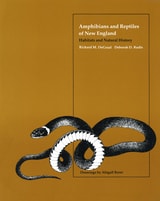
Although numerous species of amphibians and reptiles live in New England and the northeastern Untied States, few people are aware of their existence of know much about their life histories, habitats, or distributions. This illustrated work provides such information, compiling the latest data on nearly sixty species. Included is a detailed account of each species' range, relative abundance, habitat, breeding period (from egg deposition through larval period), home range and movements, and food habitats. Additional comments and selected references are provided throughout. 

The book is designed specifically for use in New England. The regional approach makes it possible to examine the details of distribution and habitat preference, important factors because many of these species have local, disjunct populations. The authors stress that these species constitute a valuable resource requiring and deserving conservative measures and urge that reptiles and amphibians be considered in wildlife-management policy.
[more]
cover of Arts and Crafts Architecture: History and Heritage in New England

Arts and Crafts Architecture

History and Heritage in New England

Maureen Meister

University Press of New England, 2014

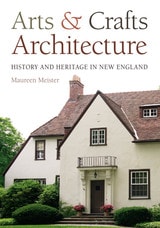
This book offers the first full-scale examination of the architecture associated with the Arts and Crafts movement that spread throughout New England at the turn of the twentieth century. Although interest in the Arts and Crafts movement has grown since the 1970s, the literature on New England has focused on craft production. Meister traces the history of the movement from its origins in mid-nineteenth-century England to its arrival in the United States and describes how Boston architects including H. H. Richardson embraced its tenets in the 1870s and 1880s. She then turns to the next generation of designers, examining buildings by twelve of the region’s most prominent architects, eleven men and a woman, who assumed leadership roles in the Society of Arts and Crafts, founded in Boston in 1897. Among them are Ralph Adams Cram, Lois Lilley Howe, Charles Maginnis, and H. Langford Warren. They promoted designs based on historical precedent and the region’s heritage while encouraging well-executed ornament. Meister also discusses revered cultural personalities who influenced the architects, notably Ralph Waldo Emerson and art historian Charles Eliot Norton, as well as contemporaries who shared their concerns, such as Louis Brandeis. Conservative though the architects were in the styles they favored, they also were forward-looking, blending Arts and Crafts values with Progressive Era idealism. Open to new materials and building types, they made lasting contributions, with many of their designs now landmarks honored in cities and towns across New England.
[more]