Results by title
51 books match the query 'Nicaragua' and 5 start with a
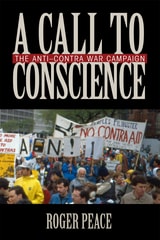
A Call to Conscience
The Anti-Contra War CampaignRoger Peace
University of Massachusetts Press, 2012
Unlike earlier U.S. interventions in Latin America, the Reagan administration's attempt to overthrow the Sandinista government of Nicaragua during the 1980s was not allowed to proceed quietly. Tens of thousands of American citizens organized and agitated against U.S. aid to the counterrevolutionary guerrillas, known as “contras.” Believing the Contra War to be unnecessary, immoral, and illegal, they challenged the administration's Cold War stereotypes, warned of “another Vietnam,” and called on the United States to abide by international norms.
A Call to Conscience offers the first comprehensive history of the anti–Contra War campaign and its Nicaragua connections. Roger Peace places this eight-year campaign in the context of previous American interventions in Latin America, the Cold War, and other grassroots oppositional movements. Based on interviews with American and Nicaraguan citizens and leaders, archival records of activist organizations, and official government documents, this book reveals activist motivations, analyzes the organizational dynamics of the anti–Contra War campaign, and contrasts perceptions of the campaign in Managua and Washington.
Peace shows how a variety of civic groups and networks—religious, leftist, peace, veteran, labor, women's rights—worked together in a decentralized campaign that involved extensive transnational cooperation.
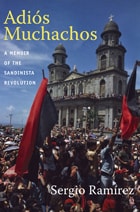
Adiós Muchachos
A Memoir of the Sandinista RevolutionSergio Ramírez
Duke University Press, 2012
Aesthetics and Revolution
Nicaraguan Poetry 1979-1990Greg Dawes
University of Minnesota Press, 1993
In Aesthetics and Revolution, Dawes demonstrates that there is an objective grounding for cultural studies found in the aesthetic means of production. By analyzing the relations and forces of production in this realm we inevitably cross over into the economic means of production as well as the struggle for political representation. Ultimately, aesthetics is at the intersection of class and gender interests and their struggle for hegemony.
In Aesthetics and Revolution, Dawes has chosen a group of writers of different theoretical sympathies, class, gender, and social positions to reveal the conflictual interests of the social classes and genders as a whole. Through close readings of their work, Dawes examines the thematic nodes that are expressed in positions as diverse as Ernesto Cardenal’s liberation theology, Pablo Antonio Cuadra’s populism, the campesino’s oral tradition, and Gioconda Belli’s erotic verses in relation to the changes taking place in revolutionary Nicaragua.
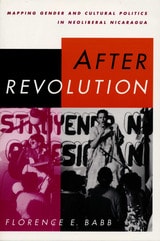
After Revolution
Mapping Gender and Cultural Politics in Neoliberal NicaraguaBy Florence E. Babb
University of Texas Press, 2001
Nicaragua's Sandinista revolution (1979-1990) initiated a broad program of social transformation to improve the situation of the working class and poor, women, and other non-elite groups through agrarian reform, restructured urban employment, and wide access to health care, education, and social services. This book explores how Nicaragua's least powerful citizens have fared in the years since the Sandinista revolution, as neoliberal governments have rolled back these state-supported reforms and introduced measures to promote the development of a market-driven economy.
Drawing on ethnographic research conducted throughout the 1990s, Florence Babb describes the negative consequences that have followed the return to a capitalist path, especially for women and low-income citizens. In addition, she charts the growth of women's and other social movements (neighborhood, lesbian and gay, indigenous, youth, peace, and environmental) that have taken advantage of new openings for political mobilization. Her ethnographic portraits of a low-income barrio and of women's craft cooperatives powerfully link local, cultural responses to national and global processes.
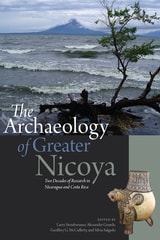
Archaeology of Greater Nicoya
Two Decades of Research in Nicaragua and Costa RicaLarry Steinbrenner
University Press of Colorado, 2021
Drawing on approaches ranging from ethnohistory to bioarchaeology to scientific and culture-historical archaeology, the book is organized into sections on redefining Greater Nicoya, projects and surveys, material culture, and mortuary practices. Individual chapters explore Indigenous groups and their origins, extensive summaries of the three largest scholarly archaeological projects completed in Pacific Nicaragua in the last quarter century, clear evidence of Mesoamerican connections from Costa Rica’s Bay of Culebra, detailed histories of lithic analysis and rock art studies in Nicaragua, new insights into mortuary and cultural practices based on osteological evidence, and reinterpretations of diagnostic ceramic types as products of related potting communities and the first definitive identification of production centers for these types. Drawing upon new 14C dates, this volume also provides the most substantial revision of the late pre-colonial chronology since the 1960s, a correction that has critical implications for understanding the prehistory of Greater Nicoya.