52 books match the query 'Noncitizens' and 5 start with a

cover of Abolitionist Intimacies: Queer and Trans Migrants against the Deportation State

Abolitionist Intimacies

Queer and Trans Migrants against the Deportation State

Eithne Luibheid

Duke University Press, 2025
In Abolitionist Intimacies, Eithne Luibhéid examines writings by and about queer- and trans-identified migrants and allies who contest pervasive US immigration practices and work toward a future without detention, deportation, and border controls. Luibhéid shows how these migrants and activists confront such controls by mobilizing intimacies—forging close connections in order to survive in the present. From forms of kinship beyond the heterosexual nuclear family to networks of solidarity, intimacies allow queer and trans migrants and allies to challenge the infrastructures that support the deportation state: proposed pathways to citizenship for undocumented migrants; marriage as a means for legalization; traffic interactions as a pipeline to deportation; and queer and trans migrant detention. In the process, activists and theorists have advanced new visions and configurations of possible intimacies that not only challenge deportation but also rework what immigration control and citizenship could mean. By focusing on these abolitionist efforts as well as the publicly available records on queer and trans deportees, Luibhéid highlights the new understandings that emerge when the experiences of queer and trans people are centered.
[more]
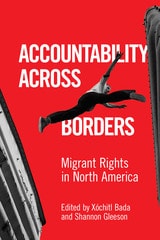
cover of Accountability Across Borders: Migrant Rights in North America

Accountability Across Borders

Migrant Rights in North America

Edited by Xóchitl Bada and Shannon Gleeson

University of Texas Press, 2019

Collecting the diverse perspectives of scholars, labor organizers, and human-rights advocates, Accountability across Borders is the first edited collection that connects studies of immigrant integration in host countries to accounts of transnational migrant advocacy efforts, including case studies from the United States, Canada, and Mexico.

Covering the role of federal, state, and local governments in both countries of origin and destinations, as well as nongovernmental organizations (NGOs), these essays range from reflections on labor solidarity among members of the United Food and Commercial Workers in Toronto to explorations of indigenous students from the Maya diaspora living in San Francisco. Case studies in Mexico also discuss the enforcement of the citizenship rights of Mexican American children and the struggle to affirm the human rights of Central American migrants in transit. As policies regarding immigration, citizenship, and enforcement are reaching a flashpoint in North America, this volume provides key insights into the new dynamics of migrant civil society as well as the scope and limitations of directives from governmental agencies.

[more]
cover of Aliens and Dissenters: Federal Suppression of Radicals, 1903-1933

Aliens and Dissenters

Federal Suppression of Radicals, 1903-1933

William Preston, Jr.

University of Illinois Press, 1994
This edition features a new foreword by Paul Buhle and a new epilogue by the author.

 
[more]
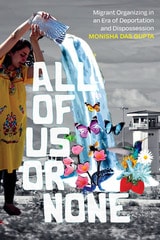
cover of All of Us or None: Migrant Organizing in an Era of Deportation and Dispossession

All of Us or None

Migrant Organizing in an Era of Deportation and Dispossession

Monisha Das Gupta

Duke University Press, 2024

In All of Us or None, Monisha Das Gupta tells the story of contemporary antideportation organizing in the United States by migrants and refugees labeled as criminal aliens. These activists, who live daily with criminalization, work against forms of deportation that Das Gupta calls settler carcerality—the United States’ use of deportation to exert territorial control in the face of Indigenous self-determination. Drawing on fieldwork with antideportation organizing groups in New York, Los Angeles, Long Beach, and Honolulu, Das Gupta documents the inventive methods of struggle against settler carcerality. Das Gupta shows how the organizers’ actions and visions depart from the settler colonial nature of the mainstream demands for a pathway to citizenship and civil rights. Through direct action, storytelling, political education, and youth and queer leadership, these organizations and collectives conceptualize an abolitionist vision of migration justice that rejects the settler state and encompasses all those who are disavowed. By highlighting this work, Das Gupta demonstrates the transformative promise offered by a dissident migrant-led politics working toward dismantling settler structures and logics.
[more]
cover of Argonauts of West Africa: Unauthorized Migration and Kinship Dynamics in a Changing Europe

Argonauts of West Africa

Unauthorized Migration and Kinship Dynamics in a Changing Europe

Apostolos Andrikopoulos

University of Chicago Press, 2023

Examines the paradoxes of kinship in the lives of unauthorized African migrants as they struggle for mobility, employment, and citizenship in Europe.

In rapidly changing and highly precarious contexts, unauthorized African migrants turn to kinship in search of security, stability, and predictability. Through the exchange of identity documents between “siblings,” assistance in obtaining such documentation through kinship networks, and marriages that provide access to citizenship, new assemblages of kinship are continually made and remade to navigate the shifting demands of European states. These new kinship relations, however, often prove unreliable, taking on new, unexpected dynamics in the face of codependency; they become more difficult to control than those who enter into such relations can imagine. Through unusually close ethnographic work in West African migrant communities in Amsterdam, Apostolos Andrikopoulos reveals the unseen dynamics of kinship through shared papers, the tensions of race and gender that develop in mutually beneficial marriages, and the vast, informal networks of people, information, and documentation on which migrants rely. Throughout Argonauts of West Africa, Andrikopoulos demonstrates how inequality, exclusionary practices, and the changing policies of an often-violent state demand innovative ways of doing kinship to successfully navigate complex migration routes.
[more]