Results by title
85 books match the query 'Pacific Northwest (OR, WA)' and 7 start with a

A Deadly Wind
The 1962 Columbus Day StormJohn Dod
Oregon State University Press, 2018
The Columbus Day Storm of 1962 was a freak of nature, a weather outlier with deadly winds topping one hundred miles per hour. The storm killed dozens, injured hundreds, damaged more than fifty thousand homes, and leveled enough timber to build one million homes. To find an equally ferocious storm of its kind, fast-forward fifty years and cross the continent to Superstorm Sandy’s 2012 attack on the East Coast. While Superstorm Sandy was predicted days in advance, the Columbus Day Storm caught ill-equipped weather forecasters by surprise.
This unrivalled West Coast windstorm fueled the Asian log export market, helped give birth to the Oregon wine industry, and influenced the 1962 World Series. It remains a cautionary tale and the Pacific Northwest benchmark for severe windstorms in this era of climate change and weather uncertainty. From its genesis in the Marshall Islands to its final hours on Vancouver Island, British Columbia, the storm plowed an unparalleled path of destruction.
In A Deadly Wind, veteran journalist John Dodge tells a compelling story spiced with human drama, Cold War tension, and Pacific Northwest history. This is a must-read for the tens of thousands of storm survivors, for history buffs, and for anyone interested in the intersection of severe weather events and climate change.

A Guide to Oregon South Coast History
Traveling the Jedediah Smith TrailNathan Douthit
Oregon State University Press, 1999
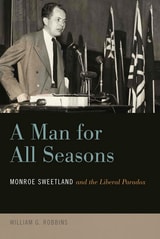
A Man for All Seasons
Monroe Sweetland and the Liberal ParadoxWilliam Robbins
Oregon State University Press, 2015
Historian William G. Robbins illuminates the wrenching transformation of American political culture in A Man for All Seasons: Monroe Sweetland and the Liberal Paradox. Racial and economic inequalities motivated much of Sweetland’s civic life, including his lifelong memberships in the American Civil Liberties Committee, the National Association for the Advancement of Colored People, the Urban League, the Japanese American Citizens League, and the Red Cross, where Sweetland worked repatriating American prisoners of war after Japan’s surrender.
Robbins’ portrait is holistic, exploring Sweetland’s socialist beginnings, inconsistencies in his politics—especially during the Cold War—and his regional legacy. He was the most important person in the resurgence of the modern, liberal Oregon Democratic Party from the late 1940s to the 1960s. He joined the National Education Association in 1964 and became the driving force behind the Bilingual Education Act of 1968 and the fight for the age-18 vote, achieved in the ratification of the 26th amendment in 1971. Monroe Sweetland was a nationally prominent figure, whose fights bequeathed to modern America important legislation that shaped its political landscape.
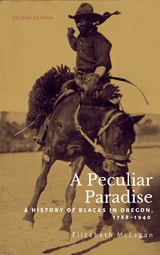
A Peculiar Paradise
A History of Blacks in Oregon, 1788-1940Elizabeth McLagan
Oregon State University Press, 2022
A Peculiar Paradise: A History of Blacks in Oregon 1788–1940 remains the most comprehensive chronology of Black life in Oregon more than forty years after its original publication in 1980. The book has long been a resource for those seeking information on the legal and social barriers faced by people of African descent in Oregon. Elizabeth McLagan’s work reveals how in spite of those barriers, Black individuals and families made Oregon their home, and helped create the state’s modern Black communities. Long out of print, the book is available again through this co-publication with Oregon Black Pioneers, Oregon’s statewide African American historical society. The revised second edition includes additional details for students and scholars, an expanded reading list, a new selection of historic images, and a new foreword by Gwen Carr and an afterword by Elizabeth McLagan.
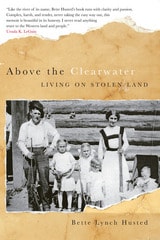
Above the Clearwater
Living on Stolen LandBette Lynch Husted
Oregon State University Press, 2004
Like her father before her, Bette Husted grew up on stolen land. The bench land above the Clearwater River in north-central Idaho had been a home for the Nez Perce Indians until the Dawes Act opened their reservation to settlement in 1895. As a child on the family homestead, Husted felt the presence of the Nez Perce: "But they were always just out of sight, like a smoky shadow behind me that I couldn't quite turn around quickly enough to catch."
Above the Clearwater chronicles her family's history on the land, revealing their joys and sorrows, their triumphs and tragedies. In a series of graceful and moving essays, Husted traces this intimate history, from her Cold War childhood to her struggles as a parent and finally to her life as a woman and teacher in the rural West. Her family's stories echo those of countless other families in the American West: the conflicts with guns, the struggles over land ownership and water rights, the isolation of women, the separations by race and class, the family secrets of mental illness and suicide.
With a powerful, poetic voice, Husted illuminates the tangled relationship between the history of a particular place and the history of the families who inhabit that place over time. As Above the Clearwater explores one family's search for a home on land taken from its original inhabitants, it quietly asks all readers to examine their own homes in the same light.
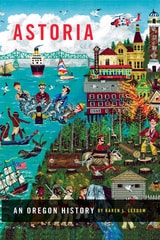
Astoria
An Oregon HistoryKaren L. Leedom
Oregon State University Press, 2021
Before Seattle, before Portland, there was Astoria.
The rest of the country is just beginning to discover Astoria, Oregon, that historic gem of a town at the mouth of the Columbia River west of Portland, and the oldest European-American settlement west of the Rockies.
The author provides a chronological look dating back to the 1500s, including European exploration, Native American life, logging, fishing, Chinese laborers in the salmon industry, a giant cheese in the Civil War, Oregon’s first female surgeon, Victorian architecture, and valiant Coast Guard rescues.
Published by Rivertide Publishing and distributed by Oregon State University Press
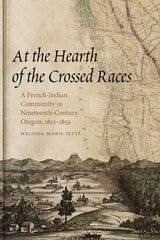
At the Hearth of the Crossed Races
A French-Indian Community in Nineteenth-Century Oregon, 1812-1859Melinda Marie Jetté
Oregon State University Press, 2015
Jetté’s study focuses on the “hearth” of this contact: French Prairie, so named for the French-Indian families who resettled the homeland of the Ahantchuyuk Kalapuyans. Although these families sought a middle course in their relations with their various neighbors, their presence ultimately contributed to the Anglo-American colonization of the region. By establishing farming and husbandry operations in the valley, the French-Indian settlers enhanced the Willamette Valley’s appeal as a destination of choice for the Anglo-Americans who later emigrated to the Pacific Northwest via the Oregon Trail.
Upon these emigrants’ arrival, the social space for the people of the “crossed races” diminished considerably, as the Anglo-Americans instituted a system of settler colonialism based on racial exclusion. Like their Native kin, the French-Indian families pursued various strategies to navigate the changing times and Jetté’s study of French Prairie takes on the relationships among all three: the French-Indian families, the indigenous peoples, and the Anglo-American settlers.
With At the Hearth of the Crossed Races, Jetté delivers a social history that deepens our understanding of the Oregon Country in the nineteenth century. This history of French Prairie provides a window into the multi-racial history of the Pacific Northwest and offers an alternative vision of early Oregon in the lives of the biracial French-Indian families whose community challenged notions of white supremacy, racial separation, and social exclusion.