55 books match the query 'Pease, Donald E.' and 5 start with a
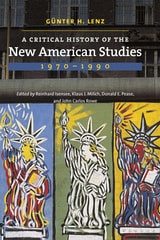
cover of A Critical History of the New American Studies, 1970–1990

A Critical History of the New American Studies, 1970–1990

Günter H. Lenz

Dartmouth College Press, 2016
Starting in 2005, Günter H. Lenz began preparing a book-length exploration of the transformation of the field of American Studies in the crucial years between 1970 and 1990. As a commentator on, contributor to, and participant in the intellectual and institutional changes in his field, Lenz was well situated to offer a comprehensive and balanced interpretation of that seminal era. Building on essays he wrote while these changes were ongoing, he shows how the revolution in theory, the emergence of postmodern socioeconomic conditions, the increasing globalization of everyday life, and postcolonial responses to continuing and new forms of colonial domination had transformed American Studies as a discipline focused on the distinctive qualities of the United States to a field encompassing the many different “Americas” in the Western Hemisphere as well as how this complex region influenced and was interpreted by the rest of the world. In tracking the shift of American Studies from its exceptionalist bias to its unmanageable global responsibilities, Lenz shows the crucial roles played by the 1930s’ Left in the U.S., the Frankfurt School in Germany and elsewhere between 1930 and 1960, Continental post-structuralism, neo-Marxism, and post-colonialism. Lenz’s friends and colleagues, now his editors, present here his final backward glance at a critical period in American Studies and the birth of the Transnational.
[more]
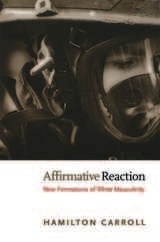
cover of Affirmative Reaction: New Formations of White Masculinity

Affirmative Reaction

New Formations of White Masculinity

Hamilton Carroll

Duke University Press, 2011

Affirmative Reaction explores the cultural politics of heteronormative white masculine privilege in the United States. Through close readings of texts ranging from the popular television drama 24 to the Marvel Comics miniseries The Call of Duty, and from the reality show American Chopper to the movie Million Dollar Baby, Hamilton Carroll argues that the true privilege of white masculinity—and its defining strategy—is not to be unmarked, universal, or invisible, but to be mobile and mutable. He describes how, in response to the perceived erosions of privilege produced by post–civil rights era identity politics, white masculinity has come to rely on the very discourses of difference that unsettled its claims on the universal; it has redefined itself as a marginalized identity.

Throughout Affirmative Reaction, Carroll examines the kinds of difference white masculinity claims for itself as it attempts to hold onto or maintain majority privilege. Whether these are traditional sites of minority difference—such as Irishness, white trash, or domestic melodrama—or reworked sites of masculinist investment—including laboring bodies, public-sphere politics, and vigilantism—the outcome is the same: the foregrounding of white masculinity over and against women, people of color, and the non-heteronormative. By revealing the strategies through which white masculinity is produced as a formal difference, Carroll sheds new light on the ways that privilege is accrued and maintained.
[more]
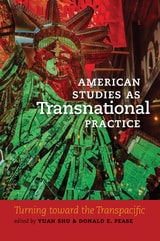
cover of American Studies as Transnational Practice: Turning toward the Transpacific

American Studies as Transnational Practice

Turning toward the Transpacific

Edited by Yuan Shu and Donald E. Pease

Dartmouth College Press, 2016
This wide-ranging collection brings together an eclectic group of scholars to reflect upon the transnational configurations of the field of American studies and how these have affected its localizations, epistemological perspectives, ecological imaginaries, and politics of translation. The volume elaborates on the causes of the transnational paradigm shift in American studies and describes the material changes that this new paradigm has effected during the past two decades. The contributors hail from a variety of postcolonial, transoceanic, hemispheric, and post-national positions and sensibilities, enabling them to theorize a “crossroads of cultures” explanation of transnational American studies that moves beyond the multicultural studies model. Offering a rich and rewarding mix of essays and case studies, this collection will satisfy a broad range of students and scholars.
[more]
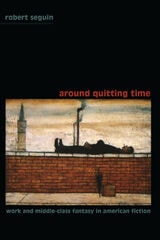
cover of Around Quitting Time: Work and Middle-Class Fantasy in American Fiction

Around Quitting Time

Work and Middle-Class Fantasy in American Fiction

Robert Seguin

Duke University Press, 2001

Virtually since its inception, the United States has nurtured a dreamlike and often delirious image of itself as an essentially classless society. Given the stark levels of social inequality that have actually existed and that continue today, what sustains this atonce hopelessly ideological and breathlessly utopian mirage? In Around Quitting Time Robert Seguin investigates this question, focusing on a series of modern writers who were acutely sensitive to the American web of ideology and utopic vision in order to argue that a pervasive middle-class imaginary is the key to the enigma of class in America.

Tracing connections between the reconstruction of the labor process and the aesthetic dilemmas of modernism, between the emergence of the modern state and the structure of narrative, Seguin analyzes the work of Nathanael West, Ernest Hemingway, Willa Cather, John Barth, and others. These fictional narratives serve to demonstrate for Seguin the pattern of social sites and cultural phenomenon that have emerged where work and leisure, production and consumption, and activity and passivity coincide. He reveals how, by creating pathways between these seemingly opposed domains, the middle-class imaginary at once captures and suspends the dynamics of social class and opens out onto a political and cultural terrain where class is both omnipresent and invisible.

Around Quitting Time will interest critics and historians of modern U.S. culture, literary scholars, and those who explore the interaction between economic and cultural forms.
[more]
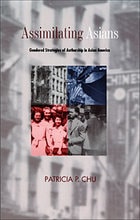
cover of Assimilating Asians: Gendered Strategies of Authorship in Asian America

Assimilating Asians

Gendered Strategies of Authorship in Asian America

Patricia P. Chu

Duke University Press, 2000

One of the central tasks of Asian American literature, argues Patricia P. Chu, has been to construct Asian American identities in the face of existing, and often contradictory, ideas about what it means to be an American. Chu examines the model of the Anglo-American bildungsroman and shows how Asian American writers have adapted it to express their troubled and unstable position in the United States. By aligning themselves with U.S. democratic ideals while also questioning the historical realities of exclusion, internment, and discrimination, Asian American authors, contends Chu, do two kinds of ideological work: they claim Americanness for Asian Americans, and they create accounts of Asian ethnicity that deploy their specific cultures and histories to challenge established notions of Americanness.
Chu further demonstrates that Asian American male and female writers engage different strategies in the struggle to adapt, reflecting their particular, gender-based relationships to immigration, work, and cultural representation. While offering fresh perspectives on the well-known writings—both fiction and memoir—of Maxine Hong Kingston, Amy Tan, Bharati Mukherjee, Frank Chin, and David Mura, Assimilating Asians also provides new insight into the work of less recognized but nevertheless important writers like Carlos Bulosan, Edith Eaton, Younghill Kang, Milton Murayama, and John Okada. As she explores this expansive range of texts—published over the course of the last century by authors of Chinese, Japanese, Korean, Filipino, and Indian origin or descent—Chu is able to illuminate her argument by linking it to key historical and cultural events.
Assimilating Asians makes an important contribution to the fields of Asian American, American, and women’s studies. Scholars of Asian American literature and culture, as well as of ethnicity and assimilation, will find particular interest and value in this book.
[more]