Results by title
126 books match the query 'People with disabilities' and 5 start with a

A History of Disability
Henri-Jacques Stiker
University of Michigan Press, 2000
The increasing numbers of scholars, policy-makers, and political activists who are concerned with questions of physical and cognitive disability will warmly welcome Henri-Jacques Stiker's book, the first to attempt to provide a framework for analyzing disability through the ages. Published in 1997 in France as Corps infirmes et sociétés and available now in an excellent English translation, the book traces the history of western cultural responses to disability, from ancient times to the present.
In this volume, Stiker examines a fundamental issue in contemporary Western discourse on disability: the cultural assumption that equality/sameness/similarity is always desired by those in society. He highlights the consequences of such a mindset, illustrating the intolerance of diversity and individualism that arises from placing such importance on equality. Importantly, Stiker does not hesitate to assert his own stance on the issues he discusses: that difference is not only acceptable, but that it is desirable, that it is necessary.
The author goes beyond anecdotal history to traverse a little known history, penetrating to the heart of collective attitudes and reflecting on elements of policy. The sweep is broad; from a rereading and reinterpretation of the Oedipus myth to current legislation regarding disablity, he proposes an analytical history that demonstrates how societies reveal themselves through their attitudes towards disability, at times in unexpected ways, since the study of detail is often the best entry into the whole of a culture. The book will be of interest to scholars of disability, historians, social scientists, cultural anthropologists, and those who are intrigued by the role that culture plays in the development of language and thought surrounding the disabled.
[more]

A History of Disability
Henri-Jacques Stiker
University of Michigan Press, 2019
The first book to attempt to provide a framework for analyzing disability through the ages, Henri-Jacques Stiker's now classic A History of Disability traces the history of western cultural responses to disability, from ancient times to the present. The sweep of the volume is broad; from a rereading and reinterpretation of the Oedipus myth to legislation regarding disability, Stiker proposes an analytical history that demonstrates how societies reveal themselves through their attitudes towards disability in unexpected ways. Through this history, Stiker examines a fundamental issue in contemporary Western discourse on disability: the cultural assumption that equality/sameness/similarity is always desired by those in society. He highlights the consequences of such a mindset, illustrating the intolerance of diversity and individualism that arises from placing such importance on equality. Working against this thinking, Stiker argues that difference is not only acceptable, but that it is desirable, and necessary.
This new edition of the classic volume features a new foreword by David T. Mitchell and Sharon L. Snyder that assesses the impact of Stiker’s history on Disability Studies and beyond, twenty years after the book’s translation into English. The book will be of interest to scholars of disability, historians, social scientists, cultural anthropologists, and those who are intrigued by the role that culture plays in the development of language and thought surrounding people with disabilities.
This new edition of the classic volume features a new foreword by David T. Mitchell and Sharon L. Snyder that assesses the impact of Stiker’s history on Disability Studies and beyond, twenty years after the book’s translation into English. The book will be of interest to scholars of disability, historians, social scientists, cultural anthropologists, and those who are intrigued by the role that culture plays in the development of language and thought surrounding people with disabilities.
[more]
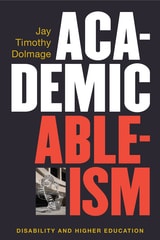
Academic Ableism
Disability and Higher EducationJay Timothy Dolmage
University of Michigan Press, 2017
Academic Ableism brings together disability studies and institutional critique to recognize the ways that disability is composed in and by higher education, and rewrites the spaces, times, and economies of disability in higher education to place disability front and center. For too long, argues Jay Timothy Dolmage, disability has been constructed as the antithesis of higher education, often positioned as a distraction, a drain, a problem to be solved. The ethic of higher education encourages students and teachers alike to accentuate ability, valorize perfection, and stigmatize anything that hints at intellectual, mental, or physical weakness, even as we gesture toward the value of diversity and innovation. Examining everything from campus accommodation processes, to architecture, to popular films about college life, Dolmage argues that disability is central to higher education, and that building more inclusive schools allows better education for all.
[more]
Academic Ableism
Disability and Higher EducationJay Timothy Dolmage
University of Michigan Press, 2017
Academic Ableism brings together disability studies and institutional critique to recognize the ways that disability is composed in and by higher education, and rewrites the spaces, times, and economies of disability in higher education to place disability front and center. For too long, argues Jay Timothy Dolmage, disability has been constructed as the antithesis of higher education, often positioned as a distraction, a drain, a problem to be solved. The ethic of higher education encourages students and teachers alike to accentuate ability, valorize perfection, and stigmatize anything that hints at intellectual, mental, or physical weakness, even as we gesture toward the value of diversity and innovation. Examining everything from campus accommodation processes, to architecture, to popular films about college life, Dolmage argues that disability is central to higher education, and that building more inclusive schools allows better education for all.
[more]
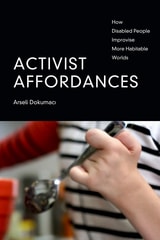
Activist Affordances
How Disabled People Improvise More Habitable WorldsArseli Dokumaci
Duke University Press, 2023
For people who are living with disability, including various forms of chronic diseases and chronic pain, daily tasks like lifting a glass of water or taking off clothes can be difficult if not impossible. In Activist Affordances, Arseli Dokumacı draws on ethnographic work with differently disabled people whose ingenuity, labor, and artfulness allow them to achieve these seemingly simple tasks. Dokumacı shows how they use improvisation to imagine and bring into being more habitable worlds through the smallest of actions and the most fleeting of movements---what she calls “activist affordances.” Even as an environment shrinks to a set of constraints rather than opportunities, the improvisatory space of performance opens up to allow disabled people to imagine that same environment otherwise. Dokumacı shows how disabled people’s activist affordances present the potential for a more liveable and accessible world for all of us.
[more]