56 books match the query 'Pictorials' and 3 start with a

cover of A Photographer’s Guide to Ohio

A Photographer’s Guide to Ohio

Ian Adams

Ohio University Press, 2011

In A Photographer’s Guide to Ohio Ian Adams, Ohio’s foremost landscape photographer, guides you to some of the most photogenic sites in the Buckeye State. With 3,600 buildings on the National Register of Historic Places, more than 120 state parks and nature preserves, and the world’s largest Amish community, Ohio’s photographic subjects are nearly endless. In more than 150 color photographs, Adams shows you how to capture the beauty of the seasons when photographing Ohio’s scenic vistas, nature preserves, waterfalls, public gardens, historic barns and bridges, landmark buildings, and town murals. Accompanied by regional maps, each entry includes clear directions and GPS locations, related websites, and historical facts about the area, as well as Adams’s detailed suggestions for capturing the best images. Both beginners and experienced photographers will find expert guidance in Adams’s clear advice on digital landscape photography and will be inspired to create their own stunning Ohio scenic images.
[more]
cover of A Photographer’s Guide to Ohio, Volume 2: Volume 2

A Photographer’s Guide to Ohio, Volume 2

Volume 2

Ian Adams

Ohio University Press, 2015

Ian Adams is perhaps the best-known landscape photographer in Ohio, and in the first volume of A Photographer’s Guide to Ohio, he shared his knowledge of what to photograph in the Buckeye State and how to photograph it. Now, in this second volume, Adams expands on his previous work, adding over 120 natural features, scenic rivers and byways, zoos and public gardens, historic buildings and murals, and even winter lighting displays to the list of places to visit and photograph in Ohio. In addition to advice on photographing landscapes, he offers tips for capturing excellent images of butterflies and dragonflies. Recognizing the rapid development of new technologies, Adams includes pointers on smartphone photography, lighting and composition, digital workflow, and sharing images across a variety of platforms. The book is illustrated with more than 100 color photographs. Comprehensive and concise, these two volumes make up a travel and photography guide to almost 300 of Ohio’s most noteworthy and beautiful outdoor places.
[more]
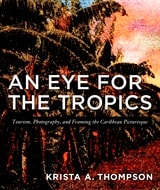
cover of An Eye for the Tropics: Tourism, Photography, and Framing the Caribbean Picturesque

An Eye for the Tropics

Tourism, Photography, and Framing the Caribbean Picturesque

Krista A. Thompson

Duke University Press, 2006

Images of Jamaica and the Bahamas as tropical paradises full of palm trees, white sandy beaches, and inviting warm water seem timeless. Surprisingly, the origins of those images can be traced back to the roots of the islands’ tourism industry in the 1880s. As Krista A. Thompson explains, in the late nineteenth century, tourism promoters, backed by British colonial administrators, began to market Jamaica and the Bahamas as picturesque “tropical” paradises. They hired photographers and artists to create carefully crafted representations, which then circulated internationally via postcards and illustrated guides and lectures.

Illustrated with more than one hundred images, including many in color, An Eye for the Tropics is a nuanced evaluation of the aesthetics of the “tropicalizing images” and their effects on Jamaica and the Bahamas. Thompson describes how representations created to project an image to the outside world altered everyday life on the islands. Hoteliers imported tropical plants to make the islands look more like the images. Many prominent tourist-oriented spaces, including hotels and famous beaches, became off-limits to the islands’ black populations, who were encouraged to act like the disciplined, loyal colonial subjects depicted in the pictures.

Analyzing the work of specific photographers and artists who created tropical representations of Jamaica and the Bahamas between the 1880s and the 1930s, Thompson shows how their images differ from the English picturesque landscape tradition. Turning to the present, she examines how tropicalizing images are deconstructed in works by contemporary artists—including Christopher Cozier, David Bailey, and Irénée Shaw—at the same time that they remain a staple of postcolonial governments’ vigorous efforts to attract tourists.

[more]