Results by title
187 books match the query 'Place' and 21 start with a
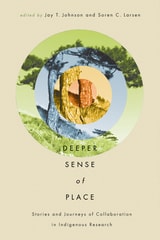
A Deeper Sense of Place
Stories and Journeys of Collaboration in Indigenous ResearchJay T. Johnson and Soren C. Larsen
Oregon State University Press, 2013
These first-person narratives offer insight into the challenges faced by Native and non-Native scholars to their academic and personal approaches during research with Indigenous communities. By addressing the ethical, political, intellectual, and practical meanings of collaboration with Indigenous peoples, A Deeper Sense of Place highlights the ways in which collaborative research can help Indigenous and settler communities find common ground through a shared commitment to land, people, and place.
A Deeper Sense of Place will inform students and academics engaged in research with Indigenous communities, as well as those interested in the challenges of employing critical, qualitative methodologies.
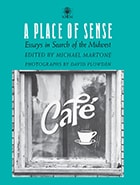
A Place Of Sense
Essays In Search Of MidwestMichael Martone
University of Iowa Press, 1988
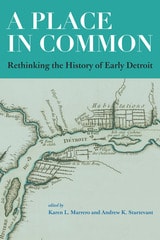
A Place in Common
Rethinking the History of Early DetroitKaren L. Marrero
Michigan State University Press, 2025
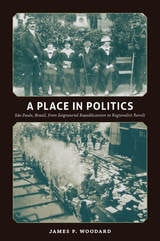
A Place in Politics
São Paulo, Brazil, from Seigneurial Republicanism to Regionalist RevoltJames P. Woodard
Duke University Press, 2009
Woodard’s fine-grained political history proceeds chronologically from the final years of the nineteenth century, when São Paulo’s leaders enjoyed political preeminence within the federal system codified by the Constitution of 1891, through the mass mobilization of 1931–32, in which São Paulo’s people marched, rioted, and eventually took up arms against the national government in what was to be Brazil’s last great regionalist revolt. In taking to the streets in the name of their state, constitutionalism, and the “civilization” that they identified with both, the people of São Paulo were at once expressing their allegiance to elements of a regionally distinct political culture and converging on a broader, more participatory public sphere that had arisen amid the political conflicts of the preceding decades.
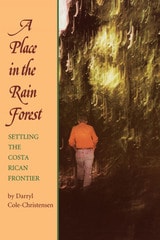
A Place in the Rain Forest
Settling the Costa Rican FrontierBy Darryl Cole-Christensen
University of Texas Press, 1997
In the 1950s, Darryl Cole-Christensen and his family were among the first settlers of the Coto Brus, an almost impenetrable, mountainous rain forest region of southeastern Costa Rica. In this evocative book, he captures the elemental struggles and rewards of settling a new frontier—an experience forever closed to most people in Western, urbanized society.
With the perspective of more than forty years' residence in the Coto Brus, Cole-Christensen ably describes both the settlers' dreams of bringing civilization and progress to the rain forest and the sweeping and irreversible changes they caused throughout the ecosystem as they cut the rain forest down. Writing neither to apologize for nor to defend their actions, he instead illuminates the personal and subjective factors that cause people to risk danger and hardship for the uncertain rewards of settling a frontier.
In his own words, Cole-Christensen says, "This is a book for the scientist who wants to recapture a sense of an incalculable world departed, for the student who asks: How is it that our forebears changed and restructured this land? For the adventurer who dreams of the expanse of frontiers, for every person who, having passed once through the darkening forest along a path in twilit stillness looks back to find that a blanket of murmurs remains."
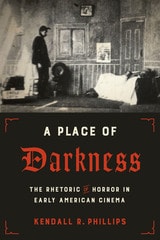
A Place of Darkness
The Rhetoric of Horror in Early American CinemaBy Kendall R. Phillips
University of Texas Press, 2018
Horror is one of the most enduringly popular genres in cinema. The term “horror film” was coined in 1931 between the premiere of Dracula and the release of Frankenstein, but monsters, ghosts, demons, and supernatural and horrific themes have been popular with American audiences since the emergence of novelty kinematographic attractions in the late 1890s. A Place of Darkness illuminates the prehistory of the horror genre by tracing the way horrific elements and stories were portrayed in films prior to the introduction of the term “horror film.”
Using a rhetorical approach that examines not only early films but also the promotional materials for them and critical responses to them, Kendall R. Phillips argues that the portrayal of horrific elements was enmeshed in broader social tensions around the emergence of American identity and, in turn, American cinema. He shows how early cinema linked monsters, ghosts, witches, and magicians with Old World superstitions and beliefs, in contrast to an American way of thinking that was pragmatic, reasonable, scientific, and progressive. Throughout the teens and twenties, Phillips finds, supernatural elements were almost always explained away as some hysterical mistake, humorous prank, or nefarious plot. The Great Depression of the 1930s, however, constituted a substantial upheaval in the system of American certainty and opened a space for the reemergence of Old World gothic within American popular discourse in the form of the horror genre, which has terrified and thrilled fans ever since.
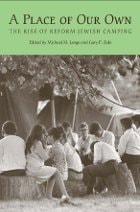
A Place of Our Own
The Rise of Reform Jewish CampingEdited by Michael M. Lorge and Gary P. Zola
University of Alabama Press, 2006
The history of educational summer camps in American Reform Judaism. Reform Judaism is not the only religious community in America to make the summer camp experience a vital part of a faith community's effort to impart its values and beliefs to its adolescents, but perhaps no group relied more on summer camp as an adjunct to home and community for this purpose. Summer camp became an important part of Reform group identity, a bulwark against the attraction of assimilation into the greater society and mere nominal Judaism.
These essays, which commemorate the fiftieth anniversary of the founding of the first Reform Jewish educational camp in the United States (Olin-Sang-Ruby Union Institute [OSRUI], in Oconomowoc, Wisconsin) cover a wide range of topics related to both the Reform Judaism movement and the development of the Reform Jewish camping system in the United States. Donald M. Splansky’s chapter on “Prayer at Reform Jewish Camps” documents changes in prayer services that took place both at OSRUI and in the Reform movement in general; Michael Zeldin’s “Making the Magic in Reform Jewish Summer Camps” describes the educational philosophies employed at many camps and analyzes their effectiveness; and Jonathan D. Sarna’s “The Crucial Decade in Jewish
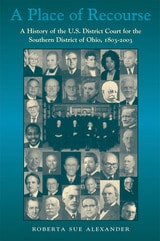
A Place of Recourse
A History of the U.S. District Court for the Southern District of Ohio, 1803–2003Roberta Sue Alexander
Ohio University Press, 2005
The first history of a federal district court in a midwestern state, A Place of Recourse explains a district court’s function and how its mission has evolved. The court has grown from an obscure institution adjudicating minor debt and land disputes to one that plays a central role in the political, economic, and social lives of southern Ohioans.
In tracing the court’s development, Alexander explores the central issues confronting the district court judges during each historical era. She describes how this court in a non-slave state responded to fugitive slave laws and how a court whose jurisdiction included a major coal-mining region responded to striking workers and the unionization movement. The book also documents judicial responses to Prohibition, New Deal legislation, crime, mass tort litigation, and racial desegregation.
The history of a court is also the history of its judges. Accordingly, Alexander provides historical insight on current and past judges. She details behind-the-scenes maneuvers in judicial appointments and also the creativity some judges displayed on the bench—such as Judge Leavitt, who adopted admiralty law to deal with the problems of river traffic.
A Place of Recourse demonstrates that, at least in the Southern District of Ohio, the federal district court has played the role its creators hoped it would—upholding federal law even when the citizens of the region actively opposed such enforcement.
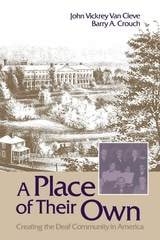
A Place of Their Own
Creating the Deaf Community in AmericaJohn Vickrey Van Cleve
Gallaudet University Press, 1989
Using original sources, this unique book focuses on the Deaf community during the 19th century. Largely through schools for the deaf, deaf people began to develop a common language and a sense of community.
A Place of Their Own brings the perspective of history to bear on the reality of deafness and provides fresh and important insight into the lives of deaf Americans.

A Place on the Corner
Elijah Anderson
University of Chicago Press, 1978
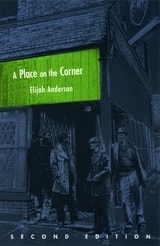
A Place on the Corner, Second Edition
Elijah Anderson
University of Chicago Press, 2004
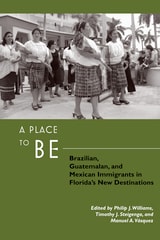
A Place to Be
Brazilian, Guatemalan, and Mexican Immigrants in Florida's New DestinationsEdited by Philip J. Williams, Timothy J. Steigenga, and Manuel A. Vásquez
Rutgers University Press, 2009
Contributors to this volume include Patricia Fortuny Loret de Mola, Carol Girón Solórzano, Silvia Irene Palma, Lúcia Ribeiro, Mirian Solfs Lizama, José Claúdio Souza Alves, Timothy J. Steigenga, Manuel A. Vásquez, and Philip J. Williams.
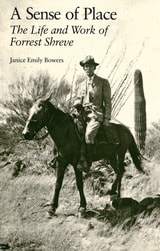
A Sense of Place
The Life and Work of Forrest ShreveJanice Emily Bowers
University of Arizona Press, 1988
Tracing Shreve's development from student to scientist, Bowers evokes the rigors and delights of fieldwork in the first half of this century and shows how Shreve's sense of place informed his scientific thought—making him, in his own words, "not an exile from some better place, but a man at home in an environment to which his life can be adjusted without physical or intellectual loss."

A Year In Place
W Scott Olsen
University of Utah Press, 2001
W. Scott Olsen and Bret Lott invited a dozen friends to consider one particular calendar month in the place they call home. The result is A Year in Place, a captivating collection of new writing by twelve eminent American writers.
More than a montage of voices and experiences, A Year in Place illustrates, as Olsen and Lott explain in their introduction, the trends in American thinking about who we are and what we care about. Rick Bass takes us to the Yaak Valley of Montana in June, where fawns are arriving, "newly-emerged, knocked-legged and groggy, legs still unfolding from that long sleeping passage." Peggy Shumaker explores the special social and cultural time that is March in Fairbanks, Alaska, where a long winter has whetted the psychic despair of inhabitants who find in the "sky’s unbearable brightness . . . a waking pain beyond endurance." Michael Martone transports us through memory to Indiana in the 1950s where each May a blimp "yawed and floated up," wallowing above a suburban neighborhood on its way to the Indianapolis 500.
These and nine other contributions yield an unforgettable book about "the places we find ourselves blessed enough to be."
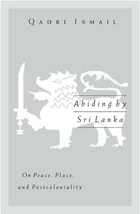
Abiding by Sri Lanka
On Peace, Place, and PostcolonialityQadri Ismail
University of Minnesota Press, 2005
Abiding by Sri Lanka examines how the disciplines of anthropology, history, and literature treat the Sri Lankan ethnic conflict. Anthropology, Ismail contends, approaches Sri Lanka as an object from an “outside” and western point of view. History, addressing the conflict from the “inside,” abides by the place and so promotes change that is nationalist and exclusive. Neither of these fields imagines an inclusive community. Literature, Ismail argues, can.
With close readings of texts that “abide” by Sri Lanka, texts that have a commitment to it, Ismail demonstrates that the problems in Sri Lanka raise fundamental concerns for us all regarding the relationship between democracies and minorities. Recognizing the structural as well as political tendencies of representative democracies to suppress minorities, Ismail rethinks democracy by redefining the concept of the minority perspective, not as a subject-position of numerical insignificance, but as a conceptual space that opens up the possibility for distinction without domination and, ultimately, peace.
Qadri Ismail is associate professor of English at the University of Minnesota. He has also been a journalist in Sri Lanka.
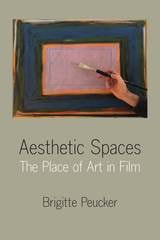
Aesthetic Spaces
The Place of Art in FilmBrigitte Peucker
Northwestern University Press, 2019
The films studied in these chapters include those by Abbas Kiarostami, Alfred Hitchcock, Michelangelo Antonioni, Jean-Luc Godard, Carl Th. Dreyer, Peter Greenaway, Rainer Werner Fassbinder, Ingmar Bergman, Jacques Rivette, Fritz Lang, F. W. Murnau, Lars von Trier, Spike Jonze, Éric Rohmer, Lech Majewski, and others. Where two media are in evidence in these films, there is usually a third, and often theater mediates between film and painting. Aesthetic Spaces interrogates issues of cinematic space and mise-en-scène from different but interconnected theoretical perspectives, organizing its chapters around some of the formal principles—space, spectator, frame, color and lighting, props, décor, and actor—that shape films.
Drawing on the older arts to renew cinema, the films examined deploy paintings as material: Poussin and Bruegel, Rembrandt, Hals and Klimt, and medieval illustrations and modernist abstractions are used to expand our notions of cinematic space. Peucker shows that when different media come together in film, they create effects of dissonance out of which new modes of looking may arise.
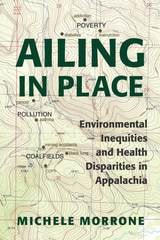
Ailing in Place
Environmental Inequities and Health Disparities in AppalachiaMichele Morrone
Ohio University Press, 2020
In Ailing in Place, Michele Morrone explores the relationship between environmental conditions in Appalachia and health outcomes that are too often ascribed to individual choices only. She applies quantitative data to observations from environmental health professionals to frame the ways in which the environment, as a social determinant of health, leads to health disparities in Appalachian communities. These examples—these stories of place—trace the impacts of water quality, waste disposal, and natural resource extraction on the health and quality of life of Appalachian people.
Public health is inextricably linked to place. Environmental conditions such as contaminated water, unsafe food, and polluted air are as important as culture, community, and landscape in characterizing a place and determining the health outcomes of the people who live there. In some places, the state of the environment is a consequence of historical activities related to natural resources and cultural practices. In others, political decisions to achieve short-term economic objectives are made with little consideration of long-term public health consequences.
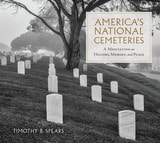
America's National Cemeteries
A Meditation on History, Memory, and PlaceTimothy B. Spears, Foreword by Roderick Gainer
University of Alabama Press, 2025
A poignant photographic tour of honor, sacrifice, and memory within America's national cemeteries
In America’s National Cemeteries, Timothy B. Spears takes the reader on a grand tour of these singular places of commemoration, the final resting place for more than four million American military personnel who died either in wartime, during their time of service, or after their honorable discharge. His absorbing account—part historical narrative and part travelogue—is enhanced by 180 of his remarkable photographs, which capture the spirit, beauty, and solemn remembrance to be found in each of the 156 national cemeteries across America.
Spears details the history of the cemeteries since their establishment during the American Civil War and explores their ongoing evolution and importance to American society and the commitment America has made to honoring its military dead. With headstones neatly arrayed in rows and each soldier typically buried in an identical fashion, the cemeteries symbolize an enduring connection between human mortality and national identity. They also reflect the nation’s persistent challenges with inequalities and injustice, violence and racism, lingering questions about “good” versus “bad” wars, and the vexed legacies of America’s military forays.
In this unique meditation on American history, memory, and place, Spears embraces the impact of the past on the present, offering an original perspective on the meaning of military service, mortality, and remembrance and how these national cemeteries have evolved into truly iconic and emblematic American spaces. The book also features a foreword by Roderick Gainer, Chief Curator of Arlington National Cemetery since 2013.
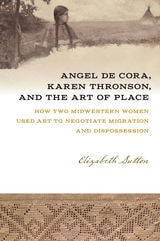
Angel De Cora, Karen Thronson, and the Art of Place
How Two Midwestern Women Used Art to Negotiate Migration and DispossessionElizabeth Sutton
University of Iowa Press, 2020
Angel De Cora (c. 1870–1919) was a Native Ho-Chunk artist who received relative acclaim during her lifetime. Karen Thronson (1850–1929) was a Norwegian settler housewife who created crafts and folk art in obscurity along with the other women of her small immigrant community. The immigration of Thronson and her family literally maps over the De Cora family’s forced migration across Wisconsin, Iowa, and onto the plains of Nebraska and Kansas. Tracing the parallel lives of these two women artists at the turn of the twentieth century, art historian Elizabeth Sutton reveals how their stories intersected and diverged in the American Midwest.
By examining the creations of these two artists, Sutton shows how each woman produced art or handicrafts that linked her new home to her homeland. Both women had to navigate and negotiate between asserting their authentic self and the expectations placed on them by others in their new locations. The result is a fascinating story of two women that speaks to universal themes of Native displacement, settler conquest, and the connection between art and place.
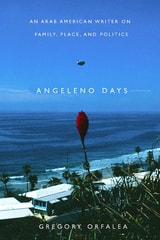
Angeleno Days
An Arab American Writer on Family, Place, and PoliticsGregory Orfalea
University of Arizona Press, 2009
Populated with fascinating characters—the Angelenos of Orfalea’s life—these essays tell the story of the author’s trials. He returns to Los Angeles to teach, trying to reconcile the LA of his childhood with the city he now faces. He takes on progressively more difficult and painful subjects, finally confronting the memories of the shocking tragedy that took the lives of his father and sister.
With more than 400,000 Arab Americans in Los Angeles—probably surpassing Detroit as the largest contingent in America—Orfalea also explores his own community and its political and social concerns. He agonizes over another destruction of Lebanon and examines in searing detail a massacre of civilians in Iraq.
Angeleno Days takes the memoir and personal essay to rare heights. Orfalea is a deeply human writer who reveals not only what it means to be human in America now, but also what it will take to remain human in the days to come. These essays soar, confound, reveal, and strike at our senses and sensibilities, forcing us to think and feel in new ways.

Authorized Heritage
Place, Memory, and Historic Sites in Prairie CanadaRobert Coutts
University of Manitoba Press, 2021