Results by title
191 books match the query 'Politics and literature' and 16 start with a
A Martian Muse
Further Essays on Identity, Politics, and the Freedom of PoetryReginald Shepherd
University of Michigan Press, 2010
Those who have read Orpheus in the Bronx, Reginald Shepherd's previous collection of essays about the act of creating poetry, and those who take on the task, can immediately understand why it was a national finalist for a prestigious National Book Critics Circle Award. Shepherd was candid and disarming, practical and funny, able to mix thoughts about the Transformers with meditations on the realities of growing up poor.
This is Reginald Shepherd's final opportunity to speak his mind about the craft he loved, the art of using words to express the soul and the wit of every person's experience. Edited by Shepherd's longtime partner and intellectual confidant, Robert Philen, A Martian Muse stands as a final monument to a master in the craft, but is also a readable, important work in its own right.
"Reginald Shepherd died September 10, 2008, after a hard struggle with cancer. While he had completed the essays presented here and had selected them from his available essays to form a collection, he didn't have time to organize the presentation of the essays within the collection.
"The task of editing this collection has been a daunting challenge as I struggle to live up to the level of intellectual engagement, clarity, and coherence that Reginald always expected. While daunting, it has also been a labor of love and a compulsion for me, based on the many years I spent with him as a partner, friend, lover, intellectual companion, and sharer of common passions."
---Robert Philen, from the Introduction
Reginald Shepherd was the editor of The Iowa Anthology of New American Poetries and Lyric Postmodernisms: An Anthology of Contemporary Innovative Poetries and the author of five books of poetry. He was a finalist for the 2009 National Book Critics Circle Award and was the recipient of grants from the NEA, the Illinois Arts Council, the Saltonstall Foundation, the Florida Arts Council, and the Vogelstein Foundation, among many other awards and honors.
A World That Will Hold All the People
Suzanne Gardinier
University of Michigan Press, 1996
Actium and Augustus
The Politics and Emotions of Civil WarRobert Alan Gurval
University of Michigan Press, 1998
Actium and Augustus marks a turning point as well. Robert Alan Gurval's unusual approach is to examine contemporary views of the battle and its immediate political and social consequences. He starts with a consideration of the official celebration and public commemoration of the Actian victory and then moves on to other questions. What were the "Actian" monuments that Octavian erected on the battle site and later in Rome? What role did the Actian victory play in the political formation of the Principate and its public ideology? What was the response of contemporary poetry? Throughout, this volume concentrates on contemporary views of Actium and its results.
Written to include the general reader, Actium and Augustus presents a thoughtful examination of a complex period. All Greek and Latin quotations are translated, and extensive illustrations present graphic evidence about the issues Romans faced.
Robert Alan Gurval is Associate Professor of Classics, University of California, Los Angeles, and has been a recipient of the Rome Prize awarded by the American Academy in Rome.
African American Satire
The Sacredly Profane NovelDarryl Dickson-Carr
University of Missouri Press, 2001
Satire's real purpose as a literary genre is to criticize through humor, irony, caricature, and parody, and ultimately to defy the status quo. In African American Satire, Darryl Dickson-Carr provides the first book-length study of African American satire and the vital role it has played. In the process he investigates African American literature, American literature, and the history of satire.
Dickson-Carr argues that major works by such authors as Rudolph Fisher, Ishmael Reed, Ralph Ellison, Langston Hughes, and George S. Schuyler should be read primarily as satires in order to avoid misinterpretation and to gain a greater understanding of their specific meanings and the eras in which they were written. He also examines the satirical rhetoric and ideological bases of complex works such as John Oliver Killens's The Cotillion and Cecil Brown's The Life and Loves of Mr. Jiveass Nigger—books that are currently out of print and that have received only scant critical attention since they were first published.
Beginning with the tradition of folk humor that originated in West Africa and was forcibly transplanted to the Americas through chattel slavery, Dickson-Carr focuses in each chapter on a particular period of the twentieth century in which the African American satirical novel flourished. He analyzes the historical contexts surrounding African American literature and culture within discrete crucial movements, starting with the Harlem Renaissance of the 1920s and ending in the present. He also demonstrates how the political, cultural, and literary ethos of each particular moment is manifested and contested in each text.
By examining these texts closely within their historical and ideological contexts, Dickson-Carr shows how African American satirical novels provide the reader of African American literature with a critique of popular ideologies seldom found in nonsatirical works. Providing a better understanding of what satire is and why it is so important for fulfilling many of the goals of African American literature, African American Satire will be an important addition to African American studies.
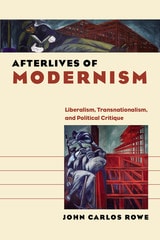
Afterlives of Modernism
Liberalism, Transnationalism, and Political CritiqueJohn Carlos Rowe
Dartmouth College Press, 2015
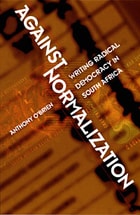
Against Normalization
Writing Radical Democracy in South AfricaAnthony O'Brien
Duke University Press, 2001
O’Brien brings together an unusual array of contemporary South African writing: cultural theory and debate, worker poetry, black and white feminist writing, Black Consciousness drama, the letters of exiled writers, and postapartheid fiction and film. Paying subtle attention to well-known figures like Nadine Gordimer, Bessie Head, and Njabulo Ndebele, but also foregrounding less-studied writers like Ingrid de Kok, Nise Malange, Maishe Maponya, and the Zimbabwean Dambudzo Marechera, he reveals in their work the construction of a political aesthetic more radically democratic than the current normalization of nationalism, ballot-box democracy, and liberal humanism in culture could imagine. Juxtaposing his readings of these writers with the theoretical traditions of postcolonial thinkers about race, gender, and nation like Paul Gilroy, bell hooks, and Gayatri Spivak, and with others such as Samuel Beckett and Vaclav Havel, O’Brien adopts a uniquely comparatist and internationalist approach to understanding South African writing and its relationship to the cultural settlement after apartheid.
With its appeal to specialists in South African fiction, poetry, history, and politics, to other Africanists, and to those in the fields of colonial, postcolonial, race, and gender studies, Against Normalization will make a significant intervention in the debates about cultural production in the postcolonial areas of global capitalism.
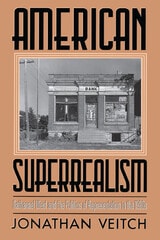
American Superrealism
Nathanael West and the Politics of Representation in the 1930sJonathan Veitch
University of Wisconsin Press, 1997
Nathanael West has been hailed as “an apocalyptic writer,” “a writer on the left,” and “a precursor to postmodernism.” But until now no critic has succeeded in fully engaging West’s distinctive method of negation. In American Superrealism, Jonathan Veitch examines West’s letters, short stories, screenplays and novels—some of which are discussed here for the first time—as well as West’s collaboration with William Carlos Williams during their tenure as the editors of Contact. Locating West in a lively, American avant-garde tradition that stretches from Marcel Duchamp to Andy Warhol, Veitch explores the possibilities and limitations of dada and surrealism—the use of readymades, scatalogical humor, human machines, “exquisite corpses”—as modes of social criticism. American Superrealism offers what is surely the definitive study of West, as well as a provocative analysis that reveals the issue of representation as the central concern of Depression-era America.
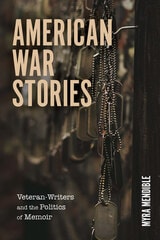
American War Stories
Veteran-Writers and the Politics of MemoirMyra Mendible
University of Massachusetts Press, 2021
American War Stories centers on an extensive selection of memoirs written by veterans of the Vietnam, Iraq, and Afghanistan conflicts—including Brian Turner's My Life as a Foreign Country, Marcus Luttrell's Lone Survivor, and Camilo Mejia's Road from ar Ramadi—to explore the complex relationship between memory and politics in the context of postmodern war. Placing veterans' stories in conversation with broader cultural and political discourses, Myra Mendible analyzes the volatile mix of agendas, identities, and issues informing veteran-writers' narrative choices to argue that their work plays an important, though underexamined, political function in how Americans remember and judge their wars.
Amid the Fall, Dreaming of Eden
Du Bois, King, Malcolm X, and Emancipatory CompositionBradford T. Stull
Southern Illinois University Press, 1999
Whom, or what, does composition—defined here as an intentional process of study, either oral or written—serve? Bradford T. Stull contends that composition would do well to articulate, in theory and practice, what could be called "emancipatory composition." He argues that emancipatory composition is radically theopolitical: it roots itself in the foundational theological and political language of the American experience while it subverts this language in order to emancipate the oppressed and, thereby, the oppressors.
To articulate this vision, Stull looks to those who compose from an oppressed place, finding in the works of W. E. B. Du Bois, Martin Luther King Jr., and Malcolm X radical theopolitical practices that can serve as a model for emancipatory composition. While Stull acknowledges that there are many sites of oppression, he focuses on what Du Bois has called the problem of the twentieth century: the color line, positing that the unique and foundational nature of the color line provides a fecund place in which, from which, a theory and practice of emancipatory composition might be elucidated.
By focusing on four key theopolitical tropes—The Fall, The Orient, Africa, and Eden—that inform the work of Du Bois, King, and Malcolm X, Stull discovers the ways in which these civil rights leaders root themselves in the vocabulary of the American experience in order to subvert it so that they might promote emancipation for African Americans, and thus all Americans.
In drawing on the work of Paulo Freire, Kenneth Burke, Edward Said, Christopher Miller, Ernst Bloch, and others, Stull also locates this study within the larger cultural context. By reading Du Bois, King, and Malcolm X together in a way that they have never before been read, Stull presents a new vision of composition practice to the African American studies community and a reading of African American emancipatory composition to the rhetoric and composition community, thus extending the question of emancipatory composition into new territory.
Amoral Gower
Language, Sex, and PoliticsDiane Watt
University of Minnesota Press, 2003
An innovative reading of John Gower’s work and an exciting new approach to medieval vernacular texts
“Moral Gower” he was called by friend and sometime rival Geoffrey Chaucer, and his “Confessio Amantis” has been viewed as an uncomplicated analysis of the universe, combining erotic narratives with ethical guidance and political commentary. Diane Watt offers the first sustained reading of John Gower’s “Confessio” to argue that this early vernacular text offers no real solutions to the ethical problems it raises—and in fact actively encourages perverse readings.
Drawing on a combination of queer and feminist theory, ethical criticism, and psychoanalytic, historicist, and textual criticism, Watt focuses on the language, sex, and politics in Gower’s writing. How, she asks, is Gower’s “Confessio” related to contemporary controversies over vernacular translation and debates about language politics? How is Gower’s treatment of rhetoric and language gendered and sexualized, and what bearing does this have on the ethical and political structure of the text? What is the relationship between the erotic, ethical, and political sections of “Confessio Amantis”? Watt demonstrates that Gower engaged in the sort of critical thinking more commonly associated with Chaucer and William Langland at the same time that she contributes to modern debates about the ethics of criticism.
An American Body | Politic
A Deleuzian ApproachBernd Herzogenrath
Dartmouth College Press, 2010
Anarchy and Culture
The Aesthetic Politics of ModernismDavid Weir
University of Massachusetts Press, 1997
Anarchism is generally understood as a failed ideology, a political philosophy that once may have had many followers but today attracts only cranks and eccentrics. This book argues that the decline of political anarchism is only half the story; the other half is a tale of widespread cultural success.
David Weir develops this thesis in several ways. He begins by considering the place of culture in the political thought of the classical anarchist thinkers William Godwin, Pierre-Joseph Proudhon, Mikhail Bakunin, and Peter Kropotkin. He then shows how the perceived “anarchy” of nineteenth-century society induced writers such as Matthew Arnold, Henry James, and Fyodor Dostoyevsky to turn away from politics and seek unity in the idea of a common culture.
Yet as other late-nineteenth-century writers and artists began to sympathize with anarchism, the prospect of a common culture became increasingly remote. In Weir's view, the affinity for anarchism that developed among members of the artistic avant-garde lies behind much of fin de siècle culture. Indeed, the emergence of modernism itself can be understood as the aesthetic realization of anarchist politics. In support of this contention, Weir shows that anarchism is the key aesthetic principle informing the work of a broad range of modernist figures, from Henrik Ibsen and James Joyce to Dadaist Hugo Ball and surrealist Luis Buñuel.
Weir concludes by reevaluating the phenomenon of postmodernism as only the most recent case of the migration of politics into aesthetics, and by suggesting that anarchism is still very much with us as a cultural condition.
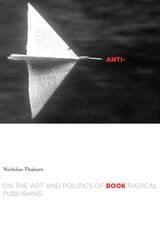
Anti-Book
On the Art and Politics of Radical PublishingNicholas Thoburn
University of Minnesota Press, 2016
No, Anti-Book is not a book about books. Not exactly. And yet it is a must for anyone interested in the future of the book. Presenting what he terms “a communism of textual matter,” Nicholas Thoburn explores the encounter between political thought and experimental writing and publishing, shifting the politics of text from an exclusive concern with content and meaning to the media forms and social relations by which text is produced and consumed. Taking a “post-digital” approach in considering a wide array of textual media forms, Thoburn invites us to challenge the commodity form of books—to stop imagining books as transcendent intellectual, moral, and aesthetic goods unsullied by commerce. His critique is, instead, one immersed in the many materialities of text.
Anti-Book engages with an array of writing and publishing projects, including Antonin Artaud’s paper gris-gris, Valerie Solanas’s SCUM Manifesto, Guy Debord’s sandpaper-bound Mémoires, the collective novelist Wu Ming, and the digital/print hybrid of Mute magazine. Empirically grounded, it is also a major achievement in expressing a political philosophy of writing and publishing, where the materiality of text is interlaced with conceptual production. Each chapter investigates a different form of textual media in concert with a particular concept: the small-press pamphlet as “communist object,” the magazine as “diagrammatic publishing,” political books in the modes of “root” and “rhizome,” the “multiple single” of anonymous authorship, and myth as “unidentified narrative object.”
An absorbingly written contribution to contemporary media theory in all its manifestations, Anti-Book will enrich current debates about radical publishing, artists’ books and other new genre and media forms in alternative media, art publishing, media studies, cultural studies, critical theory, and social and political theory.
Approaching the Millennium
Essays on Angels in AmericaDeborah R. Geis and Steven F. Kruger, Editors
University of Michigan Press, 1997
Art, Theory, Revolution
The Turn to Generality in Contemporary LiteratureMitchum Huehls
The Ohio State University Press, 2022
At Penpoint
African Literatures, Postcolonial Studies, and the Cold WarMonica Popescu
Duke University Press, 2020