Results by title
52 books match the query 'Postcolonialism in literature' and 6 start with a
A Transnational Poetics
Jahan Ramazani
University of Chicago Press, 2009
Poetry is often viewed as culturally homogeneous—“stubbornly national,” in T. S. Eliot’s phrase, or “the most provincial of the arts,” according to W. H. Auden. But in A Transnational Poetics, Jahan Ramazani uncovers the ocean-straddling energies of the poetic imagination—in modernism and the Harlem Renaissance; in post–World War II North America and the North Atlantic; and in ethnic American, postcolonial, and black British writing. Cross-cultural exchange and influence are, he argues, among the chief engines of poetic development in the twentieth and twenty-first centuries.
Reexamining the work of a wide array of poets, from Eliot, Yeats, and Langston Hughes to Elizabeth Bishop, Lorna Goodison, and Agha Shahid Ali, Ramazani reveals the many ways in which modern and contemporary poetry in English overflows national borders and exceeds the scope of national literary paradigms. Through a variety of transnational templates—globalization, migration, travel, genre, influence, modernity, decolonization, and diaspora—he discovers poetic connection and dialogue across nations and even hemispheres.
A User's Guide to Postcolonial and Latino Borderland Fiction
By Frederick Luis Aldama
University of Texas Press, 2009
Why are so many people attracted to narrative fiction? How do authors in this genre reframe experiences, people, and environments anchored to the real world without duplicating "real life"? In which ways does fiction differ from reality? What might fictional narrative and reality have in common—if anything?
By analyzing novels such as Arundhati Roy's The God of Small Things, Amitav Ghosh's The Glass Palace, Zadie Smith's White Teeth, and Hari Kunzru's The Impressionist, along with selected Latino comic books and short fiction, this book explores the peculiarities of the production and reception of postcolonial and Latino borderland fiction. Frederick Luis Aldama uses tools from disciplines such as film studies and cognitive science that allow the reader to establish how a fictional narrative is built, how it functions, and how it defines the boundaries of concepts that appear susceptible to limitless interpretations.
Aldama emphasizes how postcolonial and Latino borderland narrative fiction authors and artists use narrative devices to create their aesthetic blueprints in ways that loosely guide their readers' imagination and emotion. In A User's Guide to Postcolonial and Latino Borderland Fiction, he argues that the study of ethnic-identified narrative fiction must acknowledge its active engagement with world narrative fictional genres, storytelling modes, and techniques, as well as the way such fictions work to move their audiences.
Across Continents
Writing Goans, Making WorldsR. Benedito Ferrão
University of Michigan Press, 2026
Across Continents employs Goan literary subjectivity as epistemology to critique a specific limitation of postcolonial thought, one that does not account for the situations or afterlife of Portuguese colonialism. Employing various novels, R. Benedito Ferrão considers the relationship between Portuguese and British colonialisms through the displacement of Goan characters betwixt Asia, Africa, Europe, and North America. The experiences of these figures in dealing with the processes of nation, statecraft, and political intrigue at various historical junctures offer a comparative understanding of the tumultuous conditions of postcoloniality in the making of marginalized subjectivity across continents.
In examining the mobility and diversity of Goan experiences as represented in works by Salman Rushdie, M. G. Vassanji, Roger King, and Margaret Mascarenhas, this book calls into question limits of citizenship, nationality, and notions of belonging. Ferrão centers seemingly minor figures to exemplify the effects of colonial and postcolonial changes that connect diverse geopolities.
Allegories of the Anthropocene
Elizabeth M. DeLoughrey
Duke University Press, 2019
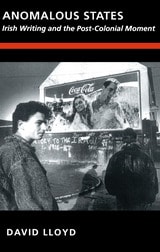
Anomalous States
Irish Writing and the Post-Colonial MomentDavid Lloyd
Duke University Press, 1993
Beginning with Heaney and Beckett, Lloyd shows how in these authors the question of identity connects with the dominance of conservative cultural nationalism and argues for the need to understand Irish culture in relation to the wider experience of colonized societies. A central essay reads Yeats's later works as a profound questioning of the founding of the state. Final essays examine the gradual formation of the state and nation as one element in a cultural process that involves conflict between popular cultural forms and emerging political economies of nationalism and the colonial state. Modern Ireland is thus seen as the product of a continuing process in which, Lloyd argues, the passage to national independence that defines Ireland's post-colonial status is no more than a moment in its continuing history.
Anomalous States makes an important contribution to the growing body of work that connects cultural theory with post-colonial historiography, literary analysis, and issues in contemporary politics. It will interest a wide readership in literary studies, cultural studies, anthropology, and history.
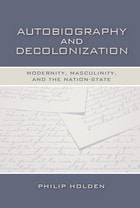
Autobiography and Decolonization
Modernity, Masculinity, and the Nation-StatePhilip Holden
University of Wisconsin Press, 2008