Results by title
88 books match the query 'Prisoners' and 6 start with a
A New England Prison Diary
Slander, Religion, and Markets in Early AmericaMartin J. Hershock
University of Michigan Press, 2012
In 1812, New Hampshire shopkeeper Timothy M. Joy abandoned his young family, fleeing the creditors who threatened to imprison him. Within days, he found himself in a Massachusetts jailhouse, charged with defamation of a prominent politician. During the months of his incarceration, Joy kept a remarkable journal that recounts his personal, anguished path toward spiritual redemption. Martin J. Hershock situates Joy's account in the context of the pugnacious politics of the early republic, giving context to a common citizen's perspective on partisanship and the fate of an unfortunate shopkeeper swept along in the transition to market capitalism.
In addition to this close-up view of an ordinary person's experience of a transformative period, Hershock reflects on his own work as a historian. In the final chapter, he discusses the value of diaries as historical sources, the choices he made in telling Joy's story, alternative interpretations of the diary, and other contexts in which he might have placed Joy's experiences. The appendix reproduces Joy's original journal so that readers can develop their own skills using a primary source.
A Suffragette in America
Reflections on Prisoners, Pickets and Political ChangeSylvia Pankhurst
Pluto Press, 2019
This book gathers Pankhurst’s writings from the year-long visit, in which she reveals her shock at the darkness hidden in American life, and draws parallels to her experiences of imprisonment and misogyny in her own country. Never before published, these writings mark an important stage in the development of the suffragette's thought, which she brought back to Britain to inform the burgeoning suffrage campaign there.

A Wall Is Just a Wall
The Permeability of the Prison in the Twentieth-Century United StatesReiko Hillyer
Duke University Press, 2024
After Prison
Navigating Adulthood in the Shadow of the Justice SystemDavid J. Harding
Russell Sage Foundation, 2020
The transition to young adulthood typically includes school completion, full-time employment, leaving the childhood home, marriage, and childbearing, events that are disrupted by incarceration. While one quarter of the young men who participated in the study successfully transitioned into adulthood—achieving employment and residential independence and avoiding arrest and incarceration—the same number of young men remained deeply involved with the criminal justice system, spending on average four out of the seven years after their initial release re-incarcerated. Not surprisingly, whites are more likely to experience success after prison. The authors attribute this racial disparity to the increased stigma of criminal records for blacks, racial discrimination, and differing levels of social network support that connect whites to higher quality jobs. Black men earn less than white men, are more concentrated in industries characterized by low wages and job insecurity, and are less likely to remain employed once they have a job.
The authors demonstrate that families, social networks, neighborhoods, and labor market, educational, and criminal justice institutions can have a profound impact on young people’s lives. Their research indicates that residential stability is key to the transition to adulthood. Harding and Harris make the case for helping families, municipalities, and non-profit organizations provide formerly incarcerated young people access to long-term supportive housing and public housing. A remarkably large number of men in this study eventually enrolled in college, reflecting the growing recognition of college as a gateway to living wage work. But the young men in the study spent only brief spells in college, and the majority failed to earn degrees. They were most likely to enroll in community colleges, trade schools, and for-profit institutions, suggesting that interventions focused on these kinds of schools are more likely to be effective. The authors suggest that, in addition to helping students find employment, educational institutions can aid reentry efforts for the formerly incarcerated by providing supports like childcare and paid apprenticeships.
After Prison offers a set of targeted policy interventions to improve these young people’s chances: lifting restrictions on federal financial aid for education, encouraging criminal record sealing and expungement, and reducing the use of incarceration in response to technical parole violations. This book will be an important contribution to the fields of scholarly work on the criminal justice system and disconnected youth.
An Appeal to Justice
Litigated Reform of Texas PrisonsBy Ben M. Crouch and James W. Marquart
University of Texas Press, 1989
How does a prison achieve institutional order while safeguarding prisoners' rights? Since the early 1960s, prison reform advocates have aggressively used the courts to extend rights and improve life for inmates, while prison administrators have been slow to alter the status quo. Litigated reform has been the most significant force in obtaining change.
An Appeal to Justice is a critical tudy of how the Texas Department of Corrections was transformed by Ruiz v. Estelle, the most sweeping class-action suit in correctional law history. Orders from federal judge William W. Justice rapidly moved the Texas system from one of the most autonomous, isolated, and paternalistic system to a more constitutional bureaucracy. In many respects the Texas experience is a microcosm of the transformation of American corrections over the second half of the twentieth century.
This is a careful account of TDC's fearful past as a plantation system, its tumultuous litigated reform, and its subsequent efforts to balance prisoner rights and prison order. Of major importance is the detailed examination of the broad stages of the reform process (and its costs and benefits) and an intimate look at prison brutality and humanity. The authors examine the terror tactics of the inmate guards, the development of prisoner gangs and widespread violence during the reforms, and the stability that eventually emerged. They also detail the change of the guard force from a relatively small, cohesive cadre dependent on discretion, personal loyalty, and physical dominance to a larger and more fragmented security staff controlled by formal procedures.
Drawing on years of research in archival sources and on hundreds of interviews with prisoners, administrators, and staff, An Appeal to Justice is a unique basis for assessing the course and consequences of prison litigation and will be valuable reading for legislators, lawyers, judges, prison administrators, and concerned citizens, as well as prison and public policy scholars.
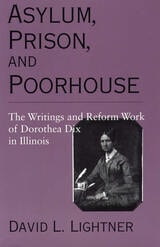
Asylum, Prison, and Poorhouse
The Writings and Reform Work of Dorothea Dix in IllinoisDavid L. Lightner
Southern Illinois University Press, 1999
This illustrated collection of annotated newspaper articles and memorials by Dorothea Dix provides a forum for the great mid-nineteenth-century humanitarian and reformer to speak for herself.
Dorothea Lynde Dix (1802–87) was perhaps the most famous and admired woman in America for much of the nineteenth century. Beginning in the early 1840s, she launched a personal crusade to persuade the various states to provide humane care and effective treatment for the mentally ill by funding specialized hospitals for that purpose. The appalling conditions endured by most mentally ill inmates in prisons, jails, and poorhouses led her to take an active interest also in prison reform and in efforts to ameliorate poverty.
In 1846–47 Dix brought her crusade to Illinois. She presented two lengthy memorials to the legislature, the first describing conditions at the state penitentiary at Alton and the second discussing the sufferings of the insane and urging the establishment of a state hospital for their care. She also wrote a series of newspaper articles detailing conditions in the jails and poorhouses of many Illinois communities.
These long-forgotten documents, which appear in unabridged form in this book, contain a wealth of information on the living conditions of some of the most unfortunate inhabitants of Illinois. In his preface, David L. Lightner describes some of the vivid images that emerge from Dorothea Dix's descriptions of social conditions in Illinois a century and a half ago: "A helpless maniac confined throughout the bitter cold of winter to a dark and filthy pit. Prison inmates chained in hallways and cellars because no more men can be squeezed into the dank and airless cells. Aged paupers auctioned off by county officers to whoever will maintain them at the lowest cost."
Lightner provides an introduction to every document, placing each memorial and newspaper article in its proper social and historical context. He also furnishes detailed notes, making these documents readily accessible to readers a century and a half later. In his final chapter, Lightner assesses both the immediate and the continuing impact of Dix's work.