Results by title
69 books match the query 'Public Affairs & Administration' and 9 start with a
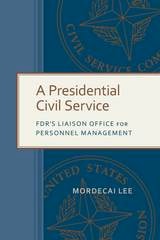
A Presidential Civil Service
FDR's Liaison Office for Personnel ManagementMordecai Lee
University of Alabama Press, 2016
Revealing the overlooked agency that transformed presidential personnel management and modern federal governance.
A Presidential Civil Service offers a comprehensive and definitive study of President Franklin Delano Roosevelt’s Liaison Office for Personnel Management (LOPM). Established in 1939 following the release of Roosevelt’s Brownlow Committee report, LOPM became a key milestone in the evolution of the contemporary executive-focused civil service.
The Progressive Movement of the nineteenth and early twentieth centuries comprised groups across the political spectrum with quite different. All, however, agreed on the need for a politically autonomous and independent federal Civil Service Commission (CSC) to eliminate patronage and political favoritism. In A Presidential Civil Service, public administration scholar Mordecai Lee explores two models open to later reformers: continuing a merit-based system isolated from politics or a management-based system subordinated to the executive and grounded in the growing field of managerial science.
Roosevelt’s 1937 Brownlow Committee, formally known as the President’s Committee on Administrative Management, has been widely studied including its recommendation to disband the CSC and replace it with a presidential personnel director. What has never been documented in detail was Roosevelt’s effort to implement that recommendation over the objections of Congress by establishing the LOPM as a nonstatutory agency.
The role and existence of LOPM from 1939 to 1945 has been largely dismissed in the history of public administration. Lee’s meticulously researched A Presidential Civil Service, however, persuasively shows that LOPM played a critical role in overseeing personnel policy. It was involved in every major HR initiative before and during World War II. Though small, the agency’s deft leadership almost always succeeded at impelling the CSC to follow its lead.
Roosevelt’s actions were in fact an artful and creative victory, a move finally vindicated when, in 1978, Congress abolished the CSC and replaced it with an Office of Personnel Management headed by a presidential appointee. A Presidential Civil Service offers a fascinating account and vital reassessment of the enduring legacy of Roosevelt’s LOPM.

Achieving the Impossible Dream
HOW JAPANESE AMERICANS OBTAINED REDRESSMitchell T. Maki, Harry H. L. Kitano, and S. Megan Berthold; Foreword by Robert T. Matsui
University of Illinois Press, 1999
Administrative Law in Central and Eastern Europe
Denis J. Galligan
Central European University Press, 1998
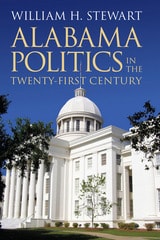
Alabama Politics in the Twenty-First Century
William H. Stewart
University of Alabama Press, 2016
An essential guide to understanding politics, power, and governance in modern Alabama.
Why does Alabama rank so low on many of the indicators of quality of life? Why did some of the most dramatic developments in the civil rights revolution of the 1960s take place in Alabama? Why is it that a few interest groups seem to have the most political power in Alabama? William H. Stewart’s Alabama Politics in the Twenty-First Century explores these questions and more, illuminating many of the often misunderstood details of contemporary Alabama politics in this cohesive and comprehensive publication.
The Alabama state government, especially as a specimen of Deep South politics, is a topic of frequent discussion by its general public—second only to college football. However, there remains a surprising lack of literature focusing on the workings of the state’s bureaucracy in an extensive and systematic way. Bearing in mind the Yellowhammer State’s long and rich political history, Stewart concentrates on Alabama’s statecraft from the first decade of the twenty-first century through the November 2010 elections and considers what the widespread Republican victories mean for their constituents. He also studies several different themes prominent during the 2010 elections, including the growing number and influence of special interest groups, the respective polarization of whites and blacks into the Republican and Democratic parties, and the increasingly unwieldy state constitution.
This fascinating and revealing text provides a wealth of information about an extremely complex state government. Featuring detailed descriptions of important concepts and events presented in a thorough and intelligible manner, Alabama Politics in the Twenty-First Century is perfect for scholars, students, everyday Alabamians, or anyone who wants the inside scoop on the subtle inner workings of the Cotton State’s politics.
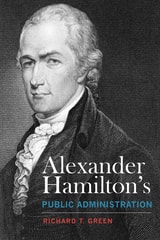
Alexander Hamilton's Public Administration
Richard T. Green
University of Alabama Press, 2019
Examines how Hamilton’s thoughts and experiences about public administration theory and practice have shaped the nation
American public administration inherited from Alexander Hamilton a distinct republican framework through which we derive many of our modern governing standards and practices. His administrative theory flowed from his republican vision, prescribing not only the how of administration but also what should be done and why. Administration and policy merged seamlessly in his mind, each conditioning the other. His Anti-Federalist detractors clearly saw this and fought his vision tooth and nail.
That conflict endures to this day because Americans still have not settled on just one vision of the American republic. That is why, Richard Green argues, Hamilton is a pivotal figure in our current reckoning. If we want to more fully understand ourselves and our ways of governing today, we must start by understanding Hamilton, and we cannot do that without exploring his administrative theory and practice in depth.
Alexander Hamilton’s Public Administration considers Hamilton both as a founder of the American republic, steeped in the currents of political philosophy and science of his day, and as its chief administrative theorist and craftsman, deeply involved in establishing the early institutions and policies that would bring his interpretation of the written Constitution to life. Accordingly, this book addresses the complex mix of classical and modern ideas that informed his vision of a modern commercial and administrative republic; the administrative ideas, institutions, and practices that flowed from that vision; and the substantive policies he deemed essential to its realization. Green’s analysis grows out of an immersion in Hamilton’s extant papers, including reports, letters, pamphlets, and essays. Readers will find a comprehensive explanation of his theoretical contributions and a richly detailed account of his ideas and practices in historical context.
American Public Administration
Past, Present, FutureFrederick C. Mosher
University of Alabama Press, 1975
The essays raise such issues as the education of civil servants, the changes necessitated by crises, the growth of social sciences in governmental concerns, and primarily, the role of public administrators in America. Each author is a distinguished expert in his own right, and each essay can stand alone as a remarkable insight into the changing world of public administration within American society. Frederick Mosher’s expertise and supervision shapes this work into a remarkable and holistic perspective on public administration over time.
An Extraordinary Scandal
The Westminster Expenses Crisis and Why It Still MattersEmma Crewe and Andrew Walker
Haus Publishing, 2019
Featuring interviews with the members of parliament, journalists, and officials close to the center of the turmoil, An Extraordinary Scandal tells the story of what really happened. Andrew Walker, the tax expert who oversaw the parliamentary expenses system, and Emma Crewe, a social scientist specializing in the institutions of parliament, bring fascinating perspectives—from both inside and outside parliament—to this account. Far from attempting provide a defense of any the parties involved, An Extraordinary Scandal explains how the parliament fell out of step with the electorate and became a victim of its own remote institutional logic, growing to become at odds with an increasingly open, meritocratic society.
Charting the crisis from its 1990s origins—when Westminster began, too slowly, to respond to wider societal changes—to its aftermath in 2010, the authors examine how the scandal aggravated the developing crisis of trust between the British electorate and Westminster politicians that continues to this day. Their in-depth research reveals new insight into how the expenses scandal acted as a glimpse of what was to come, and they reveal where the scandal’s legacy can be traced in the new age of mistrust and outrage, in which politicians are often unfairly vulnerable to being charged in the court of public opinion by those they represent.
An Institutionalist Approach to Public Utility Regulation
Edythe S. Miller
Michigan State University Press, 2002
For the past several decades, a climate of deregulation has encompassed industries ranging from public utilities to mass transportation. Harry Martin Trebing has been at the forefront of this debate as one of the world’s foremost specialists in the field of public utility regulation. Warren J. Samuels and Edythe S. Miller have collected a series of articles that assess Trebing’s theories on public utility regulation while examining his towering contribution to the field.
Area and Administration
James W. Fesler
University of Alabama Press, 2008
A foundational classic on the organization and coordination of modern government.
This fresh publication of James W. Fesler’s classic, Area and Administration is a powerful work of intellectual history. Richly illustrating how the Great Depression and World War II shaped the thinking of scholars who helped build modern American government.
It is also an authoritative work of powerful insight. The challenges of linking the center with the front lines, or securing vertical and horizonal coordination, and of connecting area and function, have only become more important in twenty-first century government. Fesler’s path-breaking book provides an extraordinarily useful foundation for grappling with issues that have become even more important for governance.