Results by title
74 books match the query 'Puerto Rico' and 4 start with a
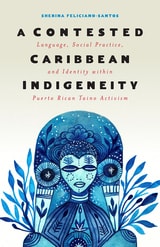
A Contested Caribbean Indigeneity
Language, Social Practice, and Identity within Puerto Rican Taíno ActivismSherina Feliciano-Santos
Rutgers University Press, 2021
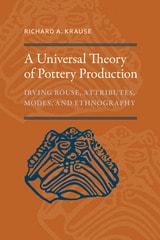
A Universal Theory of Pottery Production
Irving Rouse, Attributes, Modes, and EthnographyRichard A. Krause
University of Alabama Press, 2016
Krause posits that the careful study of an archaeological site’s ceramics can be used to formulate a step-and-stage theory of pottery production for the area. Krause’s work suggests that by comparing the results of inquiries conducted at different sites and for different times, archaeologists may be able to create a general ethnographic theory of pottery production.
Krause demonstrates this process through a comprehensive analysis of potsherds from the highly stratified Puerto Rican site of Paso del Indio. He first provides a comprehensive explanation of the archaeological concepts of attribute, mode, feature, association, site, analysis, and classification. Using these seven concepts, he categorizes the production and decorative techniques in the Paso del Indio site. Krause then applies the concept of “focal form vessels” to the site’s largest fragments to test his step-and-stage theory of production against the evidence they provide. Finally, he assigns the ceramics at Paso del Indio to previously discussed potting traditions.
Unlike other books on the subject that use statistical methods to frame basic archaeological concepts, Krause approaches these topics from the perspective of epistemology and the explicatory practices of empirical science. In A Universal Theory of Pottery Production Krause offers much of interest to North American, Caribbean, and South American archaeologists interested in the manufacture, decoration, and classification of prehistoric pottery, as well as for archaeologists interested in archaeological theory.
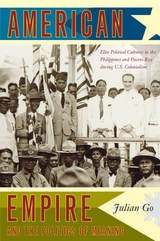
American Empire and the Politics of Meaning
Elite Political Cultures in the Philippines and Puerto Rico during U.S. ColonialismJulian Go
Duke University Press, 2007
American Empire and the Politics of Meaning is an examination of how these efforts to provide the elite of Puerto Rico and the Philippines a practical education in self-government played out on the ground in the early years of American colonial rule, from 1898 until 1912. It is the first systematic comparative analysis of these early exercises in American imperial power. The sociologist Julian Go unravels how American authorities used “culture” as both a tool and a target of rule, and how the Puerto Rican and Philippine elite received, creatively engaged, and sometimes silently subverted the Americans’ ostensibly benign intentions. Rather than finding that the attempt to transplant American-style democracy led to incommensurable “culture clashes,” Go assesses complex processes of cultural accommodation and transformation. By combining rich historical detail with broader theories of meaning, culture, and colonialism, he provides an innovative study of the hidden intersections of political power and cultural meaning-making in America’s earliest overseas empire.
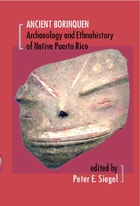
Ancient Borinquen
Archaeology and Ethnohistory of Native Puerto RicoEdited by Peter E. Siegel
University of Alabama Press, 2008
Ancient Borinquen is a re-examination of the archaeology of Puerto Rico, drawing data from beyond the boundaries of the island itself because in prehistoric times the waters between islands would not have been viewed as a boundary in the contemporary sense of the term. The last few decades have witnessed a growth of intense archaeological research on the island, from material culture in the form of lithics, ceramics, and rock art; to nutritional, architecture, and environmental studies; to rituals and social patterns; to the aftermath of Conquest.
It is unlikely that prehistoric occupants recognized the same boundaries and responded to the same political forces that operated in the formation of current nations, states, or cities. Yet, archaeologists traditionally have produced such volumes and they generally represent anchors for ongoing research in a specific region, in this case the island of Puerto Rico, its immediate neighbors, and the wider Caribbean basin.
Ancient Borinquen provides a comprehensive overview of recent thinking, new data, syntheses, and insights into current Puerto Rican archaeology, and it reflects and illuminates similar concerns elsewhere in the West Indies, lowland South America, and Central America.