Results by title
145 books match the query 'Report writing' and 14 start with a
A Minefield of Dreams
Triumphs and Travails of Independent Writing ProgramsJustin Everett
University Press of Colorado, 2017
A Pedagogy of Possibility
Bakhtinian Perspectives on Composition StudiesKay Halasek
Southern Illinois University Press, 1999
In a book that itself exemplifies the dialogic scholarship it proposes, Kay Halasek reconceives composition studies from a Bakhtinian perspective, focusing on both the discipline's theoretical assumptions and its pedagogies.
Framing her discussions at every level of the discipline—theoretical, historical, pedagogical—Halasek provides an overview of portions of the Bakhtinian canon relevant to composition studies, explores the implications of Mikhail Bakhtin's work in the teaching of writing and for current debates about the role of theory in composition studies, and provides a model of scholarship that strives to maintain dialogic balance between practice and theory, between composition studies and Bakhtinian thought.
Halasek's study ranges broadly across the field of composition, painting in wide strokes a new picture of the discipline, focusing on the finer details of the rhetorical situation, and teasing out the implications of Bakhtinian thought for classroom practice by examining the nature of critical reading and writing, the efficacy and ethics of academic discourse, student resistance, and critical and conflict pedagogy. The book ends by setting out a pedagogy of possibility, what Halasek terms elsewhere a "post-critical pedagogy" that redefines and redirects current discussions of home versus academic literacies and discourses.

A Rhetoric of Doing
Essays on Written Discourse in Honor of James L. KinneavyEdited by Stephen P. Witte, Neil Nakadate, and Roger D. Cherry
Southern Illinois University Press, 1992
Concerned with both the nature and the practice of discourse, the eighteen essays collected here treat rhetoric as a dynamic enterprise of inquiry, exploration, and application, and in doing so reflect James L. Kinneavy’s firm belief in the vital relationship between theory and practice, his commitment to a spirit of accommodation and assimilation that promotes the development of ever more powerful theories and ever more useful practices.
A thorough introduction provides the reader with clear summaries of the essays by leading-edge theorists, researchers, and teachers of writing and rhetoric. A "field context" for the ideas presented in this book is provided through the division of the various chapters into four major sections that focus on classical rhetoric and rhetorical theory in historical contexts; on dimensions of discourse theory, aspects of discourse communities, and the sorts of knowledge people access and use in producing written texts; on writing in school-related contexts; and on several dimensions of nonacademic writing. A fifth section contains a bibliographic survey and an appreciation of James Kinneavy’s work. The exceptional range of these essays makes A Rhetoric of Doing an ecumenical examination of the current state of mind in rhetoric and written communication, a survey and description of what discourse and those in the field of discourse are, in fact, doing.
A Teaching Subject
Composition Since 1966, New EditionJoseph Harris
Utah State University Press, 2012
In this classic text, Joseph Harris traces the evolution of college writing instruction since the Dartmouth Seminar of 1966. A Teaching Subject offers a brilliant interpretive history of the first decades during which writing studies came to be imagined as a discipline separable from its partners in English studies. Postscripts to each chapter in this new edition bring the history of composition up to the present.
Reviewing the development of the field through five key ideas, Harris unfolds a set of issues and tensions that continue to shape the teaching of writing today. Ultimately, he builds a case, now deeply influential in its own right, that composition defines itself through its interest and investment in the literacy work that students and teachers do together. Unique among English studies fields, composition is, Harris contends, a teaching subject.
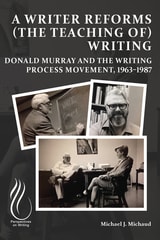
A Writer Reforms (the Teaching of) Writing
Donald Murray and the Writing Process Movement, 1963–1987Michael J. Michaud
University Press of Colorado, 2024
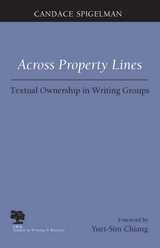
Across Property Lines
Textual Ownership in Writing GroupsCandace Spigelman
Southern Illinois University Press, 2000
Candace Spigelman investigates the dynamics of ownership in small group writing workshops, basing her findings on case studies involving two groups: a five-member creative writing group meeting monthly at a local Philadelphia coffee bar and a four-member college-level writing group meeting in their composition classroom. She explores the relationship between particular notions of intellectual property within each group as well as the effectiveness of writing groups that embrace these notions. Addressing the negotiations between the public and private domains of writing within these groups, she discovers that for both the committed writers and the novices, “values associated with textual ownership play a crucial role in writing group performance.”
Spigelman discusses textual ownership, intellectual property, and writing group processes and then reviews theories relating to authorship and knowledge making. After introducing the participants in each group, discussing their texts, and describing their workshop sessions, she examines the writers’ avowed and implied beliefs about exchanging ideas and protecting individual property rights.
Spigelman stresses the necessary tension between individual and social aspects of writing practices: She argues for the need to foster more collaborative activity among student writers by replicating the processes of writers working in nonacademic settings but also contends that all writers must be allowed to imagine their individual agency and authority as they compose.
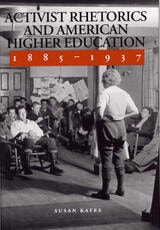
Activist Rhetorics and American Higher Education, 1885-1937
Susan Kates
Southern Illinois University Press, 2000
In this study of the history of rhetoric education, Susan Kates focuses on the writing and speaking instruction developed at three academic institutions founded to serve three groups of students most often excluded from traditional institutions of higher education in late-nineteenth-and early-twentieth-century America: white middle-class women, African Americans, and members of the working class.
Kates provides a detailed look at the work of those students and teachers ostracized from rhetorical study at traditional colleges and universities. She explores the pedagogies of educators Mary Augusta Jordan of Smith College in Northhampton, Massachusetts; Hallie Quinn Brown of Wilberforce University in Wilberforce, Ohio; and Josephine Colby, Helen Norton, and Louise Budenz of Brookwood Labor College in Katonah, New York.
These teachers sought to enact forms of writing and speaking instruction incorporating social and political concerns in the very essence of their pedagogies. They designed rhetoric courses characterized by three important pedagogical features: a profound respect for and awareness of the relationship between language and identity and a desire to integrate this awareness into the curriculum; politicized writing and speaking assignments designed to help students interrogate their marginalized standing within the larger culture in terms of their gender, race, or social class; and an emphasis on service and social responsibility.
Agents of Integration
Understanding Transfer as a Rhetorical ActRebecca S. Nowacek
Southern Illinois University Press, 2011
While many studies of transfer are longitudinal, with data collected over several years, Nowacek’s is synchronous, a rich cross-section of the writing and classroom discussions produced by a team-taught learning community—three professors and eighteen students enrolled in a one-semester general education interdisciplinary humanities seminar that consisted of three linked courses in history, literature, and religious studies. With extensive field notes, carefully selected student and teacher self-reports in the form of interviews and focus groups, and thorough examinations of recorded classroom discussions, student papers with professor comments, and student notebooks, Nowacek presents a nuanced and engaging analysis that outlines how transfer is not simply a cognitive act but a rhetorical one that involves both seeing connections and presenting them to the instructors who are institutionally positioned to recognize and value them.
Considering the challenges facing instructors teaching for transfer and the transfer of writing-related knowledge, Nowacek develops and outlines a new theoretical framework and methodological model of transfer and illustrates the practical implications through case studies and other classroom examples. She proposes transfer is best understood as an act of recontextualization, and she builds on this premise throughout the book by drawing from previous work in cognitive psychology, activity theory, and rhetorical genre theory, as well as her own analyses of student work.
This focused examination complements existing longitudinal studies and will help readers better understand not only the opportunities and challenges confronting students as they work to become agents of integration but also the challenges facing instructors as they seek to support that student work.
Appeals in Modern Rhetoric
An Ordinary Language ApproachM. Jimmie Killingsworth
Southern Illinois University Press, 2005
Appeals in Modern Rhetoric: An Ordinary-Language Approach introduces students to current issues in rhetorical theory through an extended treatment of the rhetorical appeal, a frequently used but rarely discussed concept at the core of rhetorical analysis and criticism. Shunning the standard Aristotelian approach that treats ethos, pathos, and logos as modes of appeal, M. Jimmie Killingsworth uses common, accessible language to explain the concept of the rhetorical appeal—meaning the use of language to plead and to please. The result is a practical and innovative guide to understanding how persuasion works that is suitable for graduate and undergraduate courses yet still addresses topics of current interest to specialists.
Supplementing the volume are practical and theoretical approaches to the construction and analysis of rhetorical messages and brief and readable examples from popular culture, academic discourse, politics, and the verbal arts. Killingsworth draws on close readings of primary texts in the field, referencing theorists to clarify concepts, while he decodes many of the basic theoretical constructs common to an understanding of identification. Beginning with examples of the model of appeals in social criticism, popular film, and advertising, he covers in subsequent chapters appeals to time, place, the body, gender, and race. Additional chapters cover the use of common tropes and rhetorical narrative, and each chapter begins with definitions of key concepts.
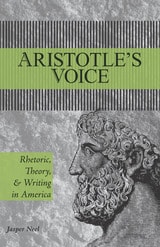
Aristotle's Voice
Rhetoric, Theory, and Writing in AmericaJasper Neel
Southern Illinois University Press, 1994
In this book, Jasper Neel’s sure-to-be-controversial resituating of Aristotle centers around three questions that have been constants in his twenty-two years of teaching experience: What does itmean to teach writing? What should one know before teaching writing? And, if there is such a thing as "research in the teaching of writing," what is it?
Believing that all composition teachers are situated politically and socially, both as part of the institution in which they teach and as beings with lived histories, Neel examines his own life and the life of composition studies as a discipline in the context of Aristotle. Neel first situates the Rhetoric as a political document; he then situates the Rhetoric in the Aristotelian system and describes how professional discourse came to know itself through Aristotle’s way of studying the world; finally, he examines the operation of the Rhetoric inside itself before arguing the need to turn to Aristotle’s notion of sophistry as a way of negating his system.
By pointing out the connections among Aristotelian rhetoric, the contemporary university, and the contemporary writing teacher, Neel shows that Aristotle’s frightening social theories are as alive today as are Aristotelian notions of discourse.
Neel explains that by their very nature teachers must speak with a professional voice. It is through showing how to "hear" one’s professional voice that Neel explores the notion of professional discourse that originates with Aristotle. In maintaining that one must pay a high price in order to speak through Aristotle’s theory or to assume the role of "professional," he argues that no neutral ground exists either for pedagogy or for the analysis of pedagogy. Neel concludes this discussion by proposing that Aristotelian sophistry is both an antidote to Aristotelian racism, sexism, and bigotry and a way of allowing Aristotelian categories of discourse to remain useful.
Finally, as an Aristotelian, a teacher, and a writer, Neel responds both to Aristotle and to professionalism by rethinking the influence of the past and reviving the voice of Aristotelian sophistry.
Assessing the Teaching of Writing
Twenty-First Century Trends and TechnologiesAmy E. Dayton
Utah State University Press, 2015
Although fraught with politics and other perils, teacher evaluation can contribute in important, positive ways to faculty development at both the individual and the departmental levels. Yet the logistics of creating a valid assessment are complicated. Inconsistent methods, rater bias, and overreliance on student evaluation forms have proven problematic. The essays in Assessing the Teaching of Writing demonstrate constructive ways of evaluating teacher performance, taking into consideration the immense number of variables involved.
Contributors to the volume examine a range of fundamental issues, including the political context of declining state funds in education; growing public critique of the professoriate and demands for accountability resulting from federal policy initiatives like No Child Left Behind; the increasing sophistication of assessment methods and technologies; and the continuing interest in the scholarship of teaching. The first section addresses concerns and advances in assessment methodologies, and the second takes a closer look at unique individual sites and models of assessment. Chapters collectively argue for viewing teacher assessment as a rhetorical practice.
Fostering new ways of thinking about teacher evaluation, Assessing the Teaching of Writing will be of great interest not only to writing program administrators but also to those concerned with faculty development and teacher assessment outside the writing program.
Assignments across the Curriculum
A National Study of College WritingDan Melzer
Utah State University Press, 2014
In Assignments across the Curriculum, Dan Melzer analyzes the rhetorical features and genres of writing assignments through the writing-to-learn and writing-in-the-disciplines perspectives. Presenting the results of his study of 2,101 writing assignments from undergraduate courses in the natural sciences, social sciences, business, and humanities in 100 postsecondary institutions in the United States, Assignments across the Curriculum is unique in its cross-institutional breadth and its focus on writing assignments.
The results provide a panoramic view of college writing in the United States. Melzer's framework begins with the rhetorical situations of the assignments—the purposes and audiences—and broadens to include the assignments' genres and discourse community contexts. Among his conclusions is that courses connected to a writing-across-the-curriculum (WAC) initiative ask students to write more often, in a greater variety of genres, and for a greater variety of purposes and audiences than non-WAC courses do, making a compelling case for the influence of the WAC movement.
Melzer's work also reveals patterns in the rhetorical situations, genres, and discourse communities of college writing in the United States. These larger patterns are of interest to WAC practitioners working with faculty across disciplines, to writing center coordinators and tutors working with students who bring assignments from a variety of fields, to composition program administrators, to first-year writing instructors interested in preparing students for college writing, and to high school teachers attempting to bridge the gap between high school and college writing.
Audience Expectations and Teacher Demands
Robert Brooke and John Hendricks
Southern Illinois University Press, 1989
The audience—the community of readers who will use the texts a writer produces—must be an important influence on the writer for his or her work to be effective.
Robert Brooke and John Hendricks examine the difficult task of teaching "writing for an audience" in a classroom where students know that the teacher, not the addressed audience, assigns the grade.
The authors describe in detail a particular writing class, taught by Brooke and observed by Hendricks, that attempted to teach writing for an audience. By combining the experiences from their study with student reactions to the class, they draw some conclusions about the dynamics of teaching writing and about learning in general.
Authoring
An Essay for the English Profession on Potentiality and SingularityJanis Haswell and Richard Haswell
Utah State University Press, 2010