Results by title
111 books match the query 'Science Fiction' and 10 start with a

A Perfect Vacuum
Stanislaw Lem
Northwestern University Press, 1999
Beginning with a review of his own book, Lem moves on to tackles (or create pastiches of) the French new novel, James Joyce, pornography, authorless writing, and Dostoevsky, while at the same time ranging across scientific topics, from cosmology to the pervasiveness of computers. The result is a metafictional tour de force by one of the world's most popular writers.
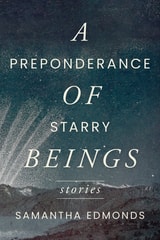
A Preponderance of Starry Beings
StoriesSamantha Edmonds
Northwestern University Press, 2025
Genre-bending stories of the cosmos and the worlds within our own skin
Blending fairy tale and science fiction with the otherworldliness of adolescence, A Preponderance of Starry Beings is a collection for anyone preoccupied with looking skyward. These stories probe the experience of coming of age on the outskirts of the universe, whether that be a small Midwestern town or a distant galaxy, and of weighing earthly obligations against the vast promises of space.
In a sleepy Ohio neighborhood, two girls seek refuge from their homophobic schoolmates in an antiques shop filled with Star Trek memorabilia. On a generation spaceship, children revolt against their parents’ plans to colonize a distant world. Deep in the Florida Everglades, seven sisters must protect their otherworldly mythology when two men arrive to fix the family automobile.
A Preponderance of Starry Beings invites us into a mundane and whimsical world of night islands, small towns, and faith lost and found, where a safe landing matters less than taking the leap.
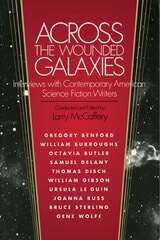
Across the Wounded Galaxies
Interviews with Contemporary American Science Fiction WritersConducted and edited by Larry McCaffery
University of Illinois Press, 1990
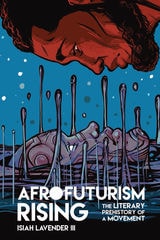
Afrofuturism Rising
The Literary Prehistory of a MovementIsiah Lavender III
The Ohio State University Press, 2019
By engaging with authors as diverse as Phillis Wheatley, David Walker, Frederick Douglass, Harriet Ann Jacobs, Samuel R. Delany Jr., Pauline Hopkins, Zora Neale Hurston, and Richard Wright, Afrofuturism Rising extends existing scholarly conversations about who creates and what is created via science fiction. Through a trans-historical rereading of texts by these authors as science fiction, Lavender highlights the ways black experience in America has always been an experience of spatial and temporal dislocation akin to science fiction. Compelling and ambitious in scope, Afrofuturism Rising redefines both science fiction and literature as a whole.

After Capitalism
Science Fiction and the End of the End of the WorldJo Lindsay Walton
Lever Press, 2027
In After Capitalism, Jo Lindsay Walton uses speculative fiction to tackle some of the largest, most urgent, and strangest political questions of our time. Is climate science itself a speculative practice, even as it conveys some of the hardest facts we know? Does the end of capitalism require the end of money, or might money mutate into something new—a currency based on time, labor or reputation? As AI threatens to take over more aspects of social life, might we think of money itself as a kind of AI, one that could be reprogrammed? Why do ecological forms of calculation—from real world carbon credits to speculative energy currencies—fail to protect the planet that sustains us?
Drawing on the works of Edward Bellamy, Octavia Butler, Samuel R. Delany, Cory Doctorow, Ursula K. Le Guin, Yoon Ha Lee, Karen Lord, Malka Older, Nnedi Okorafor, Marge Piercy, Adam Roberts, Joanna Russ, Wole Talabi, and more, Walton explores whether science fiction can create space for fugitive dreams to thrive, or whether it serves merely as a laboratory for capitalism’s own reinvention.Weaving together literary criticism, critical political economy, and perspectives from the environmental humanities, After Capitalism argues that the worlds beyond capitalism are neither unimaginable nor entirely elsewhere.
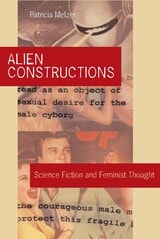
Alien Constructions
Science Fiction and Feminist ThoughtBy Patricia Melzer
University of Texas Press, 2006
Though set in other worlds populated by alien beings, science fiction is a site where humans can critique and re-imagine the paradigms that shape this world, from fundamentals such as the sex and gender of the body to global power relations among sexes, races, and nations. Feminist thinkers and writers are increasingly recognizing science fiction's potential to shatter patriarchal and heterosexual norms, while the creators of science fiction are bringing new depth and complexity to the genre by engaging with feminist theories and politics. This book maps the intersection of feminism and science fiction through close readings of science fiction literature by Octavia E. Butler, Richard Calder, and Melissa Scott and the movies The Matrix and the Alien series.
Patricia Melzer analyzes how these authors and films represent debates and concepts in three areas of feminist thought: identity and difference, feminist critiques of science and technology, and the relationship among gender identity, body, and desire, including the new gender politics of queer desires, transgender, and intersexed bodies and identities. She demonstrates that key political elements shape these debates, including global capitalism and exploitative class relations within a growing international system; the impact of computer, industrial, and medical technologies on women's lives and reproductive rights; and posthuman embodiment as expressed through biotechnologies, the body/machine interface, and the commodification of desire. Melzer's investigation makes it clear that feminist writings and readings of science fiction are part of a feminist critique of existing power relations—and that the alien constructions (cyborgs, clones, androids, aliens, and hybrids) that populate postmodern science fiction are as potentially empowering as they are threatening.

Aliens
An Anthropology of Science FictionEdited by George E. Slusser and Eric S. Rabkin
Southern Illinois University Press, 1987
How and when does there come to be an “anthropology of the alien?” This set of essays, written for the eighth J. Lloyd Eaton Conference on Fantasy and Science Fiction, is concerned with the significance of that question. “[Anthropology] is the science that must designate the alien ifit is to redefine a place for itself in the universe,” according to the Introduction.
The idea of the alien is not new. In the Renaissance, Montaigne’s purpose in describing an alien encounter was excorporation—mankind was the “savage” because the artificial devices of nature controlled him. Shakespeare’s version of the alien encounter was incorporation; his character of Caliban is brought to the artificial, political world of man and incorporated into the body politic
“The essays in this volume . . . show, in their general orientation, that the tribe of
This book is divided into three parts: “Searchings: The Quest for the Alien” includes “The Aliens in Our Mind,” by Larry Niven; “Effing the Ineffable,” by Gregory Benford; “Border Patrols,” by Michael Beehler; “Alien Aliens,” by Pascal Ducommun; and “Metamorphoses of the Dragon,” by George E. Slusser.
“Sightings: The Aliens among Us” includes “Discriminating among Friends,” by John Huntington; “Sex, Superman, Sociobiology,” by Joseph D. Miller; “Cowboys and Telepaths,” by Eric S. Rabkin; “Robots,” by Noel Perrin; “Aliens in the Supermarket,” by George R. Guffey; and “Aliens ‘R’ U.S.,” by Zoe Sofia.
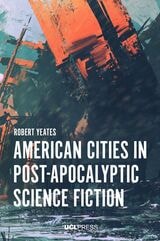
American Cities in Post-Apocalyptic Science Fiction
Robert Yeates
University College London, 2021
American Cities in Post-Apocalyptic Science Fiction traces the image of urban ruins across twentieth- and twenty-first-century American media. Surveying pulp magazines, radio dramas, films, video games, and the transmedia franchise, Robert Yeates explores how the synergy of technological innovation and artistic vision created an increasingly immersive space to reimagine the urban future. Through a series of medium-specific case studies, Yeates offers provocative new readings of familiar works such as Blade Runner and The Walking Dead situated against a fresh history of ruined cities in American literature.

Artificial Paradise
Science Fiction and American RealitySharona Ben-Tov
University of Michigan Press, 1995
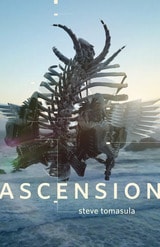
Ascension
A NovelSteve Tomasula
University of Alabama Press, 2022
A visually stunning narrative of three eras in humankind’s vexed relationship with nature.
Ascension is a novel about the end of nature, or rather, the end of three “natures”: the time just before Darwin changed the natural world; the 1980s, just as the digital and genetic revolutions begin to replace “nature” with “environment”; and today, a time when we have the ability to manipulate nature at both the scale of the planet and at the genome. The narrative follows three different biologists on the brink of each of these cultural extinctions to explore how nature occupies our imaginations and how our imaginations bring the natural world, and our place in it, into existence.
Ascension is a story of how we continually remake the world and are in turn remade by the new nature we’ve created. It is the story of humans yearning to understand their families, themselves, and the world they live in as it comes to a close, leaving them to anticipate what will follow. Rich in visual depictions of the natural world—from nineteenth century engraving and paintings to twentieth century photography and twenty-first century databases—Ascension uses the materials of three eras to drive home our inability to escape nature, and the ways our fates are irrevocably bound together even as our actions usher in an end-time.