Results by title
67 books match the query 'Segregation' and 6 start with a
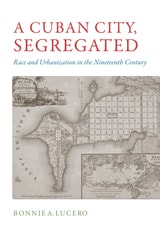
A Cuban City, Segregated
Race and Urbanization in the Nineteenth CenturyBonnie A. Lucero
University of Alabama Press, 2019
Founded as a white colony in 1819, Cienfuegos, Cuba, quickly became home to people of African descent, both free and enslaved, and later a small community of Chinese and other immigrants. Despite the racial, ethnic, and cultural diversity that defined the city’s population, the urban landscape was characterized by distinctive racial boundaries, separating the white city center from the heterogeneous peripheries. A Cuban City, Segregated: Race and Urbanization in the Nineteenth Century explores how the de facto racial segregation was constructed and perpetuated in a society devoid of explicitly racial laws.
Drawing on the insights of intersectional feminism, Bonnie A. Lucero shows that the key to understanding racial segregation in Cuba is recognizing the often unspoken ways specifically classed notions and practices of gender shaped the historical production of race and racial inequality. In the context of nineteenth-century Cienfuegos, gender, race, and class converged in the concept of urban order, a complex and historically contingent nexus of ideas about the appropriate and desired social hierarchy among urban residents, often embodied spatially in particular relationships to the urban landscape.
As Cienfuegos evolved subtly over time, the internal logic of urban order was driven by the construction and defense of a legible, developed, aesthetically pleasing, and, most importantly, white city center. Local authorities produced policies that reduced access to the city center along class and gendered lines, for example, by imposing expensive building codes on centric lands, criminalizing poor peoples’ leisure activities, regulating prostitution, and quashing organized labor. Although none of these policies mentioned race outright, this new scholarship demonstrates that the policies were instrumental in producing and perpetuating the geographic marginality and discursive erasure of people of color from the historic center of Cienfuegos during its first century of existence.
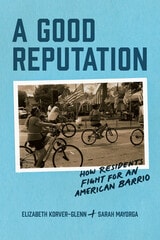
A Good Reputation
How Residents Fight for an American BarrioElizabeth Korver-Glenn and Sarah Mayorga
University of Chicago Press, 2024
Neighborhoods have the power to form significant parts of our worlds and identities. A neighborhood’s reputation, however, doesn’t always match up to how residents see themselves or wish to be seen. The distance between residents’ desires and their environment can profoundly shape neighborhood life.
In A Good Reputation, sociologists Elizabeth Korver-Glenn and Sarah Mayorga delve into the development and transformation of the reputation of Northside, a predominantly Latinx barrio in Houston. Drawing on two years of ethnographic research and in-depth interviews with residents, developers, and other neighborhood stakeholders, the authors show that people’s perceptions of their neighborhoods are essential to understanding urban inequality and poverty. Korver-Glenn and Mayorga’s empirically detailed account of disputes over neighborhood reputation helps readers understand the complexity of high-poverty urban neighborhoods, demonstrating that gentrification is a more complicated and irregular process than existing accounts of urban inequality would suggest. Offering insightful theoretical analysis and compelling narrative threads from understudied communities, A Good Reputation will yield insights for scholars of race and ethnicity, urban planning, and beyond.
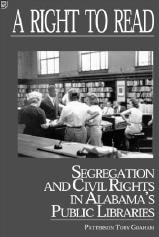
A Right to Read
Segregation and Civil Rights in Alabama's Public Libraries, 1900–1965Patterson Toby Graham
University of Alabama Press, 2006
This original and significant contribution to the historiography of the civil rights movement and education in the South details a dramatic and disturbing chapter in American cultural history.
The tradition of American public libraries is closely tied to the perception that these institutions are open to all without regard to social background. Such was not the case in the segregated South, however, where public libraries barred entry to millions of African Americans and provided tacit support for a culture of white supremacy. A Right to Read is the first book to examine public library segregation from its origins in the late 19th century through its end during the tumultuous years of the 1960s civil rights movement. Graham focuses on Alabama, where African Americans, denied access to white libraries, worked to establish and maintain their own "Negro branches." These libraries-separate but never equal-were always underfunded and inadequately prepared to meet the needs of their constituencies.
By 1960, however, African Americans turned their attention toward desegregating the white public libraries their taxes helped support. They carried out "read-ins" and other protests designed to bring attention and judicial pressure upon the segregationists. Patterson Toby Graham contends that, for librarians, the civil rights movement in their institutions represented a conflict of values that pitted their professional ethics against regional mores. He details how several librarians in Alabama took the dangerous course of opposing segregationists, sometimes with unsettling results.
This groundbreaking work built on primary evidence will have wide cross-disciplinary appeal. Students and scholars of southern and African-American history, civil rights, and social science, as well as academic and public librarians, will appreciate Graham's solid research and astute analysis.
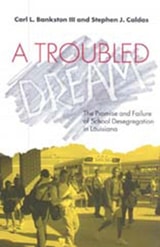
A Troubled Dream
The Promise and Failure of School Desegregation in LouisianaCarl L. Bankston
Vanderbilt University Press, 2002
Winner, Louisiana Literary Award 2003
Fifty years after Brown v. Board of Education, the United States still has a long way to go to attain true integration of our educational system.
Using extensive interviews and a wealth of statistical information, Bankston and Caldas examine the failed desegregation efforts in Louisiana as a case study to show how desegregation has followed the same unsuccessful pattern across the United States. Strong supporters of the dream of integration, Bankston and Caldas show that the practical difficulty with desegregation is that academic environments are created by all the students in a school from the backgrounds that all the students bring with them. Unfortunately, the disadvantages that minority children have to overcome affect schools more than schools can help remedy these disadvantages.
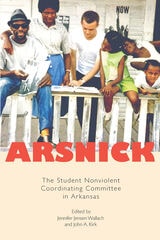
Arsnick
The Student Nonviolent Coordinating Committee in ArkansasJennifer Jensen Wallach
University of Arkansas Press, 2011
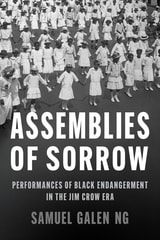
Assemblies of Sorrow
Performances of Black Endangerment in the Jim Crow EraSamuel Galen Ng
University of Illinois Press, 2026
Samuel Galen Ng illuminates this Black consciousness as it emanated from feelings of collective endangerment. The dissemination and intensification of such feelings became a pivotal way of solidifying a national Black consciousness on the eve of the Civil Rights Movement. Ng examines how performances of Black endangerment performed political work that provided Black people with important means of political organizing and insurgency. As Ng shows, the grief and mourning that took place at the performances provided public spaces for individuals and communities to observe specific losses capable of impacting Americans across the country.
Ambitious and interdisciplinary, Assemblies of Sorrow explores an overlooked facet of Black organizing and protest and traces how activists shaped fear and grief into political action.