Results by title
53 books match the query 'Statesmen' and 7 start with a
A Thomas More Source Book
Gerard B. Wegemer
Catholic University of America Press, 2004
Abraham Lincoln, Statesman Historian
Jesse Derber
University of Illinois Press, 2024
Abraham Lincoln drew upon history in his political career and particularly when crafting the rhetorical masterpieces that still resonate in the present day. Jesse Derber explores how Lincoln’s views of the limits of human understanding drove a belief in--and untiring pursuit of--historical truth.
Lincoln embraced the traditional ideas that good history made good statesmanship and that an understanding of the past informed decision-making in the present. Seeing history as a source of wisdom, Lincoln strove for accuracy through a combination of research, reasoning ability, emotional maturity, and a willingness to admit his mistakes and challenge his biases. His philosophy flowed from an idea that authentic history could enlighten people about human nature. Though he revered precedents, Lincoln understood the past could be imperfect, and that progress through change was an ineffable part of building a better nation.
Perceptive and revealing, Abraham Lincoln, Statesman Historian looks at how the Lincoln practiced history and applied its lessons to politics and leadership.
Acheson and Empire
The British Accent in American Foreign PolicyJohn T. McNay
University of Missouri Press, 2001
Acheson and Empire offers a compelling reassessment of Dean Acheson's policies toward the former colonial world during his period as secretary of state from 1949 to 1953. John T. McNay argues that Acheson inherited through his own personal history a way of understanding the world that encouraged imperial-style international relationships. This worldview represented a well-developed belief system rooted in his Ulster Protestant heritage that remained consistent throughout his life.
By exploring relationships of the United States with Britain and countries formerly or then controlled by Britain, such as India, Ireland, Iran, and Egypt, McNay shows the significance of Acheson's beliefs. McNay argues that Acheson's support of existing imperial relationships was so steadfast that it often led other nations to perceive that the United States was nothing more than a front for British interests. He believes this approach to foreign policy damaged American relations with emerging countries and misled the British regarding possibilities of an Anglo-American partnership.
Acheson and Empire contends that the widely accepted view of Acheson as a foreign policy realist is misleading and that historians should acknowledge that his affinity for the British Empire went beyond his clothing and mannerisms. McNay maintains that the widely accepted view of Acheson as one of a group of "wise men" who shaped the Cold War world by basing their decisions on cold calculation of American interests should be reconsidered.
Drawing from extensive research in archival sources, including the Truman Library, the National Archives, the Public Record Office in London, and Acheson's personal papers at Yale, Acheson and Empire offers a fresh look at Dean Acheson that runs counter to previous biographies and many histories of the Cold War.
Aleksandur Stamboliiski
BulgariaRichard Crampton
Haus Publishing, 2009
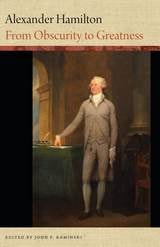
Alexander Hamilton
From Obscurity to GreatnessJohn P. Kaminski
Wisconsin Historical Society Press, 2016
Editor John P. Kaminski has gathered a remarkable collection of quotations by and about Alexander Hamilton that paint for us a nuanced portrait of a complex man. Through his own words and the words of his contemporaries -- including the man who killed him in a duel, Aaron Burr -- we can gain a better understanding of this fascinating man who rose from anonymity on a small Caribbean island to the corridors of power.
An Imaginative Whig
Reassessing the Life and Thought of Edmund BurkeEdited & Intro by Ian Crowe
University of Missouri Press, 2005
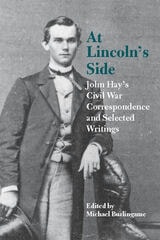
At Lincoln's Side
John Hay's Civil War Correspondence and Selected WritingsEdited by Michael Burlingame
Southern Illinois University Press, 2006
John Hay believed that “real history is told in private letters,” and the more than 220 surviving letters and telegrams from his Civil War days prove that to be true, showing Abraham Lincoln in action: “The Tycoon is in fine whack. I have rarely seen him more serene & busy. He is managing this war, the draft, foreign relations, and planning a reconstruction of the Union, all at once. I never knew with what tyrannous authority he rules the Cabinet, till now. The most important things he decides & there is no cavil.”
Along with Hay’s personal correspondence, Burlingame includes his surviving official letters. Though lacking the “literary brilliance of [Hay’s] personal letters,” Burlingame explains, “they help flesh out the historical record.” Burlingame also includes some of the letters Hay composed for Lincoln’s signature, including the celebrated letter of condolence to the Widow Bixby.
More than an inside glimpse of the Civil War White House, Hay’s surviving correspondence provides a window on the world of nineteenth-century Washington, D.C.