Results by title
73 books match the query 'Strategy' and 5 start with a
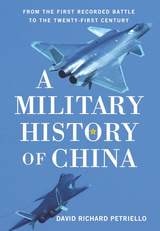
A Military History of China
From the First Recorded Battles to the Twenty-First CenturyDavid Richard Petriello
Westholme Publishing, 2018
The twenty-first century has been labeled the “Pacific Century,” both in terms of economics as well as military affairs. While South Korea and Japan have stagnated in these aspects, the growth of China since 1980 is unprecedented in modern history. While its economic achievements are both well known and studied, the rapid development of its military is not. In A Military History of China: From the First Recorded Battle to the Twenty-First Century, historian David Richard Petriello provides the first English language account of China’s martial history. China’s military prowess extends across the centuries, and includes the invention or first use of gunpowder, landmines, rocket launchers, armored cavalry, repeating crossbows, multistage rockets, and chemical weapons—in many cases, long before the West.
Illustrated with more than one hundred maps and figures, the book traces the general military history of China from the Neolithic Age to the present day. Particular attention is paid to specific battles, military thinkers, the impact of geography on warfare in China, and the role played by technology. Likewise, the work examines the underlying philosophy of why China goes to war. Because China’s military weakness over the past two centuries compared to the West has given a false sense of China’s potential, a thorough knowledge of the men, battles, tactics, geography, strategies, philosophy, and experiences of war throughout Chinese history are vital to prepare students, scholars, soldiers, and politicians for the return of China as a major innovative and global military power.
Air Power and Armies
Sir John Cotesworth Slessor, and foreword by Phillip Meilinger
University of Alabama Press, 2009
An account of Sir John Cotesworth Slessor (1897–1979), one of Great Britain's most influential airmen.
Sir John Slessor played a significant role in building the World War II Anglo-American air power partnership as an air planner on the Royal Air Force Staff, the British Chiefs of Staff, and the Combined Chiefs of Staff. He coordinated allied strategy in 1940–41, helped create an Anglo-American bomber alliance in 1942, and drafted the compromise at the Casablanca Conference that broke a deadlock in Anglo-American strategic debate.
Slessor was instrumental in defeating the U-boat menace as RAF Coastal Commander, and later shared responsibility for directing Allied air operations in the Mediterranean. Few aspects of the allied air effort escaped his influence: pilot training, aircraft procurement, and dissemination of operational intelligence and information all depended to a degree on Slessor. His influence on Anglo-American operational planning paved the way for a level of cooperation and combined action never before undertaken by the military forces of two great nations.
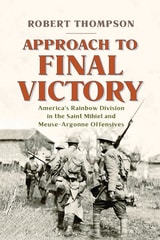
Approach to Final Victory
America's Rainbow Division in the Saint Mihiel and Meuse-Argonne OffensivesRobert Thompson
Westholme Publishing, 2023
Approach to Final Victory: America's Rainbow Division in the Saint Mihiel and Meuse-Argonne Offensives by historian Robert Thompson, chronicles the efforts of the Rainbow Division during these final two Allied offensives that were key to the ultimate Allied victory. Based on letters, journals, action reports, and unit histories, the challenges, set-backs, and accomplishments of the division stand as a fitting symbol of American valor and sacrifice during the “war to end all wars.”
Arise
Power, Strategy and Union ResurgenceJane Holgate
Pluto Press, 2021
'Jane Holgate is a brilliant thinker' - Jane McAlevey
In Arise, Jane Holgate argues that unions must revisit their understanding of power in order to regain influence and confront capital. Drawing on two decades of research and organizing experience, Holgate examines the structural inertia of today’s unions from a range of perspectives: from strategic choice, leadership and union democracy to politics, tactics and the agency afforded to rank-and-file members.
In the midst of a neoliberal era of economic crisis and political upheaval, the labor movement stands at a crossroads. Union membership is on the rise, but the ‘turn to organizing’ has largely failed to translate into meaningful gains for workers. There is considerable discussion about the lack of collectivism among workers due to casualization, gig work and precarity, yet these conditions were standard in the UK when workers built the foundations of the 19th-century trade union movement.
Drawing on history and case studies of unions developing and using power effectively, this book offers strategies for moving beyond the pessimism that prevails in much of today’s union movement. By placing power analysis back at the heart of workers’ struggle, Holgate shows us that transformational change is not only possible, but within reach.