Results by title
72 books match the query 'Survival' and 4 start with a
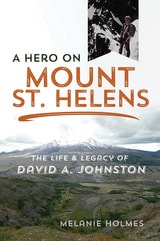
A Hero on Mount St. Helens
The Life and Legacy of David A. JohnstonMelanie Holmes. Foreword by Jeff Renner
University of Illinois Press, 2019
Melanie Holmes tells the story of Johnston's journey from a nature-loving Boy Scout to a committed geologist. Blending science with personal detail, Holmes follows Johnston through his encounters with Aleutian volcanoes, his work helping the Portuguese government assess the geothermal power of the Azores, and his dream job as a volcanologist with the U.S. Geological Survey. Interviews and personal writings reveal what a friend called “the most unjaded person I ever met,” an imperfect but kind and intelligent young scientist passionately in love with his life and work and determined to make a difference.
A Jewish Kapo in Auschwitz
History, Memory, and the Politics of SurvivalTuvia Friling
Brandeis University Press, 2014
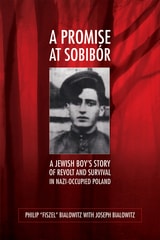
A Promise at Sobibór
A Jewish Boy’s Story of Revolt and Survival in Nazi-Occupied PolandPhilip “Fiszel” Bialowitz, with Joseph Bialowitz; Foreword by Wladyslaw Bartoszewski
University of Wisconsin Press, 2012
A Promise at Sobibór is the story of Fiszel Bialowitz, a teenaged Polish Jew who escaped the Nazi gas chambers. Between April 1942 and October 1943, about 250,000 Jews from European countries and the Soviet Union were sent to the Nazi death camp at Sobibór in occupied Poland. Sobibór was not a transit camp or work camp: its sole purpose was efficient mass murder. On October 14, 1943, approximately half of the 650 or so prisoners still alive at Sobibór undertook a daring and precisely planned revolt, killing SS officers and fleeing through minefields and machine-gun fire into the surrounding forests, farms, and towns. Only about forty-two of them, including Fiszel, are known to have survived to the end of the war.
Philip (Fiszel) Bialowitz, now an American citizen, tells his eyewitness story here in the real-time perspective of his own boyhood, from his childhood before the war and his internment in the brutal Izbica ghetto to his harrowing six months at Sobibór—including his involvement in the revolt and desperate mass escape—and his rescue by courageous Polish farmers. He also recounts the challenges of life following the war as a teenaged displaced person, and his eventual efforts as a witness to the truth of the Holocaust.
In 1943 the heroic leaders of the revolt at Sobibór, Sasha Perchersky and Leon Feldhendler, implored fellow prisoners to promise that anyone who survived would tell the story of Sobibór: not just of the horrific atrocities committed there, but of the courage and humanity of those who fought back. Bialowitz has kept that promise.
Best Books for General Audiences, selected by the American Association for School Libraries
Best Books for High Schools, selected by the American Association for School Libraries
Best Books for Special Interests, selected by the Public Library Association
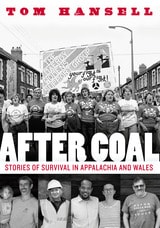
After Coal
Stories of Survival in Appalachia and WalesTom Hansell
West Virginia University Press, 2018
What happens when fossil fuels run out? How do communities and cultures survive?
Central Appalachia and south Wales were built to extract coal, and faced with coal’s decline, both regions have experienced economic depression, labor unrest, and out-migration. After Coal focuses on coalfield residents who chose not to leave, but instead remained in their communities and worked to build a diverse and sustainable economy. It tells the story of four decades of exchange between two mining communities on opposite sides of the Atlantic, and profiles individuals and organizations that are undertaking the critical work of regeneration.
The stories in this book are told through interviews and photographs collected during the making of After Coal, a documentary film produced by the Center for Appalachian Studies at Appalachian State University and directed by Tom Hansell. Considering resonances between Appalachia and Wales in the realms of labor, environment, and movements for social justice, the book approaches the transition from coal as an opportunity for marginalized people around the world to work toward safer and more egalitarian futures.