71 books match the query 'Textbooks for foreign speakers' and 10 start with a
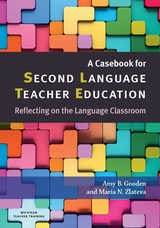
cover of A Casebook for Second Language Teacher Education: Reflecting on the Language Classroom

A Casebook for Second Language Teacher Education

Reflecting on the Language Classroom

Amy B. Gooden and Maria N. Zlateva

University of Michigan Press, 2018

This volume offers a series of actual dilemmas within language classrooms that are designed to promote reflection and discussion.  It applies the case-based pedagogy often used in business and other fields to that of second language teacher education to encourage pre- and in-service teachers to grapple with the types of dilemmas and decisions teachers confront every day. Case-based pedagogy resists simple resolutions and easy answers; the activities that precede and follow each case are designed to stimulate analysis and discussion and allow users to draw on theoretical foundations while making critical practical connections.
 
The cases represent a range of classroom contexts: K–12 ESL/sheltered English immersion, modern foreign language, and post-secondary EAP; private, charter, and public schools; and urban and suburban settings.  The book is ideally suited to College/School of Education and MA TESOL courses but will also be useful in professional development workshops for all types of language teachers. 
 
[more]
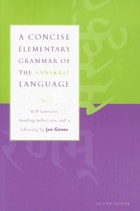
cover of A Concise Elementary Grammar of the Sanskrit Language

A Concise Elementary Grammar of the Sanskrit Language

Jan Gonda

University of Alabama Press, 2006
A standard course book for students of linguistics.
[more]
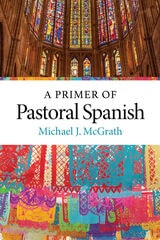
cover of A Primer of Pastoral Spanish

A Primer of Pastoral Spanish

Michael J. McGrath

Catholic University of America Press, 2022
A Primer of Pastoral Spanish is designed to provide clergy, religious and laity alike with the tools to be pastoral among Spanish-speaking people. This primer is modeled after Madrigal’s Magic Key to Spanish (1953), whose author, Margarita Madrigal, bases her methodology on creating with the language instead of memorizing it. Previous knowledge of Spanish is not necessary, although, as you will discover, you already know thousands of words in Spanish. The vocabulary you know in English is the foundation on which you can build your knowledge of Spanish vocabulary. There are thousands of English words that become Spanish words if you can recognize the slight change that takes place from one language to the other. For example, you will learn how to conjugate a verb in Spanish to the first-person singular of the past tense by dropping a letter from its translation in English and adding an accent. There are 40 units in this primer. If you were to study each unit 30 minutes a day throughout Lent, for example, think about how far you could progress. Each unit consists of four sections: Vocabulary, Prayer or Culture, Cornerstones, and Vocabulary Review. There are four Check Your Progress units. These present more Challenges based on the grammar, vocabulary, and culture you learned in the previous units. The answers to the Challenges are at the end of these units.
[more]
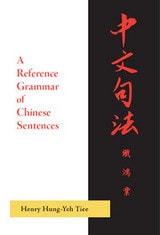
cover of A Reference Grammar of Chinese Sentences with Exercises

A Reference Grammar of Chinese Sentences with Exercises

Henry Hung-Yeh Tiee

University of Arizona Press, 1986
Begins with simple single-word-subject and simple-predicate sentences and moves systematically to transformed simple sentences and finally to compound and complex sentences. Each sentence structure is not only descriptively analyzed, but also formulated in a pedagogical pattern with examples. Exercises are provided in each unit.
[more]
cover of A Sourcebook for Ancient Greek: Grammar, Poetry, and Prose

A Sourcebook for Ancient Greek

Grammar, Poetry, and Prose

John Tomarchio

Catholic University of America Press, 2022
This book was designed for students transitioning from the study of Greek grammar to translation of texts. It was developed in classroom use for classroom use, in the context of an integrated Great Books program in liberal arts and sciences. It is meant for students not only of Classics, but more, for students of Humanities interested in direct engagement of primary sources. Each Greek text offered for translation was chosen for its theoretical interest as well as the interest of its Greek. The selections of Greek literature offered in this Sourcebook are wide-ranging. The indisputable standard of excellence for classicists is of course the Attic dialect of Athens in its glory. However, this Sourcebook is meant for students of liberal arts and sciences whose interests range far more widely. Thus, it does not hesitate to extend not only backward to the archaic Greek of Homer, but also forward to the koine Greek of the Alexandrian and Roman empires. Greek works were chosen for being seminal to Western thinking today, chosen to give students of Western arts and sciences introductions to its Greek sources Naturally, Greek grammar is taught to the newcomer analytically and sequentially, but the continuing student needs to synthesize these distended enumerations of elements and principles. Accordingly, grammatical synopses are not appended as reference tables but placed front and center as objects of study. The grammar tables offer synoptic views of integral parts of Greek grammar to show the form and logic of the whole part of speech or part of a sentence. On the basis of these tables, detailed grammatical notes and commentary appended to Greek selections that follow are tailored for continuing students.
[more]
cover of Academic Writing for Graduate Students, 3rd Edition: Essential Tasks and Skills

Academic Writing for Graduate Students, 3rd Edition

Essential Tasks and Skills

John M. Swales & Christine B. Feak

University of Michigan Press, 2012

Like its predecessor, the third edition of Academic Writing for Graduate Students explains understanding the intended audience, the purpose of the paper, and academic genres; includes the use of task-based methodology, analytic group discussion, and genre consciousness-raising; shows how to write summaries and critiques; features Language Focus sections that address linguistic elements as they affect the wider rhetorical objectives; and helps students position themselves as junior scholars in their academic communities.

Among the many changes in the third edition:
*newer, longer, and more authentic texts and examples
*greater discipline variety in texts (added texts from hard sciences and engineering)
*more in-depth treatment of research articles
*greater emphasis on vocabulary issues
*revised flow-of-ideas section
*additional tasks that require students to do their own research
*more corpus-informed content
*binding that allows the book to lay flat when open.

The Commentary (teacher's notes and key) (978-0-472-03506-9) has been revised expanded. 
[more]
cover of American Legal English, 2nd Edition: Using Language in Legal Contexts

American Legal English, 2nd Edition

Using Language in Legal Contexts

Debra S. Lee, J.D., Charles Hall, and Susan M. Barone

University of Michigan Press, 2012

Law is a profession that requires the ability to read critically, write well, synthesize sources from research, and speak concisely and clearly. American Legal English was developed to help non-native speakers improve their ability to understand and communicate in English with their legal counterparts around the world. The text is an introduction to basic legal information and the U.S. legal system that addresses the major areas of law and provides actual cases and statutes so that students can become familiar with legal syntax and legal vocabulary.

Each chapter addresses a particular area of the law and has three parts:

  • Discovering Connections is a warm-up activity that focuses on non-legal concepts that lead into a discussion of the law.
  • Legal Listening and Legally Speaking offer the opportunity to practice new vocabulary terms before they are used in context later in the chapter.
  • Legal Thumbnail provides a simplified summary of the law with actual statutory and case materials.

In the second edition, the language development activities have been moved to the back of the book and are organized in the categories of writing, reading, oral communication, grammar, and culture.


Supplemental listening activities (21 tracks) are available via an audio CD (978-0-472-00325-9) or MP3 download (978-0-472-00360-0) is available for use in conjunction with this textbook. Running time: 000:40:02.
[more]
cover of Arabic Sounds and Letters: A Beginning Programmed Course. Textbook and Manual

Arabic Sounds and Letters

A Beginning Programmed Course. Textbook and Manual

Raji M. Rammuny

University of Michigan Press, 2006

The textbook includes twenty lessons aimed at introducing Arabic sounds and writing system in a programmed method of instruction, supported by images and audio tapes*. The Manual consists of two parts. Part One includes a suggested methodology to guide teachers and students and Part Two contains basic communication needs in both Arabic script and transliteration to create a climate of enjoyable learning while students are acquiring the sounds and letters.

Raji M. Rammuny is Professor of Arabic Studies, Department of Near Eastern Studies, University of Michigan. He is the author of numerous books, including Advanced Standard Arabic through Authentic Texts and Audiovisual Materials, Parts 1 and 2, also published by the University of Michigan Press.

*The CD accompanying Arabic Sounds and Letters can be obtained from the UM Language Resource Center. Contact them by email at flacs@umich.edu or by phone at 734-764-3521.
[more]
cover of Aurrera!: A Textbook for Studying Basque, Volume 1

Aurrera!

A Textbook for Studying Basque, Volume 1

Linda White

University of Nevada Press, 2008
The Basque language is one of Europe’s most ancient, its origins as mysterious as those of the Basque people themselves. It is also the official language of Euskadi, the bustling, modern Basque Autonomous Region of Spain, and the preferred tongue of tens of thousands of Basques and their descendants living in the European Basque Country and in diaspora around the world. Aurrera! is a comprehensive text for beginning-level students who are learning Basque (the Batua form approved by the Academy of the Basque Language) in a classroom setting or on their own. Each chapter introduces an element of grammar and offers students new vocabulary, written and spoken exercises, dialogues, and other activities that demonstrate the language in action, plus Basque reading texts that will entertain while they illustrate the material covered in the chapter. The complexities of Basque grammar are explained in clear, easy-to-understand terms, and the dialogues and exercises introduce students to common idioms and the basics of social conversation. Volume 1 covers material for the first two semesters of college-level language-classroom work. It is also designed to give independent learners a sound foundation in the language that will allow them to make their own way in a Basque-speaking environment and to read basic Basque texts.
[more]
cover of Aurrera!: A Textbook for Studying Basque, Volume 2

Aurrera!

A Textbook for Studying Basque, Volume 2

Linda White

University of Nevada Press, 2010

Aurrera! is a comprehensive text for beginning-level students who are learning Basque (the Batua form approved by the Academy of the Basque Language) in a classroom setting or on their own. Each chapter introduces elements of grammar and offers students written and spoken exercises, vocabulary, dialogues, and other activities that demonstrate the language in action, plus Basque reading texts that entertain while they illustrate the points of the chapter. The complexities of Basque grammar are explained in clear, easy-to-understand terms, and the dialogues and exercises introduce students to common idioms and the basics of social conversation. Volume 1 covers material for the first two semesters of college-level language-classroom work, and volume 2 covers a third and fourth seme- ster of study, addressing more advanced grammatical structures and introducing additional vocabulary. Aurrera! offers a systematic and engaging approach to teaching Basque in a classroom. In addition, it gives independent learners a sound foundation in the language that will allow them to make their own way in a Basque-speaking environment and to read basic Basque texts.
[more]