53 books match the query 'Trial' and 6 start with a
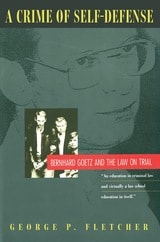
cover of A Crime of Self-Defense: Bernhard Goetz and the Law on Trial

A Crime of Self-Defense

Bernhard Goetz and the Law on Trial

George P. Fletcher

University of Chicago Press, 1990
The popular press dubbed him "the subway vigilante": Bernhard Goetz, who on December 22, 1984, shot four black youths on a New York subway train when one of them asked for five dollars. Goetz claimed to have fired in self-defense, out of fear that the young men were about to rob him.
[more]
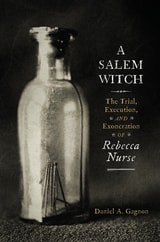
cover of A Salem Witch: The Trial, Execution, and Exoneration of Rebecca Nurse

A Salem Witch

The Trial, Execution, and Exoneration of Rebecca Nurse

Daniel A. Gagnon

Westholme Publishing, 2023

In the winter of 1692 something terrible and frightening began in Salem Village. It started with several villagers having strange fits, screaming, and unnaturally contorting themselves, and ended with almost two hundred people in jail, and at least twenty-five dead. Witchcraft accusations—claims that some inhabitants had forsaken God to become servants of the Devil—spread from Salem Village across Massachusetts, ensnaring innocent people from all strata of society under a burden of assumed guilt. One of the most significant accusations, and most unlikely, was against a seventy-one-year-old grandmother, Rebecca Nurse.
   The accusations against Nurse, a well-respected member in the community, seemed unbelievable. Unflinchingly, this ailing elderly woman insisted on her innocence and refused to falsely confess. Supported by many in Salem, Nurse’s family and neighbors challenged her accusers in court and prepared a thorough defense for her, yet nothing could surmount the fear of witchcraft, and she was sentenced to death. Nurse, seen as a martyr for the truth, later became the first person accused of witchcraft to be memorialized in North America.
    In A Salem Witch: The Trial, Execution, and Exoneration of Rebecca Nurse, the first full account of Nurse’s life, Daniel A. Gagnon vividly recreates seventeenth-century Salem, and in the process challenges previous interpretations of Nurse’s life and the 1692 witch hunt in general. Through primary source research, he reveals how the Nurse family’s role in several disputes prior to the witch hunt was different than previously thought, as well as how Nurse’s case helps answer the important question of whether the accusations of witchcraft were caused by mental illness or malicious intent. A Salem Witch reveals a remarkable woman whose legacy has transformed how the witch hunt has been remembered and memorialized.
[more]
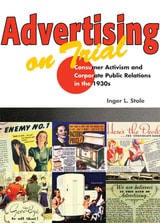
cover of Advertising on Trial: Consumer Activism and Corporate Public Relations in the 1930s

Advertising on Trial

Consumer Activism and Corporate Public Relations in the 1930s

Inger L. Stole

University of Illinois Press, 2006

In the 1930s, the United States almost regulated advertising to a degree that seems unthinkable today. Activists viewed modern advertising as propaganda that undermined the ability of consumers to live in a healthy civic environment. Organized consumer movements fought the emerging ad business and its practices with fierce political opposition.

Inger L. Stole examines how consumer activists sought to limit corporate influence by rallying popular support to moderate and change advertising. Stole weaves the story through the extensive use of primary sources, including archival research done with consumer and trade group records, as well as trade journals and engagement with the existing literature. Her account of the struggle also demonstrates how public relations developed in order to justify laissez-faire corporate advertising in light of a growing consumer rights movement, and how the failure to rein in advertising was significant not just for civic life in the 1930s but for our era as well.

[more]
cover of American Educational Governance on Trial: Change and Challenges

American Educational Governance on Trial

Change and Challenges

Edited by William L. Boyd and Debra Miretzky

University of Chicago Press, 2003

With American public education caught in a dual crisis—of both its performance and its legitimacy—educational governance has found itself increasingly on trial or under attack. This yearbook examines the sources of both crises and assesses the startling range of reform measures—many of which would, not so long ago, have seemed unthinkable—that are now being adopted. Authors include Jane Hannaway, Kenneth Strike, Tyll van Geel, Paul Hill, Allan Odden, Luvern Cunningham, Michael Kirst, James Cibulka, Jack Jennings, Bruce Cooper, Charles Taylor Kerchner, Frederick Hess, Joseph Cronin, Michael Usdan, Carolyn Herrington, and Frances Fowler.
[more]
cover of American Indian History on Trial: Historical Expertise in Tribal Litigation

American Indian History on Trial

Historical Expertise in Tribal Litigation

E. Richard Hart

University of Utah Press, 2017

Drawing from forty-five years of experience, E. Richard Hart elucidates the use of history as expert testimony in American Indian tribal litigation. Such lawsuits deal with aboriginal territory; hunting, fishing, and plant gathering rights; reservation boundaries; water rights; federal recognition; and other questions that have a historical basis. The methodology necessary to assemble successful expert testimony for tribes is complex and demanding and the legal cases have serious implications for many thousands of people, perhaps for generations.

Hart, a historian who has testified in cases that have resulted in roughly a billion dollars in judgments, uses specific cases to explain at length what kind of historical research and documentation is necessary for tribes seeking to protect and claim their rights under United States law. He demonstrates the legal questions that Native Americans face by exploring the cultural history and legal struggles of six Indian nations. He recounts how these were addressed by expert testimony grounded in thorough historical understanding, research, and argumentation. The case studies focus on the Wenatchi, Coeur d’Alene, Hualapai, Amah Mutsun, Klamath, and Zuni peoples but address issues relevant to many American tribes. 
[more]
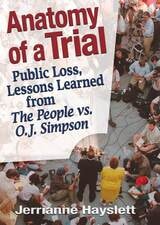
cover of Anatomy of a Trial: Public Loss, Lessons Learned from The People vs. O.J. Simpson

Anatomy of a Trial

Public Loss, Lessons Learned from The People vs. O.J. Simpson

Jerrianne Hayslett

University of Missouri Press, 2008

The People vs. O. J. Simpson ranks indisputably as the trial of the century. It featured a double murder, a celebrity defendant, a perjuring witness, and a glove that didn’t fit. The trial became a media circus of outrageous proportions that led the judge to sequester the jury, eject disruptive reporters, and fine the lawyers thousands of dollars. Now an insider at The People vs. O. J. Simpson reveals the untold story of the most widely followed trial in American history and the indelible impact it has had on the judiciary, the media, and the public.
 
            As the Los Angeles Superior Court’s media liaison, Jerrianne Hayslett had unprecedented access to the trial—and met with Judge Lance Ito daily—as she attempted, sometimes unsuccessfully, to mediate between the court and members of the media and to balance their interests. In Anatomy of a Trial, she takes readers behind the scenes to shed new light on people and proceedings and to show how the media and the trial participants changed the court-media landscape to the detriment of the public’s understanding of the judicial system.
 
            For those who think they’ve already read all there is to know about the Simpson trial, this book is an eye-opener. Hayslett kept a detailed journal during the proceedings in which she recorded anecdotes and commentary. She also shares previously undisclosed information to expose some of the myths and stereotypes perpetuated by the trial, while affirming other stories that emerged during that time. By examining this trial after more than a decade, she shows how it has produced a bunker mentality in the judicial system, shaping media and public access to courts with lasting impact on such factors as cameras in the courtroom, jury selection, admonishments from the bench, and fair-trial/free-press tensions.
 
The first account of the trial written with Judge Ito’s cooperation, Anatomy of a Trial is a page-turning narrative and features photographs that capture both the drama of the courtroom and the excesses of the media. It also includes perspectives of legal and journalism authorities and offers a blueprint for how the courts and media can better meet their responsibilities to the public.
 
Even today, judges, lawyers, and journalists across the country say the Simpson trial changed everything. This book finally tells us why.
[more]