50 books match the query 'Trust' and 3 start with a
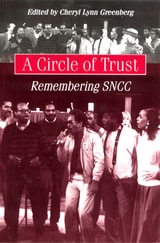
cover of A Circle of Trust: Remembering SNCC

A Circle of Trust

Remembering SNCC

Greenberg, Cheryl L

Rutgers University Press, 1998

Activists and historians reflect together on the civil rights movement and its meanings, and on the Student Nonviolent Coordinating Committee's place in American history.

"The reminiscences and reflections voiced at the SNCC reunion remind us of the remarkable vision and courageous dedication of the civil rights movement of the 1960s. Framed by Cheryl Greenberg's eloquent and probing introduction, the SNCC veterans' comments about the triumphs and limitations of their movement represent a major contribution to the historical literature on race and power in modern America." --Raymond Arsenault, University of South Florida

On the occasion of the SNCC's 25th anniversary, more than 500 people gathered at Trinity College in Connecticut to both celebrate and critique its accomplishments. More than 40 SNCC members tell their stories and reflect on the contributions, limits and legacies of the movement in A Circle of Trust. Engaging in spirited debate with each other, with historians of the movement, and with contemporary political culture more broadly, these former and perpetual activists speak of their vision of a just society and what still remains to be done. With increasing racial tension and the continued debate over integration and separatism in America in the 1990s, the content of this conference is more relevant than ever.

Cheryl Lynn Greenberg begins with an overview of SNCC and introduces each of the chapters of oral history. Participants explore the origins of SNCC, its early adoption of nonviolent protest, its ultimate renunciation of liberal integration and embrace of militant black radicalism, its refusal to repudiate far-left organizations, and controversies over the roles of women in SNCC and society at large. The result is a thoughtful, moving, sometimes acrimonious, sometimes celebratory account of one of the most significant civil rights organizations and its successes and failures.
[more]
cover of A History of Trust in Ancient Greece

A History of Trust in Ancient Greece

Steven Johnstone

University of Chicago Press, 2011
An enormous amount of literature exists on Greek law, economics, and political philosophy. Yet no one has written a history of trust, one of the most fundamental aspects of social and economic interaction in the ancient world. In this fresh look at antiquity, Steven Johnstone explores the way democracy and markets flourished in ancient Greece not so much through personal relationships as through trust in abstract systems—including money, standardized measurement, rhetoric, and haggling.
Focusing on markets and democratic politics, Johnstone draws on speeches given in Athenian courts, histories of Athenian democracy, comic writings, and laws inscribed on stone to examine how these systems worked. He analyzes their potentials and limitations and how the Greeks understood and critiqued them. In providing the first comprehensive account of these pervasive and crucial systems, A History of Trust in Ancient Greece links Greek political, economic, social, and intellectual history in new ways and challenges contemporary analyses of trust and civil society.
[more]
cover of A Matter of Trust: Building Integrity into Data, Statistics and Records to Support the Sustainable Development Goals

A Matter of Trust

Building Integrity into Data, Statistics and Records to Support the Sustainable Development Goals

Edited by Anne Thurston

University of London Press, 2020

The United Nations Sustainable Development Goals initiative has the potential to set the direction for a future world that works for everyone. Approved by 193 United Nations member countries in September 2016 to help guide global and national development policies through the year 2030, the seventeen goals build on the successes of the Millennium Development Goals, but also include new priority areas, such as climate change, economic inequality, innovation, sustainable consumption, peace, and justice. Assessed against commonly agreed targets and indicators, the goals should facilitate inter-governmental cooperation and the development of regional and even global development strategies. This book explores, through a series of case studies, the substantial challenges for assembling reliable data and statistics to address pressing development challenges, particularly in Africa. By highlighting the enormous potential value of creating and using high quality data, statistics, and records as an interconnected resource and describing how this can be achieved, the book will contribute to defining meaningful and realistic global and national development policies in the critical period to 2030.
[more]