Results by title
301 books match the query 'West (U.S.)' and 15 start with a
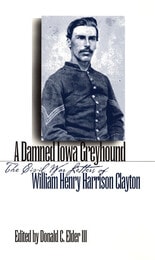
A Damned Iowa Greyhound
The Civil War Letters of William Henry Harrison ClaytonDonald C. Elder, III
University of Iowa Press, 1998
William Henry Harrison Clayton was one of nearly 75,000 soldiers from Iowa to join the Union ranks during the Civil War. Possessing a high school education and superior penmanship, Clayton served as a company clerk in the 19th Infantry, witnessing battles in the Trans-Mississippi theater. His diary and his correspondence with his family in Van Buren County form a unique narrative of the day-to-day soldier life as well as an eyewitness account of critical battles and a prisoner-of-war camp.
Clayton participated in the siege of Vicksburg and took part in operations against Mobile, but his writings are unique for the descriptions he gives of lesser-known but pivotal battles of the Civil War in the West. Fighting in the Battle of Prairie Grove, the 19th Infantry sustained the highest casualties of any federal regiment on the field. Clayton survived that battle with only minor injuries, but he was later captured at the Battle of Stirling's Plantation and served a period of ten months in captivity at Camp Ford, Texas.
Clayton's writing reveals the complicated sympathies and prejudices prevalent among Union soldiers and civilians of that period in the country's history. He observes with great sadness the brutal effects of war on the South, sympathizing with the plight of refugees and lamenting the destruction of property. He excoriates draft evaders and Copperheads back home, conveying the intra-sectional acrimony wrought by civil war. Finally, his racist views toward blacks demonstrate a common but ironic attitude among Union soldiers whose efforts helped lead to the abolition of slavery in the United States.

A Frank Waters Reader
A Southwestern Life In WritingFrank Waters
Ohio University Press, 2000
Over the course of his life, Frank Waters amassed a body of work that has few equals in the literature of the American West. Because his was a writing that touched every facet of the Western experience, his voice still echoes throughout that region’s literary world.
Swallow Press is especially proud to present this generous sampling of Frank Waters’s writings. A Frank Waters Reader encompasses the full range of his work and draws from both his nonfiction and his many novels. It stands as a testament to his singular achievement and proof of the talent that established him as the foremost writer in the Southwest.
This collection spanning forty years of writing provides an excellent introduction for the uninitiated as well as a retrospective for those already familiar with this giant talent. His gift for achieving a delicate balance among the many contrary forces at work in the land and the people who inhabit it is as true and enduring as the region that inspired him.
A Frank Waters Reader
A Southwestern Life in WritingFrank Waters
Ohio University Press, 2000
Over the course of his life, Frank Waters amassed a body of work that has few equals in the literature of the American West. Because his was a writing that touched every facet of the Western experience, his voice still echoes throughout that region’s literary world.
Swallow Press is especially proud to present this generous sampling of Frank Waters’s writings. A Frank Waters Reader encompasses the full range of his work and draws from both his nonfiction and his many novels. It stands as a testament to his singular achievement and proof of the talent that established him as the foremost writer in the Southwest.
This collection spanning forty years of writing provides an excellent introduction for the uninitiated as well as a retrospective for those already familiar with this giant talent. His gift for achieving a delicate balance among the many contrary forces at work in the land and the people who inhabit it is as true and enduring as the region that inspired him.
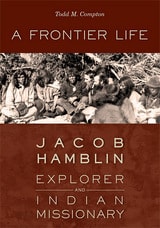
A Frontier Life
Jacob Hamblin, Explorer and Indian MissionaryTodd M. Compton
University of Utah Press, 2013
Winner of the Evans Biography Award, the John Whitmer Historical Society Best Biography Award, and the Francis Armstrong Madsen Best Book Award
Frontiersman, colonizer, missionary to the Indians, and explorer of the American West, Jacob Hamblin has long been one of the most enigmatic figures in Mormon history. In this defining biography, Todd Compton examines and disentangles many of the myths and controversies surrounding Hamblin. His Grand Canyon adventures and explorations as a guide alongside John Wesley Powell are well documented, as are his roles as a missionary, cultural liaison, and negotiator to the Indian tribes of southern Utah and Arizona. Hamblin struggled in this latter role, sometimes unable to bridge the gulf between Mormonism and Indian culture. He disavowed violent conflict and ceaselessly sought peaceful resolutions where others resorted to punitive action. He strove above all for mutual understanding in the absence of conversion.
A Frontier Life provides a rich narrative that fleshes out a picture of a sometimes vilified figure, particularly in regard to his connection to the infamous Mountain Meadows Massacre, where Compton provides nuanced discussion clarifying Hamblin’s post-massacre role—he was not present at the massacre, but reported on it to both Brigham Young and military investigators. Compton’s engagement with Mormon historiography and previous Hamblin portrayals will make this work of particular interest to both scholars and students. The casual reader will take pleasure in learning of a true pioneer who lived life at the geographical, cultural, and spiritual boundaries of his era. This dramatic, entertaining biography is a truly significant contribution to Mormon history.
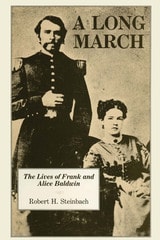
A Long March
The Lives of Frank and Alice BaldwinBy Robert H. Steinbach
University of Texas Press, 1990
During a distinguished military career, in which he rose to the rank of brigadier general and twice won the Medal of Honor, Frank Baldwin saw service in the Civil War, the Indian wars on the Great Plains, and the Spanish-American War. His wife, Alice Blackwood Baldwin, shared the "long march" with him, from his Plains service onward. In this first biography of the Baldwins, Robert Steinbach combines military and personal history to vividly portray a marriage that survived both the harshness of frontier army life and the restrictive Victorian concept of "separate spheres" for husband and wife.
Drawing on a wealth of diaries, letters, and other family papers, Steinbach re-creates the Baldwins' life on the Plains. Moving from post to post in Kansas, New Mexico, Montana, North Dakota, and Texas, they faced danger, excitement, separations, poverty, and many other hardships. Frequently they clashed over Alice's desire to be something more than "an ornament to society"—a wish eventually granted as Frank's long absences and chronic ill health required Allie to take responsibility for herself and their daughter.
With insights into military campaigns on the Great Plains in the years 1865–1890 and a revealing look at the human side of those campaigns, A Long March will appeal to a wide audience.
A Watershed Moment
The American West in the Age of LimitsEdited by Robert Frodeman, Evelyn Brister, and Luther Propst
University of Utah Press, 2024
The volume presents practical approaches to land use, land management, and community planning that are motivated by philosophical views on justice, quality of life, and sustainability in the American West. The contributors are policymakers, government employees, land and water managers, urban planners, biologists, tribal members, writers, and academics from a variety of backgrounds and perspectives. The result is a compelling vision of place-based, policy-oriented sustainability across the West.
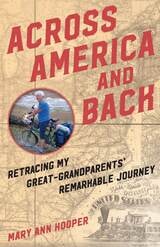
Across America and Back
Retracing My Great-Grandparents' Remarkable JourneyMary Ann Hooper
University of Nevada Press, 2018
Using the common thread of the same train trip across the American landscape, she weaves together the two stories—her great grandparents, Charles and Fannie Crosby’s leisurely Victorian tourist trip described in both their diaries—and her own trip. Mary Ann’s adventurous and determined voice fills the pages with entertaining encounters on the train, escapades on her folding bike, and her reflections on her birth country and her own life story.
During her journey, she discovers the stories of her 1950s childhood reflect a “Wild West” at odds with the West her great-grandparents record in their diaries, leading her to uncover more of the real and meatier history of the American West—going through conquest, rapid settlement, and economic development. As Mary Ann fulfills her quest to understand better why glorified myths were created to describe the Wild West of her childhood, and reflects on the pitfalls of what “progress” is doing to the environment, she is left with a much bigger question: Can we transform our way of doing things quickly enough to stop our much-loved West becoming an uninhabitable desert?
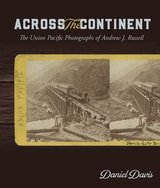
Across the Continent
The Union Pacific Photographs of Andrew Joseph RussellDaniel Davis
University of Utah Press, 2018
Copublished with the Utah State Historical Society. Affiliated with the Utah Division of State History, Utah Department of Heritage & Arts
Andrew J. Russell is primarily known as the man who photographed the famous “East and West Shaking Hands” image of the Golden Spike ceremony on May 10, 1869. He also took nearly one thousand other images that document almost every aspect of the construction of the Union Pacific Railroad. Across the Continent is the most detailed study to date of the life and work of an often-overlooked but prolific artist who contributed immensely not only to documentation of the railroad but also to the nation’s visualization of the American West and, earlier, the Civil War.
The central focus in the book is on the large body of work Russell produced primarily to satisfy the needs of the Union Pacific. Daniel Davis posits that this set of Russell’s photos is best understood not through one or a handful of individual images, but as a photographic archive. Taken as a whole, that archive shows that Russell intended for viewers never to forget who built the Union Pacific. His images celebrate working people—masons working on bridge foundations, freighters and their wagons, surveyors with their transits, engine crews posed on their engines, as well as tracklayers, laborers, cooks, machinists, carpenters, graders, teamsters, and clerks pushing paper.
Russell contributed to a golden age of Western photography that visually introduced the American West to the nation, changing its public image from that of a Great American Desert to a place of apparently unlimited economic potential.
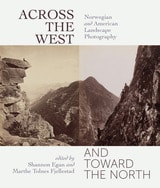
Across the West and Toward the North
Norwegian and American Landscape PhotographyEdited by Shannon Egan and Marthe Tolnes Fjellestad
University of Utah Press, 2021
In this edited volume, Norwegian and American scholars offer the first study of the striking parallels in the production, distribution, and reception of these modern expressions of landscape and nationhood. In recognizing how landscape photographs were made meaningful to international audiences—such as tourists, visitors to world’s fairs, scientists, politicians, and immigrants—the authors challenge notions of American exceptionalism and singularly nationalistic histories.
The book includes stunning photographs of mountainous landscapes, glaciers, and forests, punctuated by signs of human development and engineering, with more than one hundred rarely seen plates by photographers Knud Knudsen, Anders Beer Wilse, Timothy O’Sullivan, Charles R. Savage, and others.
American Boundaries
The Nation, the States, the Rectangular SurveyBill Hubbard Jr.
University of Chicago Press, 2009
American Labor in the Southwest
The First One Hundred YearsEdited by James C. Foster
University of Arizona Press, 1982
The Western Federation of Miners
James C. Foster, D. H. Dinwoodie
The Industrial Workers of the World
Earl Bruce White, James Byrkit
The Rise of Unionized Farm Workers
H. L. Mitchell, Edward D. Beechert, Art Carstens
Mexican Labor, North and South of the Border
John M. Hart, Rodney Anderson, David Maciel
Labor and Politics
Paul Mandel, George N. Green, Charles O. Rice

An Incomplete History of the American West
Storiesurza
University of Nevada Press, 2026
Rooted in the traditions of Western literature but unafraid to challenge them, author Gabriel Urza brings a fresh and unflinching perspective to stories that span race, class, and time. Unsentimental yet deeply humane, An Incomplete History of the American West asks readers to reconsider what the West truly means—and why the stories we tell about it still matter.
Anguish of Snails
Native American Folklore in the WestBarre Toelken
Utah State University Press, 2003
Winner of the 2004 Chicago Folklore Prize, The Anguish of Snails is an essential work for the collection of any serious reader in folklore or Native American studies.

Archetypal Light
PoemsElizabeth Dodd
University of Nevada Press, 2001
Aryan Cowboys
White Supremacists and the Search for a New Frontier, 1970–2000By Evelyn A. Schlatter
University of Texas Press, 2006
During the last third of the twentieth century, white supremacists moved, both literally and in the collective imagination, from midnight rides through Mississippi to broadband-wired cabins in Montana. But while rural Montana may be on the geographical fringe of the country, white supremacist groups were not pushed there, and they are far from "fringe elements" of society, as many Americans would like to believe. Evelyn Schlatter's startling analysis describes how many of the new white supremacist groups in the West have co-opted the region's mythology and environment based on longstanding beliefs about American character and Manifest Destiny to shape an organic, home-grown movement.
Dissatisfied with the urbanized, culturally progressive coasts, disenfranchised by affirmative action and immigration, white supremacists have found new hope in the old ideal of the West as a land of opportunity waiting to be settled by self-reliant traditional families. Some even envision the region as a potential white homeland. Groups such as Aryan Nations, The Order, and Posse Comitatus use controversial issues such as affirmative action, anti-Semitism, immigration, and religion to create sympathy for their extremist views among mainstream whites—while offering a "solution" in the popular conception of the West as a place of freedom, opportunity, and escape from modern society. Aryan Cowboys exposes the exclusionist message of this "American" ideal, while documenting its dangerous appeal.