Results by title
53 books match the query 'Wildlife' and 3 start with a
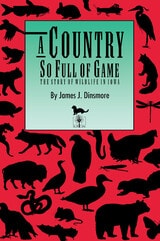
A Country So Full of Game
The Story of Wildlife in IowaJames J. Dinsmore
University of Iowa Press, 1994
Based on a thorough search of hundreds of primary sources ranging from chronicles of military expeditions to field reports by early naturalists, first-person accounts by fur traders and hunters to up-to-date county checklists, A Country So Full of Game examines the dramatic encounters of humans with elk, black bears, passenger pigeons, bobcats, prairie-chickens, otters, and many more. Each chapter discusses the animal's status and distribution when explorers first arrived in Iowa, how it was hunted or trapped, how this exploitation affected its population, and what its current status is both in Iowa and nationally. Enhanced by Mark Müller's distinctive drawings, commissioned for this book, the anecdotes evoke a sense of loss and wonder at the magic abundance of Iowa's wildlife.
Iowa has been changed more than, perhaps, any other state. We can mourn the disappearance of the bison and mountain lion while we marvel at the recent success of the wild turkey and white-tailed deer. Listening to James Dinsmore tell the story of wildlife in Iowa can open a window onto the future as other areas of our planet are increasingly altered by humans. A Country So Full of Game will allow all naturalists, both amateur and professional, hunter and biologist, to appreciate and learn from Iowa's diverse wild heritage.
American Fish and Wildlife Policy
The Human DimensionEdited by William R. Mangun
Southern Illinois University Press, 1992
These eleven original essays by leading wildlife management and public policy scholars deal with policy issues, management perspectives, and the public attitudes about wildlife that shape the world of the wildlife manager.
Part 1 contains William R. Mangun’s introductory essay "Fish and Wildlife Policy Issues" and Daniel J. Decker et al.’s "Toward a Comprehensive Paradigm of Wildlife."
Ann H. Harvey’s "Interagency Conflict and Coordination in Wildlife Management," Philip S. Cook and Ted T. Cable’s "Developing Policy for Public Access to Private Land," and Debra A. Rose’s "Implementing Endangered Species Policy" make up part 2.
Part 3 consists of Cliff Hamilton’s "Pursuing a New Paradigm in Funding State Fish and Wildlife Programs" and Trellis G. Green’s "Use of Economics in Federal and State Fishery Allocation Decisions."
The fourth part includes James J. Kennedy and Jack Ward Thomas’s "Exit, Voice, and Loyalty of Wildlife Biologists in Public Natural Resource/Environmental Agencies"; Jean C. Mangun et al.’s "Nonconsumptive Wildlife-Associated Recreation in the United States"; and Barbara A. Knuth’s "Natural Resource Hazards: Managing to Protect People from the Resource."
In part 5, Joseph F. Coates looks to the future in "Public Policy Actors and Futures."
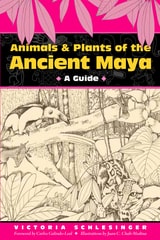
Animals and Plants of the Ancient Maya
A GuideBy Victoria Schlesinger
University of Texas Press, 2002
A growing interest in all things Maya brings an increasing number of visitors to prehistoric Maya ruins and contemporary Maya communities in Guatemala, Belize, El Salvador, western Honduras, the Yucatán Peninsula, and the southern areas of Chiapas and Tabasco, Mexico. For these visitors and indeed everyone with an interest in the Maya, this field guide highlights nearly 100 species of plants and animals that were significant to the ancient Maya and that continue to inhabit the Maya region today.
Drawing from the disciplines of biology, ecology, and anthropology, Victoria Schlesinger describes each plant or animal's habitat and natural history, identifying characteristics (also shown in a black-and-white drawing), and cultural significance to the ancient and contemporary Maya. An introductory section explains how to use the book and offers a concise overview of the history, lifeways, and cosmology of the ancient Maya. The concluding section describes the collapse of ancient Maya society and briefly traces the history of the Maya region from colonial times to the present.