Results by title
8642 books match the query '20th Century' and 836 start with a
American Cinema of the 1920s
Themes and VariationsFischer, Lucy
Rutgers University Press, 2009
In ten original essays, American Cinema of the 1920s examines the film industry's continued growth and prosperity while focusing on important themes of the era.
American Cinema of the 1930s
Themes and VariationsHark, Ina Rae
Rutgers University Press, 2007
The ten original essays in American Cinema of the 1930s focus on sixty diverse films of the decade, including Dracula, The Public Enemy, Trouble in Paradise, 42nd Street, King Kong, Imitation of Life, The Adventures of Robin Hood, Swing Time, Angels with Dirty Faces, Nothing Sacred, Jezebel, Mr. Smith Goes toWashington, and Stagecoach .
American Cinema of the 1940s
Themes and VariationsDixon, Wheeler Winston
Rutgers University Press, 2005
The 1940s was a watershed decade for American cinema and the nation. Shaking off the grim legacy of the Depression, Hollywood launched an unprecedented wave of production, generating some of its most memorable classics, including Citizen Kane, Rebecca, The Lady Eve, Sergeant York, and How Green Was My Valley. In 1942, Hollywood joined the national war effort with a vengeance, creating a series of patriotic and escapist films, such as Casablanca, Mrs. Miniver, The Road to Morocco, and Yankee Doodle Dandy.
With the end of the war, returning GIs faced a new America, in which the country had been transformed overnight. Film noir reflected a new public mood of pessimism and paranoia, in such classic films of betrayal and conflict as Kiss of Death, Force of Evil, Caught, and Apology for Murder, depicting a poisonous universe of femme fatales, crooked lawyers, and corrupt politicians.
With the threat of the atom bomb lurking in the background and the beginnings of the Hollywood Blacklist, the 1940s was a decade of crisis and change. Featuring essays by a group of respected film scholars and historians, American Cinema of the 1940s brings this dynamic and turbulent decade to life. Illustrated with many rare stills and filled with provocative insights, the volume will appeal to students, teachers, and to all those interested in cultural history and American film of the twentieth century.
American Cinema of the 1950s
Themes and VariationsPomerance, Murray
Rutgers University Press, 2005
From cold war hysteria and rampant anticommunist witch hunts to the lure of suburbia, television, and the new consumerism, the 1950s was a decade of sensational commercial possibility coupled with dark nuclear fears and conformist politics. Amid this amalgamation of social, political, and cultural conditions, Hollywood was under siege: from the Justice Department, which pressed for big film companies to divest themselves of their theater holdings; from the middleclass, whose retreat to family entertainment inside the home drastically decreased the filmgoing audience; and from the House Un-American Activities Committee, which was attempting to purge the country of dissenting political views. In this difficult context, however, some of the most talented filmmakers of all time, including John Ford, Alfred Hitchcock, Vincente Minnelli, Nicholas Ray, and Billy Wilder produced some of their most remarkable work.
Bringing together original essays by ten respected scholars in the field, American Cinema of the 1950s explores the impact of the cultural environment of this decade on film, and the impact of film on the American cultural milieu. Contributors examine the signature films of the decade, including From Here to Eternity, Sunset Blvd., Singin' in the Rain, Shane, Rear Window, and Rebel Without a Cause, as well as lesser-known but equally compelling films, such as Dial 1119, Mystery Street, Suddenly, Summer Stock, The Last Hunt, and many others.
Provocative, engaging, and accessible to general readers as well as scholars, this volume provides a unique lens through which to view the links between film and the prevailing social and historical events of the decade.
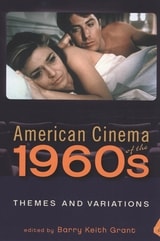
American Cinema of the 1960s
Themes and VariationsGrant, Barry Keith
Rutgers University Press, 2008
At the same time, American cinema underwent radical change as well. The studio system crumbled, and the Production Code was replaced by a new ratings system. Among the challenges faced by the film industry was the dawning shift in theatrical exhibition from urban centers to surburban multiplexes, an increase in runaway productions, the rise of independent producers, and competition from both television and foreign art films. Hollywood movies became more cynical, violent, and sexually explicit, reflecting the changing values of the time.
In ten original essays, American Cinema of the 1960s examines a range of films that characterized the decade, including Hollywood movies, documentaries, and independent and experimental films. Among the films discussed are Elmer Gantry, The Apartment, West Side Story, The Manchurian Candidate, To Kill a Mockingbird, Cape Fear, Bonnie and Clyde, 2001: A Space Odyssey, Midnight Cowboy, and Easy Rider.
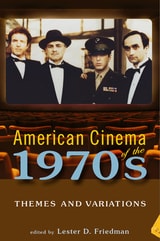
American Cinema of the 1970s
Themes and VariationsFriedman, Lester D
Rutgers University Press, 2007
Far from a placid era, the seventies was a decade of social upheavals. Events such as the killing of students at Kent State and Jackson State universities, the Watergate investigations, the legalization of abortion, and the end of the American involvement in Vietnam are only a few among the many landmark occurrences that challenged the foundations of American culture. The director-driven movies of this era reflect this turmoil, experimenting with narrative structures, offering a gallery of scruffy antiheroes, and revising traditional genre conventions.
Bringing together ten original essays, American Cinema of the 1970s examines the range of films that marked the decade, including Jaws, Rocky, Love Story, Shaft, Dirty Harry, The Godfather, Deliverance, The Exorcist, Shampoo, Taxi Driver, Star Wars, Saturday Night Fever, Kramer vs. Kramer,and Apocalypse Now .
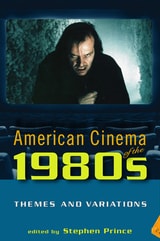
American Cinema of the 1980s
Themes and VariationsPrince, Stephen
Rutgers University Press, 2007
Bringing together original essays by ten respected scholars in the field, American Cinema of the 1980s examines the films that marked the decade, including Ordinary People, Body Heat, Blade Runner, Zelig, Platoon, Top Gun, Aliens, Blue Velvet, Robocop, Fatal Attraction, Die Hard, Batman, and sex, lies & videotape.
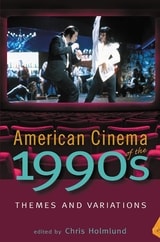
American Cinema of the 1990s
Themes and VariationsHolmlund, Chris
Rutgers University Press, 2008
The essays in American Cinema of the 1990s examine the big-budget blockbusters and critically acclaimed independent films that defined the decade. The 1990s' most popular genre, action, channeled anxieties about global threats such as AIDS and foreign terrorist attacks into escapist entertainment movies. Horror films and thrillers were on the rise, but family-friendly pictures and feel-good romances netted big audiences too. Meanwhile, independent films captured hearts, engaged minds, and invaded Hollywood: by decade's end every studio boasted its own "art film" affiliate.
American City
A Rank and File History of MinneapolisCharles Rumford Walker
University of Minnesota Press, 2005
American Coal
Russell Lee PortraitsMary Jane Appel and Douglas Brinkley
University of Texas Press, 2024
More than 100 powerful images by noted photographer Russell Lee that document the working conditions and lives of coal mining communities in the postwar United States; publication coincides with an exhibition at the National Archives in Washington, DC.
In 1946 the Truman administration made a promise to striking coal miners: as part of a deal to resume work, the government would sponsor a nationwide survey of health and labor conditions in mining camps. One instrumental member of the survey team was photographer Russell Lee. Lee had made his name during the Depression, when, alongside Dorothea Lange and Walker Evans, he used his camera to document agrarian life for the Farm Security Administration (FSA). Now he trained his lens on miners and their families to show their difficult circumstances despite their essential contributions to the nation's first wave of postwar growth.
American Coal draws from the thousands of photographs that Lee made for the survey—also on view in the US National Archives and Records Administration’s exhibition Power & Light—and includes his original, detailed captions as well as an essay by biographer Mary Jane Appel and historian Douglas Brinkley. They place his work in context and illuminate how Lee helped win improved conditions for his subjects through vivid images that captured an array of miners and their communities at work and at play, at church and in school, in moments of joy and struggle, ultimately revealing to their fellow Americans the humanity and resilience of these underrecognized workers.

American Commonplace
Essays on the Popular Culture of the United StatesUniversity of Wisconsin Press, 1982
American Community
Radical Experiments in Intentional LivingMark S. Ferrara
Rutgers University Press, 2020
American Community takes us inside forty of the most interesting intentional communities in the nation’s history, from the colonial era to the present day. You will learn about such little-known experiments in cooperative living as the Icarian communities, which took the utopian ideas expounded in a 1840 French novel and put them into practice, ultimately spreading to five states over fifty years. Plus, it covers more recent communities such as Arizona’s Arcosanti, designed by architect Paolo Soleri as a model for ecologically sustainable living.
In this provocative and engaging book, Mark Ferrara guides readers through an array of intentional communities that boldly challenged capitalist economic arrangements in order to attain ideals of harmony, equality, and social justice. By shining a light on these forgotten histories, it shows that far from being foreign concepts, communitarianism and socialism have always been vital parts of the American experience.
American Courage, American Carnage
The 7th Infantry Regiment's Combat Experience, 1812 through World War IIJohn C. McManus
University of Missouri Press, 2025
In the months leading up to the War of 1812, Congress authorized the creation of this regiment. It fought with distinction at the Battle of New Orleans, anchoring General Andrew Jackson's main defensive line, forever earning the nickname "Cottonbalers" because the soldiers of the 7th were said to have battled the British from behind large rows of cotton bales. From now on, whenever Americans went to war, the Cottonbalers would always find themselves in the center of the action, where the danger was greatest.
Between these covers is the whole story, told through the eyes of the soldiers—the realities of combat expressed in raw human terms. From the marshy grounds of the Chalmette plantation in New Orleans to the daunting heights of Chapultepec in Mexico City; from the bloody horror of the long, stone wall at Fredericksburg to the deadly crossfire of the Wheatfield at Gettysburg, from the shocking gore of Custer's massacre at Little Bighorn to the desperation of dusty frontier battles; from the foggy hills of Santiago in Cuba to the muddy, pockmarked no man's land of Belleau Wood in France; from the invasion of North Africa to Sicily, Anzio, southern France, the Vosges Mountains, the breaching of the Rhine, and the 7th's triumphant capture of Hitler's mountain home at Berchtesgaden in May, 1945, this remarkable book chronicles multiple generations of Cottonbalers who have fought and bled for their country.
American Courage, American Carnage is an inside look at the drama, tragedy, fatigue and pathos of war, from America's early nineteenth century struggles as a fledgling republic to its emergence as a superpower in the twentieth. Based on nearly a decade of archival research, battlefield visits, interviews, and intensive study, and illustrated with copious maps and photographs, this book is a moving, authoritative, tale of Americans in combat.
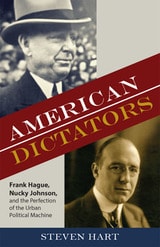
American Dictators
Frank Hague, Nucky Johnson, and the Perfection of the Urban Political MachineHart, Steven
Rutgers University Press, 2013
One man was tongue-tied and awkward around women, in many ways a mama's boy at heart, although his reputation for thuggery was well earned. The other was a playboy, full of easy charm and ready jokes, his appetite for high living a matter of public record. One man tolerated gangsters and bootleggers as long as they paid their dues to his organization. The other was effectively a gangster himself, so crooked that he hosted a national gathering of America's most ruthless killers. One man never drank alcohol. The other, from all evidence, seldom drank anything else.
American Dictators is the dual biography of two of America’s greatest political bosses: Frank Hagueand Enoch “Nucky” Johnson. Packed with compelling information and written in an informal, sometimes humorous style, the book shows Hague and Johnson at the peak of their power and the strength of their political machines during the years of Prohibition and the Great Depression. Steven Hart compares how both men used their influence to benefit and punish the local citizenry, amass huge personal fortunes, and sometimes collaborate to trounce their enemies.
Similar in their ruthlessness, both men were very different in appearance and temperament. Hague, the mayor of Jersey City, intimidated presidents and wielded unchallenged power for three decades. He never drank and was happily married to his wife for decades. He also allowed gangsters to run bootlegging and illegal gambling operations as long as they paid protection money. Johnson, the political boss of Atlantic City, and the inspiration for the hit HBO series Boardwalk Empire, presided over corruption as well, but for a shorter period of time. He was notorious for his decadent lifestyle. Essentially a gangster himself, Johnson hosted the infamous Atlantic City conference that fostered the growth of organized crime.
Both Hague and Johnson shrewdly integrated otherwise disenfranchised groups into their machines and gave them a stake in political power. Yet each failed to adapt to changing demographics and circumstances. In American Dictators, Hart paints a balanced portrait of their accomplishments and their failures.
American Diplomacy
George F. Kennan
University of Chicago Press, 1985
This expanded edition retains the lectures and essays first published in 1951 as American Diplomacy, 1900-1950 and adds two lectures delivered in 1984 as well as a new preface by the author. In these additional pieces, Kennan explains how some of his ideas have changed over the years. He confronts the events and topics that have come to occupy American opinion in the last thirty years, including the development and significance of the Cold War, the escalation of the nuclear arms race, and the American involvement in Vietnam.
"A book about foreign policy by a man who really knows something about foreign policy."—James Reston,New York Times Book Review
"These celebrated lectures, delivered at the University of Chicago in 1950, were for many years the most widely read account of American diplomacy in the first half of the twentieth century. . . . The second edition of the work contains two lectures from 1984 that reconsider the themes of American Diplomacy"—Foreign Affairs, Significant Books of the Last 75 Years.
American Diplomacy
Sixtieth-Anniversary Expanded EditionGeorge F. Kennan
University of Chicago Press, 2012
For more than sixty years, George F. Kennan’s American Diplomacy has been a standard work on American foreign policy. Drawing on his considerable diplomatic experience and expertise, Kennan offers an overview and critique of the foreign policy of an emerging great power whose claims to rightness often spill over into self-righteousness, whose ambitions conflict with power realities, whose judgmentalism precludes the interests of other states, and whose domestic politics frequently prevent prudent policies and result in overstretch. Keenly aware of the dangers of military intervention and the negative effects of domestic politics on foreign policy, Kennan identifies troubling inconsistencies in the areas between actions and ideals—even when the strategies in question turned out to be decided successes.
In this expanded sixtieth-anniversary edition, a substantial new introduction by John J. Mearsheimer, one of America’s leading political realists, provides new understandings of Kennan’s work and explores its continued resonance. As America grapples with its new role as one power among many—rather than as the “indispensable nation” that sees “further into the future”—Kennan’s perceptive analysis of the past is all the more relevant. Today, as then, the pressing issue of how to wield power with prudence and responsibility remains, and Kennan’s cautions about the cost of hubris are still timely. Refreshingly candid, American Diplomacy cuts to the heart of policy issues that continue to be hotly debated today.
“These celebrated lectures, delivered at the University of Chicago in 1950, were for many years the most widely read account of American diplomacy in the first half of the twentieth century.”—Foreign Affairs, Significant Books of the Last 75 Years
American Drama in the Age of Film
Zander Brietzke
University of Alabama Press, 2007
Is theater really dead? Does the theater, as its champions insist, really provide a more intimate experience than film? If so, how have changes in cinematic techniques and technologies altered the relationship between stage and film? What are the inherent limitations of representing three-dimensional spaces in a two-dimensional one, and vice versa?
American Drama in the Age of Film examines the strengths and weaknesses of both the dramatic and cinematic arts to confront the standard arguments in the film-versus-theater debate. Using widely known adaptations of ten major plays, Brietzke seeks to highlight the inherent powers of each medium and draw conclusions not just about how they differ, but how they ought to differ as well. He contrasts both stage and film productions of, among other works, David Mamet’s Glengarry Glen Ross, Sam Shepard’s True West, Edward Albee’s Who’s Afraid of Virginia Woolf, Margaret Edson’s Wit, Tony Kushner’s Angels in America, Tennessee Williams’s Cat on a Hot Tin Roof, Arthur Miller’s Death of a Salesman, and August Wilson’s The Piano Lesson. In reading the dual productions of these works, Brietzke finds that cinema has indeed stolen much of theater’s former thunder, by making drama more intimate, and visceral than most live events.
But theater is still vital and matters greatly, Brietzke argues, though for reasons that run counter to many of the virtues traditionally attributed to it as an art form, such as intimacy and spontaneity. Brietzke seeks to revitalize perceptions of theater by challenging those common pieties and offering a new critical paradigm, one that champions spectacle and simultaneity as the most, not least, important elements of drama.
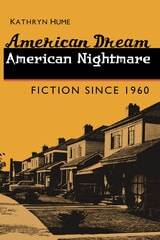
American Dream, American Nightmare
Fiction since 1960Kathryn Hume
University of Illinois Press, 2000
In breaking down the divisions among standard categories of race, religion, ethnicity, and gender, Hume identifies shared core concerns, values, and techniques among seemingly disparate and unconnected writers including T. Coraghessan Boyle, Ralph Ellison, Russell Banks, Gloria Naylor, Tim O'Brien, Maxine Hong Kingston, Walker Percy, N. Scott Momaday, John Updike, Toni Morrison, William Kennedy, Julia Alvarez, Thomas Pynchon, Leslie Marmon Silko, and Don DeLillo.
Hume explores fictional treatments of the slippage in the immigrant experience between America's promise and its reality. She exposes the political link between contemporary stories of lost innocence and liberalism's inadequacies. She also invites us to look at the literary challenge to scientific materialism in various searches for a spiritual dimension in life.
The expansive future promised by the American Dream has been replaced, Hume finds, by a sense of tarnished morality and a melancholy loss of faith in America's exceptionalism. American Dream, American Nightmare examines the differing critiques of America embedded in nearly a hundred novels and points to the source for recovery that appeals to many of the authors.
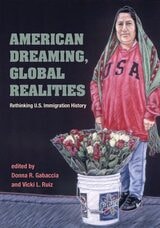
American Dreaming, Global Realities
Rethinking U.S. Immigration HistoryEdited by Donna R. Gabaccia and Vicki L. Ruiz
University of Illinois Press, 2006
An introduction to the best from the new directions in U.S. immigration history
Representing a selection of the finest new research on immigration, American Dreaming, Global Realities explores the ways in which immigrant lives and those of their children are shaped by transnational bonds, globalization, family ties, and personal choice, and the ways in which they engender a sense of belonging and a sense of themselves as “Americans.”
American Dreaming, Global Realities considers a plurality of very specific historical, economic, regional, familial, and cultural contexts. This history reveals resistance and accommodation, both persistent older traditions and Americanization, plus the creation of new cultural forms blending old and new. The twenty-two interdisciplinary essays included in this collection explore the intricate overlapping of race, class, and gender on ethnic identity and on American citizenship.
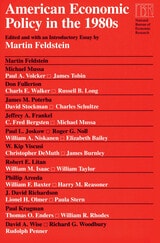
American Economic Policy in the 1980s
Edited by Martin Feldstein
University of Chicago Press, 1994
In his introduction, Martin Feldstein provides compelling analysis of policies with which he was closely involved as chairman of the Council of Economic Advisers during the Reagan administration: monetary and exchange rate policy, tax policy, and budget issues. Other leading economists and policymakers examine a variety of domestic and international issues, including monetary and exchange rate policy, regulation and antitrust, as well as trade, tax, and budget policies.
The contributors to this volume are Alberto Alesina, Phillip Areeda, Elizabeth Bailey, William F. Baxter, C. Fred Bergsten, James Burnley, Geoffrey Carliner, Christopher DeMuth, Douglas W. Elmendorf, Thomas O. Enders, Martin Feldstein, Jeffrey A. Frankel, Don Fullerton, William M. Isaac, Paul L Joskow, Paul Krugman, Robert E. Litan, Russell B. Long, Michael Mussa, William A. Niskanen, Roger G. Noll, Lionel H. Olmer, Rudolph Penner, William Poole, James M. Poterba, Harry M. Reasoner, William R. Rhodes, J. David Richardson, Charles Schultze, Paula Stern, David Stockman, William Taylor, James Tobin, W. Kip Viscusi, Paul A. Volcker, Charles E. Walker, David A. Wise, and Richard G. Woodbury.
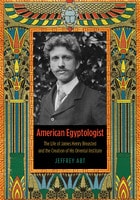
American Egyptologist
The Life of James Henry Breasted and the Creation of His Oriental InstituteJeffrey Abt
University of Chicago Press, 2011
James Henry Breasted (1865–1935) had a career that epitomizes our popular image of the archaeologist. Daring, handsome, and charismatic, he traveled on expeditions to remote and politically unstable corners of the Middle East, helped identify the tomb of King Tut, and was on the cover of Time magazine. But Breasted was more than an Indiana Jones—he was an accomplished scholar, academic entrepreneur, and talented author who brought ancient history to life not just for students but for such notables as Teddy Roosevelt and Sigmund Freud.
American Empire and the Politics of Meaning
Elite Political Cultures in the Philippines and Puerto Rico during U.S. ColonialismJulian Go
Duke University Press, 2007
American Empire and the Politics of Meaning is an examination of how these efforts to provide the elite of Puerto Rico and the Philippines a practical education in self-government played out on the ground in the early years of American colonial rule, from 1898 until 1912. It is the first systematic comparative analysis of these early exercises in American imperial power. The sociologist Julian Go unravels how American authorities used “culture” as both a tool and a target of rule, and how the Puerto Rican and Philippine elite received, creatively engaged, and sometimes silently subverted the Americans’ ostensibly benign intentions. Rather than finding that the attempt to transplant American-style democracy led to incommensurable “culture clashes,” Go assesses complex processes of cultural accommodation and transformation. By combining rich historical detail with broader theories of meaning, culture, and colonialism, he provides an innovative study of the hidden intersections of political power and cultural meaning-making in America’s earliest overseas empire.
American Energy Cinema
Robert Lifset
West Virginia University Press, 2023
Historians investigate the relationships between film, culture, and energy.
American Energy Cinema explores how Hollywood movies have portrayed energy from the early film era to the present. Looking at classics like Giant, Silkwood, There Will Be Blood, and Matewan, and at quirkier fare like A Is for Atom and Convoy, it argues that films have both reflected existing beliefs and conjured new visions for Americans about the role of energy in their lives and their history.
The essays in this collection show how film provides a unique and informative lens to understand perceptions of energy production, consumption, and infrastructure networks. By placing films that prominently feature energy within historical context and analyzing them as historical objects, the contributing authors demonstrate how energy systems of all kinds are both integral to the daily life of Americans and inextricable from larger societal changes and global politics.
American Eugenics
Race, Queer Anatomy, and the Science of NationalismNancy Ordover
University of Minnesota Press, 2003
Traces the history of eugenics ideology in the United States and its ongoing presence in contemporary life
The Nazis may have given eugenics its negative connotations, but the practice—and the “science” that supports it—is still disturbingly alive in America in anti-immigration initiatives, the quest for a “gay gene,” and theories of collective intelligence. Tracing the historical roots and persistence of eugenics in the United States, Nancy Ordover explores the political and cultural climate that has endowed these campaigns with mass appeal and scientific legitimacy.
American Eugenics demonstrates how biological theories of race, gender, and sexuality are crucially linked through a concern with regulating the “unfit.” These links emerge in Ordover’s examination of three separate but ultimately related American eugenics campaigns: early twentieth-century anti-immigration crusades; medical models and interventions imposed on (and sometimes embraced by) lesbians, gays, transgendered people, and bisexuals; and the compulsory sterilization of poor women and women of color. Throughout, her work reveals how constructed notions of race, gender, sexuality, and nation are put to ideological uses and how “faith in science” can undermine progressive social movements, drawing liberals and conservatives alike into eugenics-based discourse and policies.
American Evangelicalism
Conservative Religion and the Quandary of ModernityHunter, James D
Rutgers University Press, 1983
American Evangelicals and the 1960s
Edited by Axel R. Schäfer
University of Wisconsin Press, 2013
American Exceptionalism as Religion
Postmodern DiscontentJordan Carson
The Ohio State University Press, 2020
As American exceptionalism resurfaces in public discourse, Carson’s timely work invites readers to reconsider the nexus of religion, politics, and culture. Carson argues that defining religion according to secularist criteria has insulated ostensibly secular ideologies as well as traditional religion from public scrutiny. DeLillo’s, Castillo’s, Pynchon’s, Saunders’s, and Robinson’s redefinitions of religion result in a better grasp of how individuals actually live out their religious lives. More importantly, these authors help erect a framework for constructively engaging American exceptionalism and the ideas that support it.
American Fiction in the Cold War
Thomas H. Schaub
University of Wisconsin Press, 1991
In American Fiction in the Cold War Thomas Hill Schaub makes it clear that Trilling’s summary was in itself a mythic reconstruction, a prominent example of the way liberal writers in the late 1940s and 1950s came to terms with their political past. Schaub’s book brilliantly analyzes their efforts to reshape an “old” liberalism alleged to hold naively optimistic views of human nature, scientific reason, and social progress into a “new,” skeptical liberalism that recognized the persistence of human evil, the fragility of reason, and the ambiguity of moral decision.
Most important, as American Fiction in the Cold War demonstrates, these liberal reassessments of history, politics, human nature, and destiny—what Schaub calls the “liberal narrative”—mediated the critical and imaginative production of the literary community after World War II. Schaub shows that the elements of this narrative are visible in a wide spectrum of cultural narratives in American history, political philosophy, and social criticism during the Cold War era. His analysis of the dominant critical communities of the late 1940s—led by critics such as Lionel Trilling and Irving Howe, Cleanth Brooks and Allen Tate—recovers the political meanings embedded within their debates over the nature of literary realism, the definition of the novel, and speculations on its “death.”
In the second part of his study, Schaub turns to Ralph Ellison, Flannery O’Connor, Norman Mailer, and John Barth. His readings of their fiction isolate the political and cultural content of works often faulted for their apparent efforts to transcend social history. Reviewing John Barth’s End of the Road, for example, he shows the politics of culture concealed within what seems to be a philosophical narrative. In novel after novel, he demonstrates, the liberal narrative is operating from within, tuning and steering the direction of the plot and the creation of the character. Schaub’s penetrating exploration of the relationship between U.S. political and social thought and the literary consciousness in the early postwar years will be of interest to intellectual historians and to students of American literary culture.
American Genesis
A Century of Invention and Technological Enthusiasm, 1870-1970Thomas P. Hughes
University of Chicago Press, 2004
A sweeping history of the inventors, inventions, and innovations that together created modern America.
A stunning, wide-ranging history from one of the foremost historians of technology of our age American Genesis tells the sweeping story of the technological revolution that made modern America. Unlike other histories of technology, which focus on particular inventions like the light bulb or the automobile, American Genesis makes these inventions characters in a broad chronicle, both shaped by and shaping a culture. By weaving scientific and technological advancement into other cultural trends, and bringing in fascinating characters like Edison, Ford, and Frederick Taylor, Hughes demonstrates here the myriad ways in which the two are inexorably linked, and in a new preface, he recounts his earlier missteps in predicting the future of technology and follows its move into the information age.
American Genesis
A Century of Invention and Technological Enthusiasm, 1870-1970Thomas P. Hughes
University of Chicago Press, 2004
*PULITZER PRIZE FINALIST*
A sweeping history of the inventors, inventions, and innovations that together created modern America.
A stunning, wide-ranging history from one of the foremost historians of technology of our age American Genesis tells the sweeping story of the technological revolution that made modern America. Unlike other histories of technology, which focus on particular inventions like the light bulb or the automobile, American Genesis makes these inventions characters in a broad chronicle, both shaped by and shaping a culture. By weaving scientific and technological advancement into other cultural trends, and bringing in fascinating characters like Edison, Ford, and Frederick Taylor, Hughes demonstrates here the myriad ways in which the two are inexorably linked, and in a new preface, he recounts his earlier missteps in predicting the future of technology and follows its move into the information age.
American Girls and Global Responsibility
A New Relation to the World during the Early Cold WarHelgren, Jennifer
Rutgers University Press, 2017
Jennifer Helgren argues that a new internationalist girl citizenship took root in the country in the years following World War II in youth organizations such as Camp Fire Girls, Girl Scouts, YWCA Y-Teens, schools, and even magazines like Seventeen. She shows the particular ways that girls’ identities and roles were configured, and reveals the links between internationalist youth culture, mainstream U.S. educational goals, and the U.S. government in creating and marketing that internationalist girl, thus shaping the girls’ sense of responsibilities as citizens.
American Girls in Red Russia
Chasing the Soviet DreamJulia L. Mickenberg
University of Chicago Press, 2017
Mickenberg reveals the complex motives that drew American women to Russia as they sought models for a revolutionary new era in which women would be not merely independent of men, but also equal builders of a new society. Soviet women, after all, earned the right to vote in 1917, and they also had abortion rights, property rights, the right to divorce, maternity benefits, and state-supported childcare. Even women from Soviet national minorities—many recently unveiled—became public figures, as African American and Jewish women noted. Yet as Mickenberg’s collective biography shows, Russia turned out to be as much a grim commune as a utopia of freedom, replete with economic, social, and sexual inequities.
American Girls in Red Russia recounts the experiences of women who saved starving children from the Russian famine, worked on rural communes in Siberia, wrote for Moscow or New York newspapers, or performed on Soviet stages. Mickenberg finally tells these forgotten stories, full of hope and grave disappointments.

American Girls in Red Russia
Chasing the Soviet DreamJulia L. Mickenberg
University of Chicago Press, 2017
If you were an independent, adventurous, liberated American woman in the 1920s or 1930s where might you have sought escape from the constraints and compromises of bourgeois living? Paris and the Left Bank quickly come to mind. But would you have ever thought of Russia and the wilds of Siberia? This choice was not as unusual as it seems now. As Julia L. Mickenberg uncovers in American Girls in Red Russia, there is a forgotten counterpoint to the story of the Lost Generation: beginning in the late nineteenth century, Russian revolutionary ideology attracted many women, including suffragists, reformers, educators, journalists, and artists, as well as curious travelers. Some were famous, like Isadora Duncan or Lillian Hellman; some were committed radicals, though more were just intrigued by the “Soviet experiment.” But all came to Russia in search of social arrangements that would be more equitable, just, and satisfying. And most in the end were disillusioned, some by the mundane realities, others by horrifying truths.
Mickenberg reveals the complex motives that drew American women to Russia as they sought models for a revolutionary new era in which women would be not merely independent of men, but also equal builders of a new society. Soviet women, after all, earned the right to vote in 1917, and they also had abortion rights, property rights, the right to divorce, maternity benefits, and state-supported childcare. Even women from Soviet national minorities—many recently unveiled—became public figures, as African American and Jewish women noted. Yet as Mickenberg’s collective biography shows, Russia turned out to be as much a grim commune as a utopia of freedom, replete with economic, social, and sexual inequities.
American Girls in Red Russia recounts the experiences of women who saved starving children from the Russian famine, worked on rural communes in Siberia, wrote for Moscow or New York newspapers, or performed on Soviet stages. Mickenberg finally tells these forgotten stories, full of hope and grave disappointments.
American Girls, Beer, and Glenn Miller
GI Morale in World War IIJames J. Cooke
University of Missouri Press, 2016
As World War II dawned in Europe, General George C. Marshall, the new Army Chief of Staff, had to acknowledge that American society—and the citizens who would soon become soldiers—had drastically changed in the previous few decades. Almost every home had a radio, movies could talk, and driving in an automobile to the neighborhood soda fountain was part of everyday life. A product of newly created mass consumerism, the soldier of 1940 had expectations of material comfort, even while at war. Historian James J. Cooke presents the first comprehensive look at how Marshall’s efforts to cheer soldiers far from home resulted in the enduring morale services that the Army provides still today.
Marshall understood that civilian soldiers provided particular challenges and wanted to improve the subpar morale services that had been provided to Great War doughboys. Frederick Osborn, a civilian intellectual, was called to head the newly formed morale branch, which quickly became the Special Services Division. Hundreds of on-post movie theaters showing first-run movies at reduced prices, service clubs where GIs could relax, and inexpensive cafeterias were constructed. The Army Exchange System took direction under Brigadier General Joseph Byron, offering comfort items at low prices; the PX sold everything from cigarettes and razor blades to low-alcohol beer in very popular beer halls.
The great civic organizations—the YMCA, the Salvation Army, the Jewish Welfare Board, and others—were brought together to form the United Service Organizations (USO). At USO Camp Shows, admired entertainers like Bob Hope, Bing Crosby, and Frances Langford brought home-style entertainment to soldiers within the war zones. As the war heightened in intensity, the Special Service Companies grew to over forty in number, each containing more than one hundred enlisted men. Trained in infantry skills, soldiers in the companies at times would have to stop showing movies, pick up their rifles, and fight.
The Special Services Division, PX, and USO were crucial elements in maintaining GI morale, and Cooke’s work makes clear the lasting legacy of these efforts to boost the average soldier’s spirits almost a century ago. The idea that as American soldiers serve abroad, they should have access to at least some of the comforts of home has become a cultural standard.
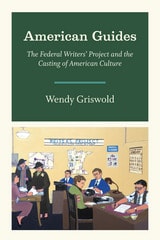
American Guides
The Federal Writers’ Project and the Casting of American CultureWendy Griswold
University of Chicago Press, 2016
Griswold’s subject here is the Project’s American Guides, an impressively produced series that set out not only to direct travelers on which routes to take and what to see throughout the country, but also to celebrate the distinctive characteristics of each individual state. Griswold finds that the series unintentionally diversified American literary culture’s cast of characters—promoting women, minority, and rural writers—while it also institutionalized the innovative idea that American culture comes in state-shaped boxes. Griswold’s story alters our customary ideas about cultural change as a gradual process, revealing how diversity is often the result of politically strategic decisions and bureaucratic logic, as well as of the conflicts between snobbish metropolitan intellectuals and stubborn locals. American Guides reveals the significance of cultural federalism and the indelible impact that the Federal Writers’ Project continues to have on the American literary landscape.
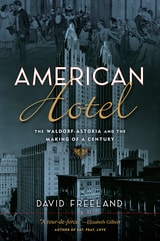
American Hotel
The Waldorf-Astoria and the Making of a CenturyDavid Freeland
Rutgers University Press, 2021
American Hotel takes us behind the glittering image to reveal the full extent of the Waldorf’s contribution toward shaping twentieth-century life and culture. Historian David Freeland examines the Waldorf from the opening of its first location in 1893 through its rise to a place of influence on the local, national, and international stage. Along the way, he explores how the hotel’s mission to provide hospitality to a diverse range of guests was put to the test by events such as Prohibition, the anticommunist Red Scare, and civil rights struggles.
Alongside famous guests like Frank Sinatra, Martin Luther King, Richard Nixon, and Eleanor Roosevelt, readers will meet the lesser-known men and women who made the Waldorf a leader in the hotel industry and a key setting for international events. American Hotel chronicles how institutions such as the Waldorf-Astoria played an essential role in New York’s growth as a world capital.
American Idyll
Academic Antielitism as Cultural CritiqueCatherine Liu
University of Iowa Press, 2011
A trenchant critique of failure and opportunism across the political spectrum, American Idyll argues that social mobility, once a revered hallmark of American society, has ebbed, as higher education has become a mechanistic process for efficient sorting that has more to do with class formation than anything else. Academic freedom and aesthetic education are reserved for high-scoring, privileged students and vocational education is the only option for economically marginal ones.
Throughout most of American history, antielitist sentiment was reserved for attacks against an entrenched aristocracy or rapacious plutocracy, but it has now become a revolt against meritocracy itself, directed against what insurgents see as a ruling class of credentialed elites with degrees from exclusive academic institutions. Catherine Liu reveals that, within the academy and stemming from the relatively new discipline of cultural studies, animosity against expertise has animated much of the Left’s cultural criticism.
By unpacking the disciplinary formation and academic ambitions of American cultural studies, Liu uncovers the genealogy of the current antielitism, placing the populism that dominates headlines within a broad historical context. In the process, she emphasizes the relevance of the historical origins of populist revolt against finance capital and its political influence. American Idyll reveals the unlikely alliance between American pragmatism and proponents of the Frankfurt School and argues for the importance of broad frames of historical thinking in encouraging robust academic debate within democratic institutions. In a bold thought experiment that revives and defends Richard Hofstadter’s theories of anti-intellectualism in American life, Liu asks, What if cultural populism had been the consensus politics of the past three decades?
American Idyll shows that recent antielitism does nothing to redress the source of its discontent—namely, growing economic inequality and diminishing social mobility. Instead, pseudopopulist rage, in conservative and countercultural forms alike, has been transformed into resentment, content merely to take down allegedly elitist cultural forms without questioning the real political and economic consolidation of powers that has taken place in America during the past thirty years.

American Immunity
War Crimes and the Limits of International LawPatrick Hagopian
University of Massachusetts Press, 2013
In 1955 the Supreme Court ruled that veterans of the U.S. armed forces could not be court-martialed for overseas crimes that were not detected until after they had left military service. Territorial limitations placed such acts beyond the jurisdiction of civilian courts, and there was no other American court in which they could be adjudicated. As a result, a jurisdictional gap emerged that for decades exempted former troops from prosecution for war crimes. “This was not merely a theoretical possibility,” Patrick Hagopian writes. Over a dozen former soldiers who participated in the My Lai massacre did in fact “get away with murder.” Further court rulings expanded the gap to cover civilian employees and contractors that accompanied the armed forces.
In American Immunity, Hagopian places what he calls the “superpower exemption” in the context of a long-standing tension between international law and U.S. sovereignty. He shows that despite the U.S. role in promulgating universal standards of international law and forming institutions where those standards can be enforced, the United States has repeatedly refused to submit its own citizens and troops to the jurisdiction of international tribunals and failed to uphold international standards of justice in its own courts.
In 2000 Congress attempted to close the jurisdictional gap with passage of the Military Extraterritorial Jurisdiction Act. The effectiveness of that legislation is still in question, however, since it remains unclear how willing civilian American juries will be to convict veterans for conduct in foreign war zones.
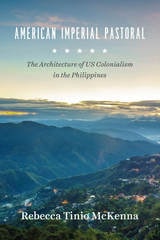
American Imperial Pastoral
The Architecture of US Colonialism in the PhilippinesRebecca Tinio McKenna
University of Chicago Press, 2017
In American Imperial Pastoral, Rebecca Tinio McKenna examines the design, construction, and use of Baguio, making visible the physical shape, labor, and sustaining practices of the US’s new empire—especially the dispossessions that underwrote market expansion. In the process, she demonstrates how colonialists conducted market-making through state-building and vice-versa. Where much has been made of the racial dynamics of US colonialism in the region, McKenna emphasizes capitalist practices and design ideals—giving us a fresh and nuanced understanding of the American occupation of the Philippines.

American Interests and Policies in the Middle East, 1900-1939
John A. DeNovo
University of Minnesota Press, 1963
American Interests and Policies in the Middle East, 1900-1939 was first published in
1963. Minnesota Archive Editions uses digital technology to make long-unavailable books once again accessible, and are published unaltered from the original University of Minnesota Press editions.Scholars concerned with the diplomatic history of the United States have largely neglected the subject of American relations with the Middle East during the four decades before World War I. With this study, Professor DeNovo fills the gap by describing and assessing the United States' cultural, economic, and diplomatic relations with Turkey, Persia, and the Arab East in that period. He traces, chronologically and topically, the activities of such American interest groups as Protestant missionaries, educators, philanthropists, archaeologists, businessmen, and technical advisers, as well as the official actions of their government.
The account falls roughly into three chronological periods. The first section traces the interest groups through the pre-World War I years of political and cultural stirring in the Ottoman Empire and Persia. Special attention is given to the Chester Project for railroad development in Turkey. The second part deals with the upheavals accompanying World War I and the tasks of peacemaking from the Mudros armistice through the Lausanne settlement of 1923. The latter chapters detail the rise of the Turkish national movement, the deepening Persian and Arab nationalism, and the accommodation of American cultural and economic groups to these conditions. The author points out that before World War II began, Americans had acquired a significant interest in Middle Eastern oil and had become emotionally involved in the Arab-Zionist tension. In 1939 the United States was on the verge of a new phase in its Middle Eastern relations when that region would become more intimately linked to America's national security.
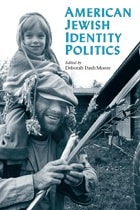
American Jewish Identity Politics
Deborah Dash Moore, editor
University of Michigan Press, 2009
"Displays the full range of informed, thoughtful opinion on the place of Jews in the American politics of identity."
---David A. Hollinger, Preston Hotchkis Professor of American History, University of California, Berkeley
"A fascinating anthology whose essays crystallize the most salient features of American Jewish life in the second half of the twentieth century."
---Beth S. Wenger, Katz Family Associate Professor of American Jewish History and Director of the Jewish Studies Program, University of Pennsylvania
"A wonderful collection of important essays, indispensable for understanding the searing conflicts over faith, familial, and political commitments marking American Jewry's journey through the paradoxes of the post-Holocaust era."
---Michael E. Staub, Professor of English, Baruch College, CUNY, and author of Torn at the Roots: The Crisis of Jewish Liberalism in Postwar America
"This provocative anthology offers fascinating essays on Jewish culture, politics, religion, feminism, and much more. It is a must-read for all those interested in the intersection of Jewish life and identity politics in the modern period."
---Joyce Antler, Samuel Lane Professor of American Jewish History and Culture, Brandeis University
"This collection of essays invites the reader to engage with some of the best writing and thinking about American Jewish life by some of the finest scholars in the field. Deborah Moore's introduction offers an important framework to understand not only the essays, but the academic and political contexts in which they are rooted."
---Riv-Ellen Prell, Professor and Chair, American Studies, University of Minnesota, and editor of Women Remaking American Judaism
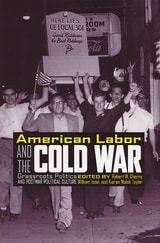
American Labor and the Cold War
Grassroots Politics and Postwar Political CultureCherny, Robert
Rutgers University Press, 2004
The American labor movement seemed poised on the threshold of unparalleled success at the beginning of the post-World War II era. Fourteen million strong in 1946, unions represented thirty five percent of non-agricultural workers. Why then did the gains made between the 1930s and the end of the war produce so few results by the 1960s?
This collection addresses the history of labor in the postwar years by exploring the impact of the global contest between the United States and the Soviet Union on American workers and labor unions. The essays focus on the actual behavior of Americans in their diverse workplaces and communities during the Cold War. Where previous scholarship on labor and the Cold War has overemphasized the importance of the Communist Party, the automobile industry, and Hollywood, this book focuses on politically moderate, conservative workers and union leaders, the medium-sized cities that housed the majority of the population, and the Roman Catholic Church. These are all original essays that draw upon extensive archival research and some upon oral history sources.
American Labor in the Southwest
The First One Hundred YearsEdited by James C. Foster
University of Arizona Press, 1982
The Western Federation of Miners
James C. Foster, D. H. Dinwoodie
The Industrial Workers of the World
Earl Bruce White, James Byrkit
The Rise of Unionized Farm Workers
H. L. Mitchell, Edward D. Beechert, Art Carstens
Mexican Labor, North and South of the Border
John M. Hart, Rodney Anderson, David Maciel
Labor and Politics
Paul Mandel, George N. Green, Charles O. Rice
American Literary Minimalism
Robert C. Clark
University of Alabama Press, 2015
Tracing the evolution of minimalist style from Hemingway to the twenty‑first century.
Although a handful of books and articles have been written about American literary Minimalism during the last forty years, the mode remains misunderstood. When in a 2011 interview in The Paris Review author Ann Beattie was asked how she felt about being “classed as a minimalist,” she began her answer: “none of us have ever known what that means.” Her response brings into focus the lack of agreement or clarity about the sources and definitions of literary Minimalism. Robert C. Clark’s American Literary Minimalism fills this significant gap.
Clark demonstrates that, despite assertions by many scholars to the contrary, the movement originated in the aesthetic programs of the Imagists and literary Impressionists active at the turn of the twentieth century. The genre reflects the philosophy that “form is thought,” and that style alone dictates whether a poem, story, or novel falls within the parameters of the tradition. The characteristics of Minimalist fiction are efficiency, frequent use of allusion, and implication through omission.
Organizing his analysis both chronologically and according to lines of influence, Clark offers a definition of the mode, describes its early stages, and then explores six works that reflect its core characteristics: Ernest Hemingway’s In Our Time; Raymond Carver’s Cathedral; Jay McInerney’s Bright Lights, Big City; Susan Minot’s Monkeys; Sandra Cisneros’s Caramelo; and Cormac McCarthy’s The Road. In his conclusion, Clark discusses the ongoing evolution of the category.
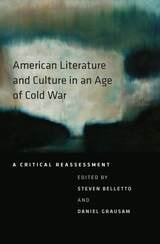
American Literature and Culture in an Age of Cold War
A Critical ReassessmentSteven Belletto
University of Iowa Press, 2012
Likewise, the authors describe phenomena—such as the FBI’s surveillance of writers (especially African Americans), biopolitics, development theory, struggles over the centralization and decentralization of government, and the cultural work of Reaganism—that open up new contexts for discussing postwar culture. Extending the timeline and expanding the geographic scope of Cold War culture, this book reveals both the literature and the culture of the time to be more dynamic and complex than has been generally supposed.
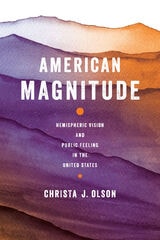
American Magnitude
Hemispheric Vision and Public Feeling in the United StatesChrista J. Olson
The Ohio State University Press, 2021
Winner, 2023 Rhetoric Society of America Book Award
Winner, 2022 Marie Hochmuth Nichols Award from the National Communication Association
At a moment in US politics when racially motivated nationalism, shifting relations with Latin America, and anxiety over national futures intertwine, understanding the long history of American preoccupation with magnitude and how it underpins national identity is vitally important. In American Magnitude, Christa J. Olson tracks the visual history of US appeals to grandeur, import, and consequence (megethos), focusing on images that use the wider Americas to establish US character. Her sources—including lithographs from the US-Mexican War, pre–Civil War paintings of the Andes, photo essays of Machu Picchu, and WWII-era films promoting hemispheric unity—span from 1845 to 1950 but resonate into the present.
Olson demonstrates how those crafting the appeals that feed the US national imaginary—artists, scientists, journalists, diplomats, and others—have invited US audiences to view Latin America as a foil for the greatness of their own nation and encouraged white US publics in particular to see themselves as especially American among Americans. She reveals how each instance of visual rhetoric relies upon the eyes of others to instantiate its magnitude—and falters as some viewers look askance instead. The result is the possibility of a post-magnitude United States: neither great nor failed, but modest, partial, and imperfect.
American Mainline Religion
Its Changing Shape and FutureWade Clark Roof and William McKinney
Rutgers University Press, 1987
"American Mainline Religion" provides a new "mapping" of the families of American religion and the underlying social, cultural, and demographic forces that will reshape American religion in the century to come. Going beyond the headlines in daily newspapers, Roof and McKinney document the decline of the Protestant establishment, the rise of a more assimilated and public-minded Roman Catholicism, the place of black Protestantism and Judaism, and the resurgence of conservative Protestantism as a religious and cultural force.
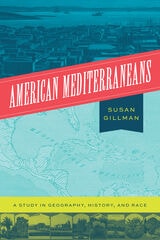
American Mediterraneans
A Study in Geography, History, and RaceSusan Gillman
University of Chicago Press, 2022
The naturalist Alexander von Humboldt, visiting the Gulf-Caribbean in the early nineteenth century, called it America’s Mediterranean. Almost a century later, Southern California was hailed as “Our Mediterranean, Our Italy!” Although “American Mediterranean” is not a household phrase in the United States today, it once circulated widely in French, Spanish, and English as a term of art and folk idiom. In this book, Susan Gillman asks what cultural work is done by this kind of unsystematic, open-ended comparative thinking.
American Mediterraneans tracks two centuries of this geohistorical concept, from Humboldt in the early 1800s, to writers of the 1890s reflecting on the Pacific world of the California coast, to writers of the 1930s and 40s speculating on the political past and future of the Caribbean. Following the term through its travels across disciplines and borders, American Mediterraneans reveals a little-known racialized history, one that paradoxically appealed to a range of race-neutral ideas and ideals.
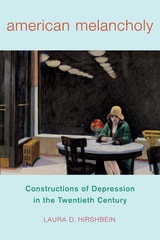
American Melancholy
Constructions of Depression in the Twentieth CenturyHirshbein, Laura D
Rutgers University Press, 2009
American Melancholy traces the growth of depression as an object of medical study and as a consumer commodity and illustrates how and why depression came to be such a huge medical, social, and cultural phenomenon. It is the first book to address gender issues in the construction of depression, explores key questions of how its diagnosis was developed, how it has been used, and how we should question its application in American society.
American Missionaries and the Middle East
Foundational EncountersMehmet Ali Dogan
University of Utah Press, 2010
During the nineteenth and early twentieth centuries, American missionary encounters in the Middle East set foundations for later U.S.-Middle Eastern relations. Missionaries presented examples of American culture to Middle Eastern peoples, just as they interpreted the Middle East for Americans back home. These engagements prompt larger questions about the consequences of American Christian cultural projection into the wider world.
This volume focuses on regions that were once part of the Ottoman Empire in western Asia, the Balkans, and North Africa. Contributors explain the distinctly American dimensions of these missionary encounters, the cultural influences they exerted on the region, and their consequences for local nationalism, print culture, education, and more. This is an excellent resource for specialists in history, Middle Eastern studies, American studies, religious studies, missiology, and anyone interested more broadly in American engagement in the Middle East.