Results by title
8642 books match the query '20th Century' and 836 start with a
American Naturalism and the Jews
Garland, Norris, Dreiser, Wharton, and CatherDonald Pizer
University of Illinois Press, 2007
American Nietzsche
A History of an Icon and His IdeasJennifer Ratner-Rosenhagen
University of Chicago Press, 2011
If you were looking for a philosopher likely to appeal to Americans, Friedrich Nietzsche would be far from your first choice. After all, in his blazing career, Nietzsche took aim at nearly all the foundations of modern American life: Christian morality, the Enlightenment faith in reason, and the idea of human equality. Despite that, for more than a century Nietzsche has been a hugely popular—and surprisingly influential—figure in American thought and culture.
In American Nietzsche, Jennifer Ratner-Rosenhagen delves deeply into Nietzsche's philosophy, and America’s reception of it, to tell the story of his curious appeal. Beginning her account with Ralph Waldo Emerson, whom the seventeen-year-old Nietzsche read fervently, she shows how Nietzsche’s ideas first burst on American shores at the turn of the twentieth century, and how they continued alternately to invigorate and to shock Americans for the century to come. She also delineates the broader intellectual and cultural contexts within which a wide array of commentators—academic and armchair philosophers, theologians and atheists, romantic poets and hard-nosed empiricists, and political ideologues and apostates from the Left and the Right—drew insight and inspiration from Nietzsche’s claims for the death of God, his challenge to universal truth, and his insistence on the interpretive nature of all human thought and beliefs. At the same time, she explores how his image as an iconoclastic immoralist was put to work in American popular culture, making Nietzsche an unlikely posthumous celebrity capable of inspiring both teenagers and scholars alike.
A penetrating examination of a powerful but little-explored undercurrent of twentieth-century American thought and culture, American Nietzsche dramatically recasts our understanding of American intellectual life—and puts Nietzsche squarely at its heart.
American Poetry as Transactional Art
Stephen Fredman
University of Alabama Press, 2020
Explores the ways American poetry engages with visual art, music, fiction, spirituality, and performance art
Many people think of poetry as a hermetic art, as though poets wrote only about themselves or as if the subject of poetry were finally only poetry—its forms and traditions. Indeed much of what constitutes poetry in the lyric tradition depends on a stringently controlled point of view and aims for a timeless, intransitive utterance. Stephen Fredman’s study proposes a different perspective.
American Poetry as Transactional Art explores a salient quality of much avant-garde American poetry that has so far lacked sustained treatment: namely, its role as a transactional art. Specifically Fredman describes this role as the ways it consistently engages in conversation, talk, correspondence, going beyond the scope of its own subjects and forms—its existential interactions with the outside world. Poetry operating in this vein draws together images, ideas, practices, rituals, and verbal techniques from around the globe, and across time—not to equate them, but to establish dialogue, to invite as many guests as possible to the World Party, which Robert Duncan has called the “symposium of the whole.”
Fredman invites new readers into contemporary poetry by providing lucid and nuanced analyses of specific poems and specific interchanges between poets and their surroundings. He explores such topics as poetry’s transactions with spiritual traditions and practices over the course of the twentieth century; the impact of World War II on the poetry of Charles Olson and George Oppen; exchanges between poetry and other art forms including sculpture, performance art, and ambient music; the battle between poetry and prose in the early work of Paul Auster and in Lyn Hejinian’s My Life. The epilogue looks briefly at another crucial transactional occasion: teaching American poetry in the classroom in a way that demonstrates that it is at the center of the arts and at the heart of American culture.
American Pogrom
The East St. Louis Race Riot and Black PoliticsCharles L. Lumpkins
Ohio University Press, 2008
Charles Lumpkins shows that black residents of East St. Louis had engaged in formal politics since the 1870s, exerting influence through the ballot and through patronage in a city dominated by powerful real estate interests even as many African Americans elsewhere experienced setbacks in exercising their political and economic rights.
While Lumpkins asserts that the race riots were a pogrom—an organized massacre of a particular ethnic group—orchestrated by certain businessmen intent on preventing black residents from attaining political power and on turning the city into a “sundown” town permanently cleared of African Americans, he also demonstrates how the African American community survived. He situates the activities of the black citizens of East St. Louis in the context of the larger story of the African American quest for freedom, citizenship, and equality.

American Policy Toward Communist Eastern Europe
The Choices AheadJohn C. Campbell
University of Minnesota Press, 1965
American Policy Toward Communist Eastern Europe was first published in 1965. Minnesota Archive Editions uses digital technology to make long-unavailable books once again accessible, and are published unaltered from the original University of Minnesota Press editions.
Perhaps no aspect of American foreign relations has been in greater need of clarification and understanding than our policy toward the Communist nations of Eastern Europe, both as to what has happened in the past and what is possible for the future. In this book a former State Department Official, now on the staff of the Council on Foreign Relations, provides objective information which will help students, professors, members of adult study groups, and others concerned with American foreign policy to understand and discuss this important subject.
Mr. Campbell reminds us that the cold war began in Eastern Europe in the aftermath of the second World War. Since that time, the question of what to do about Eastern Europe has been in the forefront of American foreign policy. For some years, he contends, we have been uncertain of our objectives and ambivalent in our policies. Meanwhile, changes since the death of Stalin have created new situations both for the Soviet Union and for the West.In analyzing what has happened, the author emphasizes the forces which have shaken the unity of the Soviet bloc to create new perspectives and possibilities. He discusses the effects of the Soviet- Chinese split, the relationship of the German question to that of Eastern Europe, and the phenomenon of national Communism as it has appeared in different forms in Yugoslavia, Poland, Rumania, and elsewhere.After presenting the historical background, the author discusses American aims and current policies and outlines the choices he sees ahead. He does not plead for any one of the alternative lines of action, presenting them, rather, as a basis for reasoned consideration and debate.
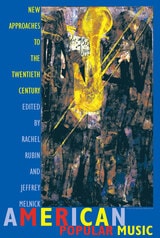
American Popular Music
New Approaches to the Twentieth CenturyRachel Rubin
University of Massachusetts Press, 2001
Designed as a broad introductory survey, and written by experts in the field, this book examines the rise of American music over the past hundred years — the period in which that music came into its own and achieved unprecedented popularity. Beginning with a look at music as a business, eleven essays explore a variety of popular musical genres, including Tin Pan Alley, blues, jazz, country, gospel, rhythm and blues, rock and roll, folk, rap, and Mexican American corridos. Reading these essays, we come to see that the forms created by one group often appeal to, and are in turn influenced by, other groups—across lines of race, ethnicity, class, gender, region, and age. The chapters speak to one another, arguing for the primacy of such concepts as minstrelsy, urbanization, hybridity, and crossover as the most powerful tools for understanding American popular music. Moving beyond outdated music-industry categories and misleading genre labels, while acknowledging the complexities of the market, the book recovers and reinforces the essential blackness of much popular music—even a presumably white form like country and western. In addition to Rachel Rubin and Jeffrey Melnick, contributors include Reebee Garofalo, Geoffrey Jacques, Kip Lornell, Mark Anthony Neal, Millie Rahn, David Sanjek, James Smethurst, Elijah Wald, and Gail Hilson Woldu.
American Power and International Theory at the Council on Foreign Relations, 1953-54
David M. McCourt, Editor
University of Michigan Press, 2020
Between December 1953 and June 1954, the elite think-tank the Council on Foreign Relations (CFR) joined prominent figures in International Relations, including Pennsylvania’s Robert Strausz-Hupé, Yale’s Arnold Wolfers, the Rockefeller Foundation’s William Thompson, government adviser Dorothy Fosdick, and nuclear strategist William Kaufmann. They spent seven meetings assessing approaches to world politics—from the “realist” theory of Hans Morgenthau to theories of imperialism of Karl Marx and V.I. Lenin—to discern basic elements of a theory of international relations.
The study group’s materials are an indispensable window to the development of IR theory, illuminating the seeds of the theory-practice nexus in Cold War U.S. foreign policy. Historians of International Relations recently revised the standard narrative of the field’s origins, showing that IR witnessed a sharp turn to theoretical consideration of international politics beginning around 1950, and remained preoccupied with theory. Taking place in 1953–54, the CFR study group represents a vital snapshot of this shift.
This book situates the CFR study group in its historical and historiographical contexts, and offers a biographical analysis of the participants. It includes seven preparatory papers on diverse theoretical approaches, penned by former Berkeley political scientist George A. Lipsky, followed by the digest of discussions from the study group meetings. American Power and International Theory at the Council on Foreign Relations, 1953–54 offers new insights into the early development of IR as well as the thinking of prominent elites in the early years of the Cold War.
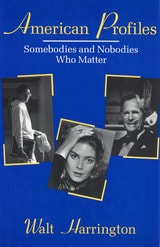
American Profiles
Somebodies and Nobodies Who MatterWalt Harrington
University of Missouri Press, 1992
Author Walt Harrington, award-winning writer for the Washington Post Magazine, lifts the masks of celebrity and obscurity to reveal the lives of some singular men and women--from actress Kelly McGillis to nocturnal satanist Anton LaVey.
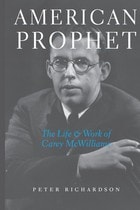
American Prophet
The Life and Work of Carey McWilliamsPeter Richardson
University of Michigan Press, 2005
Peter Richardson's absorbing and elegantly paced book reveals a figure thoroughly engaged with the issues of his time. Deftly interweaving correspondence, diary notes, published writings, and McWilliams's own and others' observations on a colorful and influential cast of characters from Hollywood, New York, Washington, DC, and the American West, Richardson maps the evolution of McWilliams's personal and professional life. Among those making an appearance are H. L. Mencken (McWilliams's mentor and role model), Louis Adamic, John Fante, Robert Towne, Richard Nixon, Studs Terkel, J. Edgar Hoover, Arthur Schlesinger, Jr., and Joseph McCarthy.
American Prophet illustrates the arc of McWilliams's life and career from his early literary journalism through his legal and political activism, his stint in state government, and his two decades as editor of the Nation. This book makes the case for McWilliams's place in the Olympian realm of our most influential and prescient political writers.
Peter Richardson is the editorial director at PoliPointPress in Sausalito, California. He is the author or editor of numerous works on language, literature, and California public policy. He holds a Ph.D. in English from the University of California Berkeley.
American Reform Judaism
An IntroductionDana Evan Kaplan
Rutgers University Press, 2003
The only comprehensive and up-to-date look at Reform Judaism, this book analyzes the forces currently challenging the Reform movement, now the largest Jewish denomination in the United States.
To distinguish itself from Orthodox and Conservative Judaism, the Reform movement tries to be an egalitarian, open, and innovative version of the faith true to the spirit of the tradition but nonetheless fully compatible with modern secular life. Promoting itself in this way, Reform Judaism has been tremendously successful in recruiting a variety of people—intermarried families, feminists, gays and lesbians, and interracial families among others—who resist more traditional forms of worship.
As an unintended result of this success, the movement now struggles with an identity crisis brought on by its liberal theology, which teaches that each Jew is free to practice Judaism more or less as he or she pleases. In the absence of the authority that comes from a theology based on a commanding, all-powerful God, can Reform Judaism continue to thrive? Can it be broadly inclusive and still be uniquely and authentically Jewish?
Taking this question as his point of departure, Dana Evan Kaplan provides a broad overview of the American Reform movement and its history, theology, and politics. He then takes a hard look at the challenges the movement faces as it attempts to reinvent itself in the new millennium. In so doing, Kaplan gives the reader a sense of where Reform Judaism has come from, where it stands on the major issues, and where it may be going.
Addressing the issues that have confronted the movement—including the ordination of women, acceptance of homosexuality, the problem of assimilation, the question of rabbinic officiation at intermarriages, the struggle for acceptance in Israel, and Jewish education and others—Kaplan sheds light on the connection between Reform ideology and cultural realities. He unflinchingly, yet optimistically, assesses the movement’s future and cautions that stormy weather may be ahead.
American Relief Aid and the Spanish Civil War
Eric R. Smith
University of Missouri Press, 2013
The Spanish Civil War created a conflict for Americans who preferred that the United States remain uninvolved in foreign affairs. Despite the country's isolationist tendencies, opposition to the rise of fascism across Europe convinced many Americans that they had to act in support of the Spanish Republic. While much has been written about the war itself and its international volunteers, little attention has been paid to those who coordinated these relief efforts at home.
American Relief Aid and the Spanish Civil War tells the story of the political campaigns to raise aid for the Spanish Republic as activists pushed the limits of isolationist thinking. Those concerned with Spain’s fate held a range of political convictions (including anarchists, socialists, liberals, and communists) with very different understandings of what fascism was. Yet they all agreed that fascism’s advance must be halted. With labor strikes, fund-raising parties, and ambulance tours, defenders of Spain in the United States sought to shift the political discussion away from isolation of Spain’s elected government and toward active assistance for the faltering Republic.
Examining the American political organizations affiliated with this relief effort and the political repression that resulted as many of Spain’s supporters faced the early incarnations of McCarthyism’s trials, Smith provides new understanding of American politics during the crucial years leading up to World War II. By also focusing on the impact the Spanish Civil War had on those of Spanish ethnicity in the United States, Smith shows how close to home the seemingly distant war really hit.
American Rhetoric in the New Deal Era, 1932-1945
A Rhetorical History of the United States, Volume VIIThomas Benson
Michigan State University Press, 2006
The New Deal era is hard to define with precision—in time or in ideology. Some historians use New Deal to designate the intense period of domestic reform legislation of the first Franklin Delano Roosevelt administration, 1933–37. Others confine discussion of the era to the legislation of 1933, and identify another wave of legislation in 1935 as a Second New Deal. Most of the essays in this book focus on the prewar period, with glimpses that look forward to the rhetoric of the approach to and engagement in World War II.
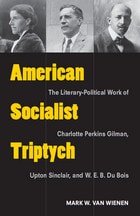
American Socialist Triptych
The Literary-Political Work of Charlotte Perkins Gilman, Upton Sinclair, and W. E. B. Du BoisMark W. Van Wienen
University of Michigan Press, 2014
"A meticulously researched, highly informed, carefully argued, and very accessible account of American socialism, socialists, and socialistic thinking, from the late nineteenth century through the 1960s . . . challenges the intellectual and political legacy of Werner Sombart's Why Is There No Socialism in the United States?, whose spirit still hovers over animated discussions about the 'failures' of socialism in the United States."
---James A. Miller, George Washington University
"A valuable rethinking and reframing of the traditions of leftist literary scholarship in the U.S."
---Sylvia Cook, University of Missouri, St. Louis
American Socialist Triptych: The Literary-Political Work of Charlotte Perkins Gilman, Upton Sinclair, and W. E. B. Du Bois explores the contributions of three writers to the development of American socialism over a fifty--year period and asserts the vitality of socialism in modern American literature and culture.
Drawing upon a wide range of texts including archival sources, Mark W. Van Wienen demonstrates the influence of reform-oriented, democratic socialism both in the careers of these writers and in U.S. politics between 1890 and 1940. While offering unprecedented in-depth analysis of modern American socialist literature, this book charts the path by which the supposedly impossible, dangerous ideals of a cooperative commonwealth were realized, in part, by the New Deal.
American Socialist Triptych provides in-depth, innovative readings of the featured writers and their engagement with socialist thought and action. Upton Sinclair represents the movement's most visible manifestation, the Socialist Party of America, founded in 1901; Charlotte Perkins Gilman reflects the socialist elements in both feminism and 1890s reform movements, and W. E. B. Du Bois illuminates social democratic aspirations within the NAACP. Van Wienen's book seeks to re-energize studies of Sinclair by treating him as a serious cultural figure whose career peaked not in the early success of The Jungle but in his nearly successful 1934 run for the California governorship. It also demonstrates as never before the centrality of socialism throughout Gilman's and Du Bois's literary and political careers.
More broadly, American Socialist Triptych challenges previous scholarship on American radical literature, which has focused almost exclusively on the 1930s and Communist writers. Van Wienen argues that radical democracy was not the phenomenon of a decade or of a single group but a sustained tradition dispersed within the culture, providing a useful genealogical explanation for how socialist ideas were actually implemented through the New Deal.
American Socialist Triptych also revises modern American literary history, arguing for the endurance of realist and utopian literary modes at the height of modernist literary experimentation and showing the importance of socialism not only to the three featured writers but also to their peers, including Edward Bellamy, Hamlin Garland, Jack London, Edna St. Vincent Millay, and Claude McKay. Further, by demonstrating the importance of social democratic thought to feminist and African American campaigns for equality, the book dialogues with recent theories of radical egalitarianism. Readers interested in American literature, U.S. history, political theory, and race, gender, and class studies will all find in American Socialist Triptych a valuable and provocative resource.
American Studies in a Moment of Danger
George Lipsitz
University of Minnesota Press, 2001
A forthright look at the future of the discipline in the wake of immense social changes.
What becomes of "national knowledge" in our age of globalization? If dramatic changes in technology, commerce, and social relations are undermining familiar connections between culture and place, what happens to legacies of learning that put the nation at the center of the study of history, culture, language, politics, and geography? In short, what remains of American Studies? At a critical moment, this book offers a richly textured historical perspective on where our notions of national knowledge-and our sense of American Studies-have come from and where they may lead in a future of new ideas about culture and community.
The America that seems to be disappearing before our very eyes is, George Lipsitz argues, actually the cumulative creation of yesterday’s struggles over identity, culture, and power. With examples from statistics and history, poster designs and music lyrics, Lipsitz shows how American Studies has been shaped by the social movements of the 1930s, 1960s, and 1980s. His analysis reveals the sedimented history of social movement contestation contained in contemporary popular music, visual art, and cinema.Finally, Lipsitz identifies the ways in which the globalization of commerce and culture are producing radically new understandings of politics, performance, consumption, knowledge, and nostalgia; the changing realities present not so much a danger as a clear challenge to a still-evolving American Studies-a challenge that this book helps us to confront wisely, flexibly, and effectively. Critical American Studies SeriesAnnouncing a new seriesCritical American Studies George Lipsitz, series editorThis series examines recent trends in American Studies that address fundamental questions about history, culture, social structure, race, gender, sexuality, and citizenship. It examines the forces-including mass migration, global economy, the seeming weaknesses of the nation-state, and ongoing ethnic antagonisms-that compel the field to reexamine the role of culture in producing individual and collective identities.
American Sunshine
Diseases of Darkness and the Quest for Natural LightDaniel Freund
University of Chicago Press, 2012
In the second half of the nineteenth century, American cities began to go dark. Hulking new buildings overspread blocks, pollution obscured the skies, and glass and smog screened out the health-giving rays of the sun. Doctors fed anxities about these new conditions with claims about a rising tide of the "diseases of darkness," especially rickets and tuberculosis.
In American Sunshine, Daniel Freund tracks the obsession with sunlight from those bleak days into the twentieth century. Before long, social reformers, medical professionals, scientists, and a growing nudist movement proffered remedies for America’s new dark age. Architects, city planners, and politicians made access to sunlight central to public housing and public health. and entrepreneurs, dairymen, and tourism boosters transformed the pursuit of sunlight and its effects into a commodity. Within this historical context, Freund sheds light on important questions about the commodification of health and nature and makes an original contribution to the histories of cities, consumerism, the environment, and medicine.
American Superrealism
Nathanael West and the Politics of Representation in the 1930sJonathan Veitch
University of Wisconsin Press, 1997
Nathanael West has been hailed as “an apocalyptic writer,” “a writer on the left,” and “a precursor to postmodernism.” But until now no critic has succeeded in fully engaging West’s distinctive method of negation. In American Superrealism, Jonathan Veitch examines West’s letters, short stories, screenplays and novels—some of which are discussed here for the first time—as well as West’s collaboration with William Carlos Williams during their tenure as the editors of Contact. Locating West in a lively, American avant-garde tradition that stretches from Marcel Duchamp to Andy Warhol, Veitch explores the possibilities and limitations of dada and surrealism—the use of readymades, scatalogical humor, human machines, “exquisite corpses”—as modes of social criticism. American Superrealism offers what is surely the definitive study of West, as well as a provocative analysis that reveals the issue of representation as the central concern of Depression-era America.
American Sweepstakes
How One Small State Bucked the Church, the Feds, and the Mob to Usher in the Lottery AgeKevin Flynn
University Press of New England, 2015
American Theater in the Culture of the Cold War
Producing and Contesting Containment, 1947-1962Bruce A. Mcconachie
University of Iowa Press, 2003
McConachie reconstructs these cognitive processes by relying on scripts, set designs, reviews, memoirs, and other evidence. After establishing his theoretical framework, he focuses on three archtypal figures of containment significant in Cold War culture, Empty Boys, Family Circles, and Fragmented Heroes. McConachie uses a range of plays, musicals, and modern dances from the dominant culture of the Cold War to discuss these figures, including The Seven Year Itch, Cat on a Hot Tin Roof; The King and I,A Raisin in the Sun, Night Journey, and The Crucible. In an epilogue, he discusses the legacy of Cold War theater from 1962 to 1992.
American Tomboys, 1850-1915
Renée M. Sentilles
University of Massachusetts Press, 2018
American Tropics
Articulating Filipino AmericaAllan Punzalan Isaac
University of Minnesota Press, 2006
American Vaudeville
Geoffrey Hilsabeck
West Virginia University Press, 2021
At the heart of American Vaudeville is one strange, unsettling fact: for nearly fifty years, from the late nineteenth century to the 1930s, vaudeville was everywhere—then, suddenly, it was nowhere. This book tells the story of what was once the most popular form of entertainment in the country using lists, creation myths, thumbnail biographies, dreams, and obituaries. A lyric history—part social history, part song—American Vaudeville sits at the nexus between poetry, experimental nonfiction, and, because it includes historic images, art books.
Geoffrey Hilsabeck’s book grows out of extensive archival research. Rather than arranging that research—the remains of vaudeville—into a realistic picture or tidy narrative, Hilsabeck dreams vaudeville back into existence, drawing on photographs, letters, joke books, reviews, newspaper stories, anecdotes, and other material gathered from numerous archives, as well as from memoirs by vaudeville performers like Buster Keaton, Eva Tanguay, and Eddie Cantor. Some of this research is presented as-is, a letter from a now forgotten vaudeville performer to her booking agent, for example; some is worked up into brief scenes and biographies; and some is put to even more imaginative uses, finding new life in dialogues and prose poems.
American Vaudeville pulls the past into the present and finds in the beauty and carnivalesque grotesqueness of vaudeville a fitting image of American life today.
American War Stories
Veteran-Writers and the Politics of MemoirMyra Mendible
University of Massachusetts Press, 2021
American War Stories centers on an extensive selection of memoirs written by veterans of the Vietnam, Iraq, and Afghanistan conflicts—including Brian Turner's My Life as a Foreign Country, Marcus Luttrell's Lone Survivor, and Camilo Mejia's Road from ar Ramadi—to explore the complex relationship between memory and politics in the context of postmodern war. Placing veterans' stories in conversation with broader cultural and political discourses, Myra Mendible analyzes the volatile mix of agendas, identities, and issues informing veteran-writers' narrative choices to argue that their work plays an important, though underexamined, political function in how Americans remember and judge their wars.
American Warsaw
The Rise, Fall, and Rebirth of Polish ChicagoDominic A. Pacyga
University of Chicago Press, 2019
Every May, a sea of 250,000 people decked out in red and white head to Chicago’s Loop to celebrate the Polish Constitution Day Parade. In the city, you can tune in to not one but four different Polish-language radio stations or jam out to the Polkaholics. You can have lunch at pierogi food trucks or pick up pączkis at the grocery store. And if you’re lucky, you get to take off work for Casimir Pulaski Day. For more than a century, Chicago has been home to one of the largest Polish populations outside of Poland, and the group has had an enormous influence on the city’s culture and politics. Yet, until now, there has not been a comprehensive history of the Chicago Polonia.
With American Warsaw, award-winning historian and Polish American Dominic A. Pacyga chronicles more than a century of immigration, and later emigration back to Poland, showing how the community has continually redefined what it means to be Polish in Chicago. He takes us from the Civil War era until today, focusing on how three major waves of immigrants, refugees, and fortune seekers shaped and then redefined the Polonia. Pacyga also traces the movement of Polish immigrants from the peasantry to the middle class and from urban working-class districts dominated by major industries to suburbia. He documents Polish Chicago’s alignments and divisions: with other Chicago ethnic groups; with the Catholic Church; with unions, politicians, and city hall; and even among its own members. And he explores the ever-shifting sense of Polskość, or “Polishness.”
Today Chicago is slowly being eclipsed by other Polish immigrant centers, but it remains a vibrant—and sometimes contentious—heart of the Polish American experience. American Warsaw is a sweeping story that expertly depicts a people who are deeply connected to their historical home and, at the same time, fiercely proud of their adopted city. As Pacyga writes, “While we were Americans, we also considered ourselves to be Poles. In that strange Chicago ethnic way, there was no real difference between the two.”
American Women in World War I
They Also ServedLettie Gavin
University Press of Colorado, 1997
Americanization, Acculturation, and Ethnic Identity
The Nisei Generation in HawaiiEileen H. Tamura
University of Illinois Press, 1994
Wartime hysteria over "foreign" ways fueled a movement for Americanization that swept the United States during and after World War I. Eileen H. Tamura examines the forms that hysteria took in Hawai'i, where the Nisei (children of Japanese immigrants) were targets of widespread discrimination.
Tamura analyzes Hawaii's organized effort to force the Nisei to adopt "American" ways, discussing it within the larger phenomenon of Nisei acculturation. While racism was prevalent in "paradise," the Nisei and their parents also performed as active agents in their own lives, with the older generation attempting to maintain Japanese cultural ways and the younger wishing to become "true Americans." Caucasian "Americanizers," often associated with powerful agricultural interests, wanted labor to remain cheap and manageable; they lobbied for racist laws and territorial policies, portending the treatment of ethnic Japanese on the U.S. mainland during World War II.
Tamura offers a wealth of original source material, using personal accounts as well as statistical data to create an essential resource for students of American ethnic history and U.S. race and class relations.
Americans All
Good Neighbor Cultural Diplomacy in World War IIBy Darlene J. Sadlier
University of Texas Press, 2012
Cultural diplomacy—“winning hearts and minds” through positive portrayals of the American way of life—is a key element in U.S. foreign policy, although it often takes a backseat to displays of military might. Americans All provides an in-depth, fine-grained study of a particularly successful instance of cultural diplomacy—the Office of the Coordinator of Inter-American Affairs (CIAA), a government agency established by President Franklin D. Roosevelt in 1940 and headed by Nelson A. Rockefeller that worked to promote hemispheric solidarity and combat Axis infiltration and domination by bolstering inter-American cultural ties.
Darlene J. Sadlier explores how the CIAA used film, radio, the press, and various educational and high-art activities to convince people in the United States of the importance of good neighbor relations with Latin America, while also persuading Latin Americans that the United States recognized and appreciated the importance of our southern neighbors. She examines the CIAA’s working relationship with Hollywood’s Motion Picture Society of the Americas; its network and radio productions in North and South America; its sponsoring of Walt Disney, Orson Welles, John Ford, Gregg Toland, and many others who traveled between the United States and Latin America; and its close ties to the newly created Museum of Modern Art, which organized traveling art and photographic exhibits and produced hundreds of 16mm educational films for inter-American audiences; and its influence on the work of scores of artists, libraries, book publishers, and newspapers, as well as public schools, universities, and private organizations.
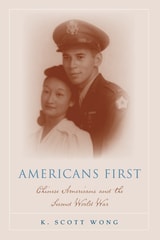
Americans First
Chinese Americans and the Second World WarK. Scott Wong
Temple University Press, 2008
In Americans First, K. Scott Wong uses archival research and oral histories to provide the first detailed account of Chinese Americans in the American military. Wong traces the history of the 14th Air Service Group, a segregated outfit of Chinese Americans sent to China in support of the American Army Air Corps and the Chinese Air Force. His ethnic history of inclusion shows how this new generation of Chinese Americans was more socially accepted, moving from the margins of society into the American mainstream during a time of pervasive racism.
Americans View Their Dust Bowl Experience
John R. Wunder
University Press of Colorado, 2001
Americans and Their Land
The House Built on AbundanceAnne Mackin
University of Michigan Press, 2006
—James Carroll, author of House of War and An American Requiem, winner of the National Book Award
“Anne Mackin has taken a fresh and provocative look at that most fascinating of relationships: the one between the American people and the American land.”
—Michael Pollan, Knight Professor of Journalism and Director of the Knight Program in Science and Environmental Journalism at University of California Berkeley, contributing writer to the New York Times Magazine, and author of The Omnivore's Dilemma and The Botany of Desire
“Anne Mackin has given us a valuable and less-used lens to view the development of our neighborhoods, towns and cities: the land itself. Our relationship to the earth beneath our feet—how we dig it, buy it, sell it, zone it, pave it, spoil it or pamper it—helps explain what is produced on top of the land in our nation, from farms to homes to skyscrapers. All in all, Mackin takes us on a novel and erudite journey, from one coast to the other, and from Colonial times to the present. This valuable book marks a significant and lasting contribution to the way we see and understand our landscape and ourselves.”
—Alex Marshall, author of How Cities Work: Suburbs, Sprawl, and the Roads Not Taken
“To really understand the origins of the range war now raging between smart growth and property rights advocates over the future of the American land, you need to read this exceptional book.”
—Robert D. Yaro, President Regional Plan Association and Professor in Practice, University of Pennsylvania
Thomas Malthus once said, “The happiness of the Americans depended much less upon their peculiar degree of civilization than . . . upon their having a great plenty of fertile uncultivated land.”
Malthus knew. Lord MacCaulay knew. Albert Gallatin knew. America and its people would change as a growing population whittled away the supply of land.
Nothing has shaped the American character like the abundance of land that met the colonist, the pioneer, and the early suburbanite. With today’s political and economic institutions shaped by the largesse of yesteryear, how will Americans fare in the new landscape of water wars, expensive housing, rising fuel prices, environmental and property rights battles, and powerful industrial lobbies?
Why is land the key to American democracy? How can we protect our democracy as more people and industries compete more intensively for our remaining resources? Americans and Their Land begins an important, overdue discussion of these questions. Anne Mackin takes the reader story by story from frontier history to the present and shows how land shaped the American political landscape. She shows how our evolving traditions of apportioning resources have allowed diminished supplies to create our present, increasingly unequal society, and she asks how 300 million Americans living in the new American landscape of growing competition can better share those resources.
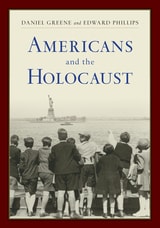
Americans and the Holocaust
A ReaderDaniel Greene
Rutgers University Press, 2021
Americans and the Holocaust explores these enduring questions by gathering together more than one hundred primary sources that reveal how Americans debated their responsibility to respond to Nazism. Drawing on groundbreaking research conducted for the United States Holocaust Memorial Museum’s Americans and the Holocaust exhibition, these carefully chosen sources help readers understand how Americans’ responses to Nazism were shaped by the challenging circumstances in the United States during the 1920s, 1930s, and 1940s, including profound economic crisis, fear of communism, pervasive antisemitism and racism, and widespread isolationism.
Collecting newspaper and magazine articles, popular culture materials, and government records, Americans and the Holocaust is a valuable resource for students and historians seeking to shed light on this dark era in world history.
To explore further, visit the United States Holocaust Memorial Museum's digital exhibit, available here: https://exhibitions.ushmm.org/americans-and-the-holocaust
Published in association with the United States Holocaust Memorial Museum.
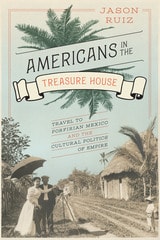
Americans in the Treasure House
Travel to Porfirian Mexico and the Cultural Politics of EmpireBy Jason Ruiz
University of Texas Press, 2014
When railroads connected the United States and Mexico in 1884 and overland travel between the two countries became easier and cheaper, Americans developed an intense curiosity about Mexico, its people, and its opportunities for business and pleasure. Indeed, so many Americans visited Mexico during the Porfiriato (the long dictatorship of Porfirio Díaz, 1876–1911) that observers on both sides of the border called the hordes of tourists and business speculators a “foreign invasion,” an apt phrase for a historical moment when the United States was expanding its territory and influence.
Americans in the Treasure House examines travel to Mexico during the Porfiriato, concentrating on the role of travelers in shaping ideas of Mexico as a logical place for Americans to extend their economic and cultural influence in the hemisphere. Analyzing a wealth of evidence ranging from travelogues and literary representations to picture postcards and snapshots, Jason Ruiz demonstrates that American travelers constructed Mexico as a nation at the cusp of modernity, but one requiring foreign intervention to reach its full potential. He shows how they rationalized this supposed need for intervention in a variety of ways, including by representing Mexico as a nation that deviated too dramatically from American ideals of progress, whiteness, and sexual self-control to become a modern “sister republic” on its own. Most importantly, Ruiz relates the rapid rise in travel and travel discourse to complex questions about national identity, state power, and economic relations across the U.S.–Mexico border.
America’s Romance with the English Garden
Thomas J. Mickey
Ohio University Press, 2013
Named one of “the year’s best gardening books” by The Spectator (UK, Nov. 2014)
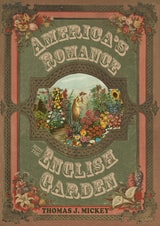
The 1890s saw a revolution in advertising. Cheap paper, faster printing, rural mail delivery, railroad shipping, and chromolithography combined to pave the way for the first modern, mass-produced catalogs. The most prominent of these, reaching American households by the thousands, were seed and nursery catalogs with beautiful pictures of middle-class homes surrounded by sprawling lawns, exotic plants, and the latest garden accessories—in other words, the quintessential English-style garden.
America’s Romance with the English Garden is the story of tastemakers and homemakers, of savvy businessmen and a growing American middle class eager to buy their products. It’s also the story of the beginnings of the modern garden industry, which seduced the masses with its images and fixed the English garden in the mind of the American consumer. Seed and nursery catalogs delivered aspirational images to front doorsteps from California to Maine, and the English garden became the look of America.
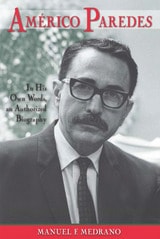
Americo Paredes
In His Own Words, an Authorized BiographyManuel F. Medrano
University of North Texas Press, 2010
Amid the Fall, Dreaming of Eden
Du Bois, King, Malcolm X, and Emancipatory CompositionBradford T. Stull
Southern Illinois University Press, 1999
Whom, or what, does composition—defined here as an intentional process of study, either oral or written—serve? Bradford T. Stull contends that composition would do well to articulate, in theory and practice, what could be called "emancipatory composition." He argues that emancipatory composition is radically theopolitical: it roots itself in the foundational theological and political language of the American experience while it subverts this language in order to emancipate the oppressed and, thereby, the oppressors.
To articulate this vision, Stull looks to those who compose from an oppressed place, finding in the works of W. E. B. Du Bois, Martin Luther King Jr., and Malcolm X radical theopolitical practices that can serve as a model for emancipatory composition. While Stull acknowledges that there are many sites of oppression, he focuses on what Du Bois has called the problem of the twentieth century: the color line, positing that the unique and foundational nature of the color line provides a fecund place in which, from which, a theory and practice of emancipatory composition might be elucidated.
By focusing on four key theopolitical tropes—The Fall, The Orient, Africa, and Eden—that inform the work of Du Bois, King, and Malcolm X, Stull discovers the ways in which these civil rights leaders root themselves in the vocabulary of the American experience in order to subvert it so that they might promote emancipation for African Americans, and thus all Americans.
In drawing on the work of Paulo Freire, Kenneth Burke, Edward Said, Christopher Miller, Ernst Bloch, and others, Stull also locates this study within the larger cultural context. By reading Du Bois, King, and Malcolm X together in a way that they have never before been read, Stull presents a new vision of composition practice to the African American studies community and a reading of African American emancipatory composition to the rhetoric and composition community, thus extending the question of emancipatory composition into new territory.
Amigas
Letters of Friendship and ExileBy Marjorie Agosín and Emma Sepúlveda
University of Texas Press, 2001
This collection of letters chronicles a remarkable, long-term friendship between two women who, despite differences of religion and ethnicity, have followed remarkably parallel paths from their first adolescent meeting in their native Chile to their current lives in exile as writers, academics, and political activists in the United States. Spanning more than thirty years (1966-2000), Agosín's and Sepúlveda's letters speak eloquently on themes that are at once personal and political—family life and patriarchy, women's roles, the loneliness of being a religious or cultural outsider, political turmoil in Chile, and the experience of exile.
Amkoullel, the Fula Boy
Amadou Hampâté Bâ
Duke University Press, 2021
Among Friends
Engendering the Social Site of PoetryAnne Dewey and Libbie Rifkin
University of Iowa Press, 2013

Amy Biehl’s Last Home
A Bright Life, a Tragic Death, and a Journey of Reconciliation in South AfricaSteven D. Gish
Ohio University Press, 2018
In 1993, white American Fulbright scholar Amy Biehl was killed in a racially motivated attack near Cape Town, after spending months working to promote democracy and women’s rights in South Africa. The ironic circumstances of her death generated enormous international publicity and yielded one of South Africa’s most heralded stories of postapartheid reconciliation. Amy’s parents not only established a humanitarian foundation to serve the black township where she was killed, but supported amnesty for her killers and hired two of the young men to work for the Amy Biehl Foundation. The Biehls were hailed as heroes by Nelson Mandela, Desmond Tutu, and many others in South Africa and the United States—but their path toward healing was neither quick nor easy.
Granted unrestricted access to the Biehl family’s papers, Steven Gish brings Amy and the Foundation to life in ways that have eluded previous authors. He is the first to place Biehl’s story in its full historical context, while also presenting a gripping portrait of this remarkable young woman and the aftermath of her death across two continents.
Amy Lowell, American Modern
Bradshaw, Melissa
Rutgers University Press, 2004
For decades, the work of one of America’s most influential poets, 1925 Pulitzer Prize–winner Amy Lowell (1874–1925), has been largely overlooked. This vigorous, courageous poet gave voice to an erotic, thoroughly American sensibility. Cigar-smoker, Boston Brahmin, lesbian, impresario, entrepreneur, and prolific poet, Lowell heralded the rush of an American poetic flowering. A best-selling poet as well as a wildly popular lecturer (autograph-seeking fans were sometimes so boisterous that she required a police escort), she was a respected authority on modern poetry, forging the path that led to the works of Allen Ginsberg, May Sarton, Sylvia Plath, and beyond. Yet, since her death, her work has suffered critical neglect.
This volume presents an essential revaluation of Lowell, and builds a solid critical basis for evaluating her poetry, criticism, politics, and influence. Essays explore the varied contributions of Lowell as a woman poet, a modernist, and a significant force of the literary debates of early twentieth-century poetics. In addition to placing Lowell in her proper historical context, contributors demonstrate her centrality to current critical and theoretical discussions: feminist, gay and lesbian, and postcolonial, in as well as in disability, American, and cultural studies. The book includes a transatlantic group of literary critics and scholars.
Amy Lowell, American Modern offers the most sustained examination of Lowell to date. It returns her to conversation and to literary history where she belongs.
Amythia
Crisis in the Natural History of Western CultureLoyal D. Rue
University of Alabama Press, 1989
Amythia results when cosmology and morality are not effectively integrated by a root metaphor, and the only possibility for the future is to transpose the old Christian God as Person to a root metaphor that is even older in origin, the concept of the Covenant tradition inherited from Israel but now understood in a nonsupernaturalist manner.
Rue asserts that amythia is a critical condition within the natural history of Western culture. The argument of the book begins with a theoretical perspective on the place of human culture within the scope of natural history and proceeds to establish the conceptual foundations for a natural history of culture.
Following an overview of the natural history of Western culture to expose the origins and depth of the contemporary intellectual and moral crisis, Rue moves on to specify and justify the limits of distinctiveness and plausibility appropriate for the task of transposing Covenant tradition. Finally, an appeal is made to the mythmakers of contemporary culture to take up the challenge of amythia.
Améfrica in Letters
Literary Interventions from Mexico to the Southern ConeJennifer Carolina Gómez Menjívar
Vanderbilt University Press, 2022
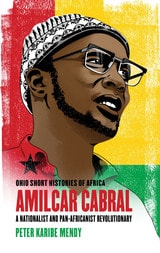
Amílcar Cabral
A Nationalist and Pan-Africanist RevolutionaryPeter Karibe Mendy
Ohio University Press, 2019
Amílcar Cabral was an agronomist who led an armed struggle that ended Portuguese colonialism in Guinea-Bissau and Cabo Verde. The uprising contributed significantly to the collapse of a fascist regime in Lisbon and the dismantlement of Portugal’s empire in Africa. Assassinated by a close associate with the deep complicity of the Portuguese colonial authorities, Cabral not only led one of Africa’s most successful liberation movements, but was the voice and face of the anticolonial wars against Portugal.
A brilliant military strategist and astute diplomat, Cabral was an original thinker who wrote innovative and inspirational essays that still resonate today. His charismatic and visionary leadership, his active pan-Africanist solidarity and internationalist commitment to “every just cause in the world,” remain relevant to contemporary struggles for emancipation and self-determination. Peter Karibe Mendy’s compact and accessible biography is an ideal introduction to his life and legacy.
An Absent Presence
Japanese Americans in Postwar American Culture, 1945-1960Caroline Chung Simpson
Duke University Press, 2001
Simpson argues that when popular journals or social theorists engaged the topic of Japanese American history or identity in the Cold War era they did so in a manner that tended to efface or diminish the complexity of their political and historical experience. As a result, the shadowy figuration of Japanese American identity often took on the semblance of an “absent presence.” Individual chapters feature such topics as the case of the alleged Tokyo Rose, the Hiroshima Maidens Project, and Japanese war brides. Drawing on issues of race, gender, and nation, Simpson connects the internment episode to broader themes of postwar American culture, including the atomic bomb, McCarthyism, the crises of racial integration, and the anxiety over middle-class gender roles.
By recapturing and reexamining these vital flashpoints in the projection of Japanese American identity, Simpson fills a critical and historical void in a number of fields including Asian American studies, American studies, and Cold War history.
An Aesthetics of Injury
The Narrative Wound from Baudelaire to TarantinoIan Fleishman
Northwestern University Press, 2018
Violence in the modernist mode, an ostensible intrusion of raw bodily harm into the artwork, aspires to transcend its own textuality, and yet, as An Aesthetics of Injury establishes, the wound paradoxically remains the essence of inscription. Fleishman thus shows how the wound, once the modernist emblem par excellence of an immediate aesthetic experience, comes to be implicated in a postmodern understanding of reality reduced to ceaseless mediation. In so doing, he demonstrates how what we think of as the most real object, the human body, becomes indistinguishable from its “nonreal” function as text. At stake in this tautological textual model is the heritage of narrative thought: both the narratological workings of these texts (how they tell stories) and the underlying epistemology exposed (whether these narrativists still believe in narrative at all).
With fresh and revealing readings of canonical authors and filmmakers seldom treated alongside one another, An Aesthetics of Injury is important reading for scholars working on literary or cinematic modernism and the postmodern, philosophy, narratology, body culture studies, queer and gender studies, trauma studies, and cultural theory.
An African Voice
The Role of the Humanities in African IndependenceRobert W. July
Duke University Press, 1987
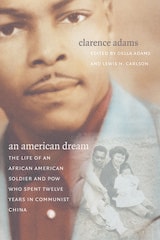
An American Dream
The Life of an African American Soldier and POW Who Spent Twelve Years in Communist ChinaClarence Adams
University of Massachusetts Press, 2007
Throughout his life, Clarence Adams exhibited self-reliance, ambition, ingenuity, courage, and a commitment to learning—character traits often equated with the successful pursuit of the American Dream. Unfortunately, for an African American coming of age in the 1930s and 1940s, such attributes counted for little, especially in the South.
Adams was a seventeen-year-old high school dropout in 1947 when he fled Memphis and the local police to join the U.S. Army. Three years later, after fighting in the Korean War in an all-black artillery unit that he believed to have been sacrificed to save white troops, he was captured by the Chinese. After spending almost three years as a POW, during which he continued to suffer racism at the hands of his fellow Americans, he refused repatriation in 1953, choosing instead the People's Republic of China, where he hoped to find educational and career opportunities not readily available in his own country.
While living in China, Adams earned a university degree, married a Chinese professor of Russian, and worked in Beijing as a translator for the Foreign Languages Press. During the Vietnam War he made a controversial anti-war broadcast over Radio Hanoi, urging black troops not to fight for someone else's political and economic freedoms until they enjoyed these same rights at home.
In 1966, having come under suspicion during the Chinese Cultural Revolution, he returned with his wife and two children to the United States, where he was subpoenaed to appear before the House Committee on Un-American Activities to face charges of “disrupting the morale of American fighting forces in Vietnam and inciting revolution in the United States.” After these charges were dropped, he and his family struggled to survive economically. Eventually, through sheer perseverance, they were able to fulfill at least part of the American Dream. By the time he died, the family owned and operated eight successful Chinese restaurants in his native Memphis.
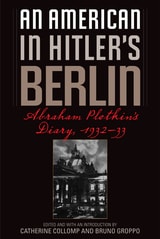
An American in Hitler's Berlin
Abraham Plotkin's Diary, 1932-33Abraham Plotkin; Edited & with an introduction by Catherine Collomp & Bruno Grop
University of Illinois Press, 2007
Compared to the writings of other American observers of the Third Reich, Plotkin's diary is unique in style, scope, themes, and time span. Most accounts of Hitler's rise to power emphasize political institutions by focusing on the Nazi party's clashes with other political forces. In contrast, Plotkin is especially attentive to socioeconomic factors, providing an alternative view from the left that stems from his access to key German labor and socialist leaders. Chronologically, the diary reports on the moment when Hitler's seizure of power was not yet inevitable and when leaders on the left still believed in a different outcome of the crisis, but it also includes Plotkin's account of the complete destruction of German labor in May 1933.

An Anthology of Contemporary Russian Women Poets
Valentina Polukhina
University of Iowa Press, 2005
Focusing on the middle generation, with major figures such as Olga Sedakova, Svetlana Kekova, Vera Pavlova, and Tatyana Shcherbina, the collection also includes work by the youngest generation—born after 1970 and not yet known outside of Russia—as well as senior poets such as Bella Akhmadulina and Natalya Gorbanevskaya. Translators include such poets as Elaine Feinstein, Ruth Fainlight, Carol Rumens, and Daniel Weissbort as well as Russianists and scholars Peter France, Catriona Kelly, Robert Reid, and Stephanie Sandler.
A significant and extensive bibliography lists the major works of prominent Russian women poets. A preface by Stephanie Sandler, a concluding note by Dmitry Kuzmin on the online Vavilon project, a postface by Elena Fanailova, and biographical notes on the poets and translators complete the anthology, which is sure to be of great interest to students and scholars of Russian literature.
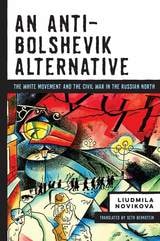
An Anti-Bolshevik Alternative
The White Movement and the Civil War in the Russian NorthLiudmila Novikova, Translated by Seth Bernstein
University of Wisconsin Press, 2018
Novikova draws on declassified archives and sources in both Russia and the West to reveal the White movement in the north as a complex social and political phenomenon with a distinct regional context. She documents the politics of the Northern Government and its relations with the British and American forces who had occupied the ports of Murmansk and Arkhangelsk at the end of World War I. As the civil war continued, the increasing involvement of the local population transformed the conflict into a ferocious "people's war" until remaining White forces under General Yevgeny Miller evacuated the region in February 1920.
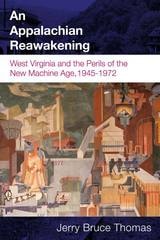
An Appalachian Reawakening
West Virginia and the Perils of the New Machine Age, 1945-1972JERRY B. THOMAS
West Virginia University Press, 2010
As the long boom of post-World War II economic expansion spread across the globe, dreams of white picket fences, democratic ideals, and endless opportunities flourished within the United States. Middle America experienced a period of affluent stability built upon a modern age of industrialization. Yet for the people of Appalachia, this new era brought economic, social, and environmental devastation, preventing many from realizing the American Dream. Some families suffered in silence; some joined a mass exodus from the mountains; while others, trapped by unemployment, poverty, illness, and injury became dependent upon welfare. As the one state most completely Appalachian, West Virginia symbolized the region's dilemma, even as it provided much of the labor and natural resources that fueled the nation's prosperity.
An Appalachian Reawakening: West Virginia and the Perils of the New Machine Age, 1945-1972 recounts the difficulties the state of West Virginia faced during the post-World War II period. While documenting this turmoil, this valuable analysis also traces the efforts of the New Frontier and Great Society programs, which stimulated maximum feasible participation and lead to the ultimate rise of grass roots activities and organizations that improved life and labor in the region and undermined the notion of Appalachian fatalism.