Results by title
8812 books match the query 'Political Science' and 626 start with a

Argentina, the United States, and the Anti-Communist Crusade in Central America, 1977–1984
Mis Lam#26Ariel Armony
Ohio University Press, 1997
Ariel Armony focuses, in this study, on the role played by Argentina in the anti–Communist crusade in Central America. This systematic examination of Argentina’s involvement in the Central American drama of the late 1970s and early 1980s fine–tunes our knowledge of a major episode of the Cold War era.
Basing his study on exhaustive research in the United States, Argentina, and Nicaragua, Armony adroitly demolishes several key assumptions that have shaped the work of scholars in U.S. foreign policy, Argentine military politics, and Central American affairs.
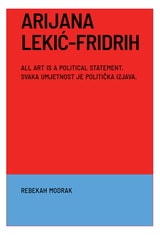
Arijana Lekic-Fridrih
All Art Is a Political Statement / Svaka Umjetnost Je Politicka IzavaRebekah Modrak
Disobedience Press, 2024
Arijana Lekić-Fridrih: All Art is a Political Statement introduces audiences to the work of Croatian artist Arijana Lekić-Fridrih and, in particular, to her Silent Mass, a performance resisting the “Be Manly” movement, a series of mass prayer events held in Croatian public squares by a battalion of men who pray for the abolition of women’s rights, for women’s “chastity,” and for men’s “masculine authority.” All Art is a Political Statement links the erosion of women’s rights across intercontinental boundaries and offers Lekić-Fridrih’s multimedia art as a guide for activism against retrograde restrictions on the freedom of women.
Arijana Lekić-Fridrih: Svaka umjetnost je politička izjava upoznaje publiku s radom hrvatske umjetnice Arijane Lekić-Fridrih, a posebno s njezinom Tihom misom, performansom otpora pokretu “Budi muško”, nizu masovnih molitvenih događanja koje na hrvatskim javnim trgovima održava bataljun muškaraca moleći za ukidanje ženskih prava, za žensku “čednost”, a za muškarce “muški autoritet”. Svaka umjetnost je politička izjava spaja eroziju ženskih prava preko interkontinentalnih granica i nudi multimedijsku umjetnost Lekić-Fridrih kao vodič za aktivizam protiv nazadnih ograničenja slobode žena.

Arikara Agriculture
Mother Corn’s Gift to the Sahnish PeopleArikara Agriculture Project; With collaborators Kelly Kindscher, Loren Yellow Bird, Michael Yellow Bird, Logan Sutton, Loren White, and Lisa Castle
University of Arizona Press, 2027
Drawing on a remarkable combination of early twentieth-century field notes, archaeological evidence, historical accounts, and the voices of Arikara collaborators, Arikara Agriculture: Mother Corn’s Gift to the Sahnish People offers a richly layered account of one of the Plains’ most accomplished agricultural societies.
Living along the Missouri River in present-day North and South Dakota, the Sahnish (Arikara) people cultivated expansive fields of corn, beans, squash, sunflowers, and other crops, sustaining vibrant communities and extensive trade networks. At the heart of this remarkable book are the invaluable records of ethnobotanist Melvin Gilmore, who documented the knowledge of Arikara elders between 1916 and 1924, capturing a lifeway on the cusp of profound change.
More than a historical study, this volume foregrounds the cultural, spiritual, and ecological significance of agriculture in Sahnish life. The contributors discuss how corn was the center of the Arikaras’ world and how it, and other agricultural crops, were important not just as food but also for the culture. The book illuminates traditional horticultural methods, food preparation techniques, and the enduring relevance of these practices today.
Both a vital contribution to ethnobiology and a community-centered preservation of knowledge, this work speaks to ongoing conversations about Indigenous foodways, resilience, and the revitalization of traditional ecological knowledge.
Aristotle and Hamilton on Commerce and Statesmanship
Michael D. Chan
University of Missouri Press, 2006
Although America’s founders may have been inspired by the political thought of ancient Greece and Rome, the United States is more often characterized by its devotion to the pursuit of commerce. Some have even said that a modern commercial republic such as the United States unavoidably lowers its moral horizon to little more than a concern with securing peace and prosperity so that commerce can flourish.
Aristotle's "Art of Rhetoric"
Aristotle
University of Chicago Press, 2019
Here Robert C. Bartlett offers a literal, yet easily readable, new translation of Aristotle’s “Art of Rhetoric,” one that takes into account important alternatives in the manuscript and is fully annotated to explain historical, literary, and other allusions. Bartlett’s translation is also accompanied by an outline of the argument of each book; copious indexes, including subjects, proper names, and literary citations; a glossary of key terms; and a substantial interpretive essay.
Aristotle's "Politics"
Second EditionAristotle
University of Chicago Press, 2013
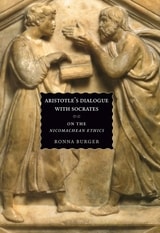
Aristotle's Dialogue with Socrates
On the "Nicomachean Ethics"Ronna Burger
University of Chicago Press, 2008
What is the good life for a human being? Aristotle’s exploration of this question in the Nicomachean Ethics has established it as a founding work of Western philosophy, though its teachings have long puzzled readers and provoked spirited discussion. Adopting a radically new point of view, Ronna Burger deciphers some of the most perplexing conundrums of this influential treatise by approaching it as Aristotle’s dialogue with the Platonic Socrates.
Tracing the argument of the Ethics as it emerges through that approach, Burger’s careful reading shows how Aristotle represents ethical virtue from the perspective of those devoted to it while standing back to examine its assumptions and implications.
“This is the best book I have read on Aristotle’s Nicomachean Ethics. It is so well crafted that reading it is like reading the Ethics itself, in that it provides an education in ethical matters that does justice to all sides of the issues.”—Mary P. Nichols, Baylor University
Aristotle's Nicomachean Ethics
Aristotle
University of Chicago Press, 2011
The most precise and authoritative translation of one of the founding works of Western culture, in an edition supported by helpful, effective notes
The Nicomachean Ethics is one of Aristotle’s most widely read and influential works. Ideas central to ethics—that happiness is the end of human endeavor, that moral virtue is formed through action and habituation, and that good action requires prudence—found their most powerful proponent in the person medieval scholars simply called “the Philosopher.” Drawing on their intimate knowledge of Aristotle’s thought, Robert C. Bartlett and Susan D. Collins have produced here an English-language translation of the Ethics that is as remarkably faithful to the original as it is graceful in its rendering.
Aristotle is well known for the precision with which he chooses his words, and in this elegant translation his work has found its ideal match. Bartlett and Collins provide copious notes and a glossary providing context and further explanation for students, as well as an introduction and a substantial interpretive essay that sketch central arguments of the work and the seminal place of Aristotle’s Ethics in his political philosophy as a whole.
The Nicomachean Ethics has engaged the serious interest of readers across centuries and civilizations—of peoples ancient, medieval, and modern; pagan, Christian, Muslim, and Jewish—and this new edition will take its place as the standard English-language translation.
Aristotle's Politics
Living Well and Living TogetherEugene Garver
University of Chicago Press, 2011
Close examination of Aristotle’s treatise, Garver finds, reveals a significant, practical role for philosophy to play in politics. Philosophers present arguments about issues—such as the right and the good, justice and modes of governance, the relation between the good person and the good citizen, and the character of a good life—that politicians must then make appealing to their fellow citizens. Completing Garver’s trilogy on Aristotle’s unique vision, Aristotle’s Politics yields new ways of thinking about ethics and politics, ancient and modern.
Aristotle's Teaching in the "Politics"
Thomas L. Pangle
University of Chicago Press, 2013
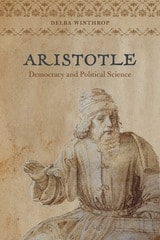
Aristotle
Democracy and Political ScienceDelba Winthrop
University of Chicago Press, 2018
Today, democracy is seen as the best or even the only legitimate form of government. With this book, Delba Winthrop punctures this complacency and takes up the challenge of justifying democracy through Aristotle’s political science. In Aristotle’s time and in ours, democrats want inclusiveness; they want above all to include everyone as a part of a whole. But what makes a whole? This is a question for both politics and philosophy, and Winthrop shows that Aristotle pursues the answer in the Politics. She uncovers in his political science the insights philosophy brings to politics and, especially, the insights politics brings to philosophy. Through her appreciation of this dual purpose and her skilled execution of her argument, Winthrop makes profound discoveries. Central to politics, she maintains, is the quality of assertiveness—the kind of speech that demands to be heard. Aristotle, she shows for the first time, carries assertive speech into philosophy, where human reason claims its due as a contribution to the universe. Political science has the high role of teaching ordinary folk about democracy and what sustains it.
This posthumous publication is more than an honor to Delba Winthrop’s memory. It is a gift to partisans of democracy, advocates of justice, and students of Aristotle.
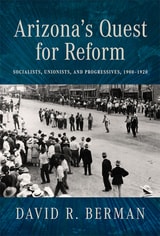
Arizona’s Quest for Reform
Socialists, Unionists, and Progressives, 1900–1920David R. Berman
University of Arizona Press, 2026
In Arizona’s Quest for Reform, David R. Berman traces the rise and fall of a dynamic coalition of socialists, labor activists, and progressive Democrats led by the influential Governor George Hunt as they pursued sweeping reforms in a rapidly changing state. From the fight for workers’ rights and women’s suffrage to the use of the initiative process and the role of radical newspapers, Berman brings to life the people and movements that shaped Arizona’s early political identity.
Drawing on extensive primary sources and organized in a clear chronological structure, Berman’s study reveals the tensions, alliances, and dramatic events that defined Arizona’s reform efforts between 1900 and 1920. The book explores the impact of powerful mining interests, railroad companies, and labor unions, while also examining the racialization of Mexican miners and their evolving role in the labor movement. Through vivid storytelling and rigorous scholarship, Berman uncovers the complexities of political change in a state straddling the transition from territory to statehood.
This landmark work will appeal to scholars of western history, labor studies, and political science, as well as general readers interested in Arizona’s unique place in the national Progressive movement. Arizona’s Quest for Reform not only deepens our understanding of the past but also offers timely insights into the enduring challenges of coalition building, grassroots activism, and political reform. It is a vital contribution to the study of Arizona and the American West.
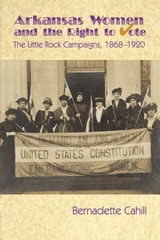
Arkansas Women and the Right to Vote
The Little Rock Campaigns: 1868-1920Bernadette Cahill
Butler Center for Arkansas Studies, 2015

Arms and the People
Popular Movements and the Military from the Paris Commune to the Arab SpringEdited by Mike Gonzalez and Houman Barekat
Pluto Press, 2012
Arms and the People explores the impact of profound social polarisation on the internal cohesion of the state’s ‘armed bodies of men’ and on the contested loyalties of soldiers. The different contributors examine a series of historical moments in which a crisis in the military institution has reflected a deeper social crisis which has penetrated that institution and threatened to disable it.
With a range of international contributors who have either studied or been directly involved in such social upheavals, Arms and the People is a pioneering contribution to the study of revolutionary change and will appeal to students and academics in history, politics and sociology.
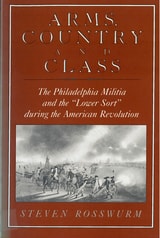
Arms, Country, and Class
The Philadelphia Militia and the Lower Sort during the American RevolutionSteve Rosswurm
Rutgers University Press, 1989
In 1949 and 1950, the Congress of Industrial Organizations (CIO) expelled many left-wing unions, representing 750,000 workers, because they were supposedly Communist-dominated. This collection of previously unpublished essays explores the history of those eleven left-led unions. Some essays consider specific aspects of several unions--the Longshoremen, the United Electricians (UE), the Fur Workers, and the Food and Tobacco Workers--while others take up the impact of the federal government's and the Catholic church's anticommunism upon the unions as a whole.
This collection also addresses central domestic issues of twentieth-century America: race and government policy in the shaping of trade unionism; the impact of anticommunism and the cold war on race relations and working conditions; and the short- and long-range impact of the expulsions upon the labor movement. With groundbreaking essays that also concern the post-World War II period, Southern workers and workers in non-basic industries, this book will appeal to students of radicalism, race relations, anticommunism, and labor history.
Arresting Citizenship
The Democratic Consequences of American Crime ControlAmy E. Lerman and Vesla M. Weaver
University of Chicago Press, 2014
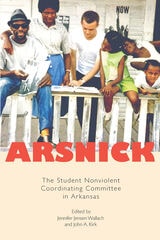
Arsnick
The Student Nonviolent Coordinating Committee in ArkansasJennifer Jensen Wallach
University of Arkansas Press, 2011
Art & Outrage
Provocation, Controversy and the Visual ArtsJohn A. Walker
Pluto Press, 1998
When art hits the headlines, it is usually because it has caused offence or is perceived by the media to have shock-value. Over the last fifty years many artists have been censored, vilified, accused of blasphemy and obscenity, threatened with violence, prosecuted and even imprisoned. Their work has been trashed by the media and physically attacked by the public.
In Art & Outrage, John A. Walker covers the period from the late 1940s to the 1990s to provide the first detailed survey of the most prominent cases of art that has scandalised. The work of some of Britain’s leading, and less well known, painters and sculptors of the postwar period is considered, such as Richard Hamilton, Bryan Organ, Rachel Whiteread, Reg Butler, Damien Hirst, Jamie Wagg, Barry Flanagan and Antony Gormley. Included are works made famous by the media, such as Carl Andre’s Tate Gallery installation of 120 bricks, Rick Gibson’s foetus earrings, Anthony-Noel Kelly’s cast body-parts sculptures and Marcus Harvey’s portrait of Myra Hindley. Walker describes how each incident emerged, considers the arguments for and against, and examines how each was concluded. While broadly sympathetic to radical contemporary art, Walker has some residual sympathy for the layperson’s bafflement and antagonism. This is a scholarly yet accessible study of the interface between art, society and mass media which offers an alternative history of postwar British art and attitudes.
Art after Money, Money after Art
Creative Strategies Against FinancializationMax Haiven
Pluto Press, 2018
Even as he shows how imaginary money and the so-called “creative economy” extract an artist’s potential, Haiven identifies and assesses a range of creative strategies for mocking, decrypting, hacking, sabotaging, and exiting capitalism through art. Focusing on the ways contemporary artists understand, imagine, and contend with material and immaterial forms of cash, debt, and credit, Haiven reveals the potential for creativity and resistance in a world dominated by financialization.
Written for artists, activists, and scholars, this book takes seriously the need to understand and resist capitalism in an age of corporate abuse and exploitation.
Art and Activism
Jazz Artists and Writers in the Civil Rights VanguardJack Marchbanks
Ohio University Press, 2026
Explore how jazz legends and literary icons united art and activism, shaping the civil rights movement and transforming American culture during the pivotal period between 1955 and 1965.
Art and Activism explores the powerful, symbiotic relationships among artists such as Nina Simone, Abbey Lincoln, and Lena Horne and their literary counterparts—Lorraine Hansberry, Maya Angelou, and Langston Hughes. These creative figures positioned themselves as cultural thought leaders within the evolving civil rights movement. While the Jim Crow South was the movement’s operational front, Jack Marchbanks argues that New York City’s intellectual, cultural, and fundraising communities functioned as its strategic command center.
Readers who admire jazz legends like Duke Ellington, Dave Brubeck, Miles Davis, and Charles Mingus—and those fascinated by prominent African American writers like James Baldwin and Ralph Ellison—will discover how these artists intertwined their work with the civil rights struggle. The book examines their involvement in pivotal confrontations and their connections with key leaders such as the Reverend Dr. Martin Luther King Jr., Daisy Bates, Ella Baker, and Malcolm X.
By illuminating the intersection of art and activism, this study offers a fresh perspective on the pivotal decade from 1955 to 1965. It is an essential resource for undergraduate courses and an engaging read for anyone seeking to understand the civil rights era through a cultural lens.
Art and Postcapitalism
Aesthetic Labour, Automation and Value ProductionDave Beech
Pluto Press, 2019
Art and Postcapitalism
Aesthetic Labour, Automation and Value ProductionDave Beech
Pluto Press, 2019
Art beyond Borders
Artistic Exchange in Communist Europe (1945-1989)Jérôme Bazin
Central European University Press, 2016
Art for a Modern India, 1947-1980
Rebecca M. Brown
Duke University Press, 2009
Through close analyses of specific objects of art and design, Brown describes how Indian artists engaged with questions of authenticity, iconicity, narrative, urbanization, and science and technology. She explains how the filmmaker Satyajit Ray presented the rural Indian village as a socially complex space rather than as the idealized site of “authentic India” in his acclaimed Apu Trilogy, how the painter Bhupen Khakhar reworked Indian folk idioms and borrowed iconic images from calendar prints in his paintings of urban dwellers, and how Indian architects developed a revivalist style of bold architectural gestures anchored in India’s past as they planned the Ashok Hotel and the Vigyan Bhavan Conference Center, both in New Delhi. Discussing these and other works of art and design, Brown chronicles the mid-twentieth-century trajectory of India’s modern visual culture.
Art of War
Niccolò Machiavelli
University of Chicago Press, 2003
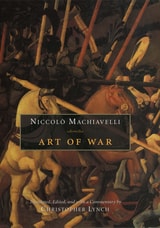
Machiavelli scholar Christopher Lynch offers a sensitive and entirely new translation of the Art of War, faithful to the original but rendered in modern, idiomatic English. Lynch's fluid translation helps readers appreciate anew Machiavelli's brilliant treatments of the relationships between war and politics, civilians and the military, and technology and tactics. Clearly laying out the fundamentals of military organization and strategy, Machiavelli marshals a veritable armory of precepts, prescriptions, and examples about such topics as how to motivate your soldiers and demoralize the enemy's, avoid ambushes, and gain the tactical and strategic advantage in countless circumstances.
To help readers better appreciate the Art of War, Lynch provides an insightful introduction that covers its historical and political context, sources, influence, and contemporary relevance. He also includes a substantial interpretive essay discussing the military, political, and philosophical aspects of the work, as well as maps, an index of names, and a glossary.
Art, Imagination and Public Service
Hughie O'Donoghue, Brenda Hale, James O'Donnell, Clare Moriarty, Micheal O'Siadhail, and David Blunkett
Haus Publishing, 2021
Intended to inspire public servants of all kinds to reconnect fearlessly with their fundamental humanity, the three conversations in Art, Imagination and Public Service present a way of thinking about imaginative, compassionate, and intelligent public service. The book consists of three dialogues: between former UK Home Secretary David Blunkett and poet Micheal O’Siadhail, former UK Supreme Court president Brenda Hale and painter Hughie O’Donoghue, and UK Permanent Secretary Clare Moriarty and musician James O’Donnell. Together they explore how art and imagination can sustain public servants and enable them to find new ways of addressing the problems facing government, parliament, and the law—problems that resist utilitarian responses in which people end up being treated only as statistics in a target-driven world. Through these conversations, the speakers discover surprising connections in approaches to their work.

Artful Assassins
Murder as Art in Modern MexicoFernando Fabio Sanchez
Vanderbilt University Press, 2010
Sanchez argues that the seemingly hopeless cycle of violence experienced by Mexico in the 20th century, as reflected in its "crime genre," reveals a broader intrinsic cultural and political failure that suggests grave implications for the current state of crisis. Tracing the development of a national Mexican identity from the 1910 Mexican Revolution onward, Sanchez focuses on the indelible presence of violence and crime underlying the major works that contributed to a larger communal narrative.
Artful Assassins ultimately offers a panoramic overview of the evolution of Mexican arts and letters, as well as nationalism, by claiming murder and assassination as literary and cinematic motifs. The collapse of post-revolutionary political unity was presaged all along in Mexican culture, Sanchez argues. It need only to have been sought in the art of the nation.

Arthur Vandenberg
The Man in the Middle of the American CenturyHendrik Meijer
University of Chicago Press, 2017
Originally the editor and publisher of the Grand Rapids Herald, Vandenberg was appointed and later elected to the Senate in 1928, where he became an outspoken opponent of the New Deal and a leader among the isolationists who resisted FDR’s efforts to aid European allies at the onset of World War II. But Vandenberg soon recognized the need for unity at the dawn of a new world order; and as a Republican leader, he worked closely with Democratic administrations to build the strong bipartisan consensus that established the Marshall Plan, the United Nations, and NATO. Vandenberg, as Meijer reveals, was instrumental in organizing Congressional support for these monumental twentieth-century foreign policy decisions.
Vandenberg’s life and career offer powerful lessons for today, and Meijer has given us a story that suggests an antidote to our current democratic challenges. After reading this poignant biography, many will ask: Where is the Vandenberg of today?
Artificial Africas
Colonial Images in the Times of GlobalizationRuth Mayer
Dartmouth College Press, 2002
Arts of the Political
New Openings for the LeftAsh Amin and Nigel Thrift
Duke University Press, 2013
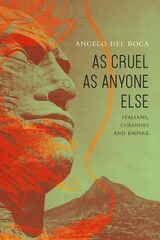
As Cruel as Anyone Else
Italians, Colonies and EmpireAngelo Del Boca
Seagull Books, 2024
Between the end of the nineteenth century and over the first half of the twentieth, Italy invaded and occupied the Horn of Africa, Libya, and several other territories. Yet recognition of this history of colonial destruction, racist violence, and genocidal aerial and chemical warfare—carried out not only during the Fascist dictatorship but also under preceding liberal governments—has been consistently repressed beneath the myth that the Italians never truly practiced colonialism.
The late journalist, historian, novelist, campaigner, and former Resistance fighter Angelo Del Boca dismantles this myth. He expertly narrates episodes of state violence committed by Italians both abroad—from Ethiopia to Slovenia, from China to Libya—and “at home” during the civil war following Unification in the 1860s or when the anti-Fascist Resistance faced off against the Republic of Salò after 1943. Attentive to the losses and pain suffered by all sides in war, Del Boca deftly demonstrates how such violence was not only a tool of domination but has also been central to creating and shaping an Italian “people.”
Drawing on a lifetime of interviews as a special correspondent, decades of work in private and state archives, and his own experiences during the Second World War, Del Boca’s popular and influential work has contributed to overturning views of Italian history. Presenting many historical episodes in English for the first time, As Cruel as Anyone Else provides a key to reading contemporary Italy, its place in international politics, and the disturbing permanence of the far-right within mainstream Italian politics.

As French as Everyone Else?
A Survey of French Citizens of Maghrebin, African, and Turkish OriginAuthored by Sylvain Brouard and Vincent Tiberj
Temple University Press, 2011
France is often depicted as the model of assimilationist or republican integration in the international literature on immigration. However, rarely have surveys drilled down to provide individual responses from a double representative sample. In As French as Everyone Else?, Sylvain Brouard and Vincent Tiberj provide a comprehensive assessment of the state of integration in France and challenge the usual crisis of integration by systematically comparing the "new French" immigrants, as well as their children and grandchildren born in France, with a sample of the French general population.
The authors' survey considers a wide range of topics, including religious affiliation and religiosity, political attitudes and political efficacy, value systems (including gender roles, work ethics, and anti-Semitism), patterns of integration, multiple identities and national belongings, and affirmative action. As the authors show, despite existing differences, immigrants of Maghrebin, African, and Turkish origin share a wide scope of commonality with other French citizens.
As if the Future Mattered
Translating Social and Economic Theory into Human BehaviorNeva R. Goodwin, Editor
University of Michigan Press, 1996
Asia First
China and the Making of Modern American ConservatismJoyce Mao
University of Chicago Press, 2015
Mao explores the deep resonance American conservatives felt with the defeat of Chiang Kai-Shek and his exile to Taiwan, which they lamented as the loss of China to communism and the corrosion of traditional values. In response, they fomented aggressive anti-communist positions that urged greater action in the Pacific, a policy known as “Asia First.” While this policy would do nothing to oust the communists from China, it was powerfully effective at home. Asia First provided American conservatives a set of ideals—American sovereignty, selective military intervention, strident anti-communism, and the promotion of a technological defense state—that would bring them into the global era with the positions that are now their hallmark.
Asia as Method
Toward DeimperializationKuan-Hsing Chen
Duke University Press, 2010
Chen is one of the most important intellectuals working in East Asia today; his writing has been influential in Taiwan, South Korea, Hong Kong, Japan, Singapore, and mainland China for the past fifteen years. As a founding member of the Inter-Asia Cultural Studies Society and its journal, he has helped to initiate change in the dynamics and intellectual orientation of the region, building a network that has facilitated inter-Asian connections. Asia as Method encapsulates Chen’s vision and activities within the increasingly “inter-referencing” East Asian intellectual community and charts necessary new directions for cultural studies.
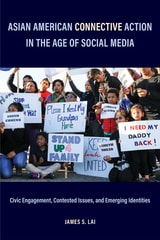
Asian American Connective Action in the Age of Social Media
Civic Engagement, Contested Issues, and Emerging IdentitiesJames S. Lai
Temple University Press, 2022
Social media provides ethno-racial immigrant groups—especially those who cannot vote due to factors such as lack of citizenship and limited English proficiency—the ability to mobilize and connect around collective issues. Online spaces and discussion forums have encouraged many Asian Americans to participate in public policy debates and take action on social justice issues. This form of digital group activism serves as an adaptive political empowerment strategy for the fastest-growing and largest foreign-born population in America. Asian American Connective Action in the Age of Social Media illuminates how associating online can facilitate and amplify traditional forms of political action.
James Lai provides diverse case studies on contentious topics ranging from affirmative action debates to textbook controversies to emphasize the complexities, limitations, and challenges of connective action that is relevant to all racial groups. Using a detailed multi-methods approach that includes national survey data and Twitter hashtag analysis, he shows how traditional immigrants, older participants, and younger generations create online consensus and mobilize offline to foment political change. In doing so, Lai provides a nuanced glimpse into the multiple ways connective action takes shape within the Asian American community.
Asian American Political Participation
Emerging Constituents and Their Political IdentitiesJanelle S. Wong
Russell Sage Foundation, 2012
Asianisms
Regionalist Interactions and Asian IntegrationEdited by Marc Frey and Nicola Spakowski
National University of Singapore Press, 2015
This book investigates the multifarious discursive and material constructions of Asia within the region and in the West. It reconstructs regional constellations, intersections and relations in their national, transnational and global contexts. Moving far beyond the more well-known Japanese Pan-Asianism of the first half of the twentieth century, the chapters investigate visions of Asia that have sought to provide common meanings and political projects in efforts to trace, and construct, Asia as a united and common space of interaction. By tracing the imagination of civil society actors throughout Asia, the volume leaves behind state-centered approaches to regional integration and uncovers the richness and depth of complex identities within a large and culturally heterogeneous space.
Asking About Prices
A New Approach to Understanding Price StickinessAlan Blinder
Russell Sage Foundation, 1998
Aspirational Fascism
The Struggle for Multifaceted Democracy under TrumpismWilliam E. Connolly
University of Minnesota Press, 2017
Coming to terms with a new period of uncertainty when it is still replete with possibilities
This quick and engaging study clearly lays out the United States’ current democratic crisis. Examining the early stages of the Nazi movement in Germany, William E. Connolly detects synergies with Donald Trump’s rhetorical style. Tapping into a sense of contemporary fragility, Aspirational Fascism pays particular attention to how conflicts between neoliberalism and the pluralizing left have placed the white working class in a bind. Ultimately, Connolly believes a multifaceted democracy constitutes the best antidote to aspirational fascism and rethinks what a politics of the left might look like today.
Forerunners is a thought-in-process series of breakthrough digital works. Written between fresh ideas and finished books, Forerunners draws on scholarly work initiated in notable blogs, social media, conference plenaries, journal articles, and the synergy of academic exchange. This is gray literature publishing: where intense thinking, change, and speculation take place in scholarship.
Assault on the Media
The Nixon YearsWilliam E. Porter and Thomas A. Mascaro
University of Michigan Press, 2024
Informed by a half-century of historical analyses and released documents, this expanded edition of William E. Porter’s award-winning Assault on the Media analyzes new documents of significance; synthesizes recent historical analyses; incorporates legal evaluations by journalism scholars; and traces how Nixon-era plans cultivated the divisive state of 21st-century society and amplified assaults on journalism. It also evaluates lasting concerns about the Supreme Court’s Pentagon Papers decision and journalists cited for contempt as a form of prior restraint; the currencies of power and race in protecting confidential sources; and regulatory decisions that hamper effective journalism. Assault on the Media not only documents the incidents and circumstances of governmental intimidation, harassment, and regulation of the news media during the Nixon presidency, but it offers insights into the long-term effects and their relevance today.
Assembling Ethnicities in Neoliberal Times
Ethnographic Fictions and Sri Lanka’s WarNimanthi Perera-Rajasingham
Northwestern University Press, 2019
Assembling Ethnicities in Neoliberal Times: Ethnographic Fictions and Sri Lanka’s War argues that the bloody war fought between the Sri Lankan state and the separatist Tamil Tigers from 1983 to 2009 should be understood as structured and animated by the forces of global capitalism. Using Aihwa Ong’s theorization of neoliberalism as a mobile technology and assemblage, this book explores how contemporary globalization has exacerbated forces of nationalism and racism.
Nimanthi Perera-Rajasingham finds that ethnographic fictions have both internalized certain colonial Orientalist impulses and critically engaged with categories of objective gazing, empiricism, and temporal distancing. She demonstrates that such fictions take seriously the task of bearing witness and documenting the complex productions of ethnic identities and the devastations wrought by warfare. To this end, Assembling Ethnicities
explores colonial-era travel writing by Robert Knox (1681) and Leonard Woolf (1913); contemporary works by Michael Ondaatje, Romesh Gunesekera, Shobasakthi, Dharmasiri Bandaranayake, and Thamotharampillai Shanaathanan; and cultural festivals and theater, including vernacular performances of Euripides’s The Trojan Women and women workers’ theater.
The book interprets contemporary fictions to unpack neoliberalism’s entanglements with nationalism and racism, engaging current issues such as human rights, the pastoral, Tamil militancy, immigrant lives, feminism and nationalism, and postwar developmentalism.
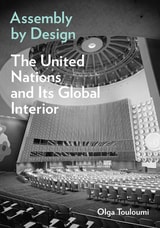
Assembly by Design
The United Nations and Its Global InteriorOlga Touloumi
University of Minnesota Press, 2024
How the United Nations headquarters became the architectural instrument and broadcast medium of global diplomacy
For almost seven years after World War II, a small group of architects took on an exciting task: to imagine the spaces of global governance for a new political organization called the United Nations (UN). To create the iconic headquarters of the UN in New York City, these architects experimented with room layouts, media technologies, and design in tribunal courtrooms, assembly halls, and council chambers. The result was the creation of a new type of public space, the global interior.
Assembly by Design shows how this space leveraged media to help the UN communicate with the world. With its media infrastructure, symbols, acoustic design, and architecture, the global interior defined political assembly both inside and outside the UN headquarters, serving as the architectural medium to organize multilateral encounters of international publics around the globe. Demonstrating how aesthetics have long held sway over political work, Olga Touloumi posits that the building framed diplomacy on the ground amid a changing political landscape that brought the United States to the forefront of international politics, destabilizing old and establishing new geopolitical alliances.
Uncovering previously closed institutional and family archives, Assembly by Design offers new information about the political and aesthetic decisions that turned the UN headquarters into a communications organism. It looks back at a moment of hope, when politicians, architects, and diplomats—believing that assembly was a matter of design—worked together to deliver platforms for global democracy and governance.
Associative Democracy
New Forms of Economic and Social GovernancePaul Hirst
University of Massachusetts Press, 1994
Not simply a utopian idea, associative democracy calls for new forms of economic and social governance as supplements to representative democracy and market economies. It addresses the problems of the overload of big government by democratizing and empowering civil society. It transfers social provision to self-governing voluntary associations, while retaining public funding and political accountability. In the economic sphere, it advocates regional economic regulation through public-private partnerships, the promotion of self-governing industrial districts, and the democratization of the company.

Asylum, Prison, and Poorhouse
The Writings and Reform Work of Dorothea Dix in IllinoisDavid L. Lightner
Southern Illinois University Press, 1999
This illustrated collection of annotated newspaper articles and memorials by Dorothea Dix provides a forum for the great mid-nineteenth-century humanitarian and reformer to speak for herself.
Dorothea Lynde Dix (1802–87) was perhaps the most famous and admired woman in America for much of the nineteenth century. Beginning in the early 1840s, she launched a personal crusade to persuade the various states to provide humane care and effective treatment for the mentally ill by funding specialized hospitals for that purpose. The appalling conditions endured by most mentally ill inmates in prisons, jails, and poorhouses led her to take an active interest also in prison reform and in efforts to ameliorate poverty.
In 1846–47 Dix brought her crusade to Illinois. She presented two lengthy memorials to the legislature, the first describing conditions at the state penitentiary at Alton and the second discussing the sufferings of the insane and urging the establishment of a state hospital for their care. She also wrote a series of newspaper articles detailing conditions in the jails and poorhouses of many Illinois communities.
These long-forgotten documents, which appear in unabridged form in this book, contain a wealth of information on the living conditions of some of the most unfortunate inhabitants of Illinois. In his preface, David L. Lightner describes some of the vivid images that emerge from Dorothea Dix's descriptions of social conditions in Illinois a century and a half ago: "A helpless maniac confined throughout the bitter cold of winter to a dark and filthy pit. Prison inmates chained in hallways and cellars because no more men can be squeezed into the dank and airless cells. Aged paupers auctioned off by county officers to whoever will maintain them at the lowest cost."
Lightner provides an introduction to every document, placing each memorial and newspaper article in its proper social and historical context. He also furnishes detailed notes, making these documents readily accessible to readers a century and a half later. In his final chapter, Lightner assesses both the immediate and the continuing impact of Dix's work.

Asylum
The Concept and the PracticeRanjana Khanna
Duke University Press, 2026
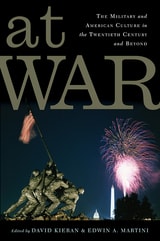
At War
The Military and American Culture in the Twentieth Century and BeyondKieran, David
Rutgers University Press, 2018
At War offers short, accessible essays addressing the central issues in the new military history—ranging from diplomacy and the history of imperialism to the environmental issues that war raises and the ways that war shapes and is shaped by discourses of identity, to questions of who serves in the U.S. military and why and how U.S. wars have been represented in the media and in popular culture.
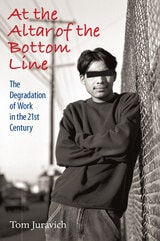
At the Altar of the Bottom Line
The Degradation of Work in the 21st CenturyThomas Juravich
University of Massachusetts Press, 2009
Tom Juravich combines oral history with social and economic analysis to provide a vivid account of the multiple challenges presented in today's workplaces.
Based on extensive interviews with workers in four different industries, this book takes us behind the statistics of the economic collapse and into the lives of Americans who are struggling to make ends meet and support their families.
At a Verizon call center in Andover, Massachusetts, customer service reps find themselves overwhelmed by the pace of work and the constant monitoring. They describe a daily routine marked by regimentation, intense pressure to sell, and unrelenting stress. In New Bedford, undocumented Guatemalans in the fish-processing industry are fired if they don't work fast enough, cheated out of wages, and mistreated by supervisors. Juravich describes a brutal immigration raid by U.S. Immigration and Customs Enforcement that divided families and forced workers further underground.
Juravich then takes us inside the operating rooms at the Boston Medical Center, where hospital consolidation has brought a new “bottom line” philosophy that has fundamentally altered the way patient care is delivered. Surgery takes place almost non-stop, driving some nurses from their chosen profession and leaving those who remain exhausted.
The final case study looks at the shuttering of the Jones Beloit plant, an internationally known manufacturer of machinery for the paper industry. Despite the best efforts of highly skilled and productive workers to save their plant, it was abruptly closed and they were abandoned after their CEO recklessly became involved in a shaky foreign investment.
Juravich argues that workers face a series of paradoxes in the contemporary American workplace. They can no longer assume that large established firms create good jobs. The new working conditions often resemble what was traditionally associated with marginal and low-wage employers. He concludes that we must bring a discussion about the quality of jobs back into the public discourse and that a “good jobs” strategy is a fundamental building block to economic recovery.
Workers' voices are front and center in this highly readable book. It includes striking photographs by Paul Shoul and a CD that presents a series of audio documentaries with excerpts from the interviews, as well as four original songs written and performed by Juravich.
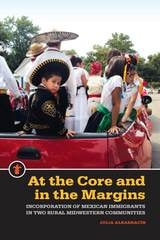
At the Core and in the Margins
Incorporation of Mexican Immigrants in Two Rural Midwestern CommunitiesJulia Albarracín
Michigan State University Press, 2016
Based on 260 surveys and 47 in-depth interviews, this study combines quantitative and qualitative research to explore the level and characteristics of immigrant incorporation in Beardstown and Monmouth. It assesses the advancement of immigrants in the immigration/ residency/citizenship process, the immigrants’ level of cultural integration (via language, their connectedness with other members of society, and their relationships with neighbors), the degree and characteristics of discrimination against immigrants in these two towns, and the extent to which immigrants participate in different social and political activities and trust government institutions.
Immigrants in new destinations are likely to be poorer, to be less educated, and to have weaker English-language skills than immigrants in traditional destinations. Studying how this population negotiates the obstacles to and opportunities for incorporation is crucial.

At the Edge of the Pampas
Land and Longing in ArgentinaRachel Cypher
University of Arizona Press, 2027
Industrial agriculture has transformed vast stretches of the Earth, but few places reveal its contradictions more clearly than the Pampas of Argentina.
In At the Edge of the Pampas, anthropologist Rachel Cypher traces the explosive rise of genetically modified soybeans across one of the world’s great agricultural heartlands. Drawing on immersive long-term fieldwork, the book moves from soybean fields and cattle feedlots to dryland forests to show that industrial agriculture takes many forms. Soy—one of the world’s most standardized commodities—must first pass through local ecologies, informal economies, inherited obligations, and intimate relations of trust before it can circulate as a global asset.
Urgent and deeply original, At the Edge of the Pampas offers a major rethinking of how value is gathered within industrial capitalism and how unruly social and ecological life persists inside even the most engineered landscapes.