Results by title
8642 books match the query '20th Century' and 836 start with a
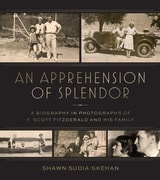
An Apprehension of Splendor
A Biography in Photographs of F. Scott Fitzgerald and His FamilyShawn Sudia-Skehan; Foreword by Jackson R. Bryer; Introduction by Eleanor Lanahan
University of Alabama Press, 2025
A unique collection of Fitzgerald family photographs, many never before published, hand selected by a curator of the Scott and Zelda Fitzgerald Museum.
Enter the Jazz Age glamour of F. Scott and Zelda Fitzgerald and their daughter, Scottie. An Apprehension of Splendor is a rich pictorial biography that illuminates the lives of this brilliant literary family in 344 rare photographs, 180 of which have never been published.
The Fitzgeralds are chiefly known from a small number of iconic, posed images, but the dashing couple and their daughter amassed hundreds of candid snapshots now housed in archives and university library collections throughout North America. These rare photos reveal the full, vivid lives behind the icons—a Buffalo boy cradling a velvety puppy, a jaunty southern gamine in the shade of a loblolly pine laughing at a secret, the stoic gloom of an enlistee in a scratchy woolen uniform, a plot taking shape in the mind of a fledgling writer with bed-tousled hair, an amorous young couple struggling to light a cigarette in the chiaroscuro of a Riviera beach, an unhappy baby tugged through the snow in a laundry basket lashed to a sled, and a myriad of other images that will rekindle fascination with the Fitzgeralds and their time.
With unparalleled access to the family’s personal papers and photographs, Shawn Sudia-Skehan, former director of acquisitions at the Scott and Zelda Fitzgerald Museum, handpicked and annotated this collection of images that brings readers closer to the Fitzgeralds than any other work. Readers of Tender Is the Night, The Beautiful and Damned, and many other works by F. Scott and Zelda will recognize some of the places and experiences that inspired their unforgettable fictions.
A captivating portrait of Jazz Age celebrity, young passion, and artistic ambition, An Apprehension of Splendor returns the perfume to the luminous flower of the Fitzgeralds.
An Arizona Chronology
Statehood, 1913–1936Douglas D. Martin; Edited by Patricia Paylore
University of Arizona Press, 1966
Here were the years in which Arizona’s “bad men” virtually dropped out of sight, and the trigger-blast was displaced by the gavel-thumping sound of law and order as a Territory grew up and became a state. The problem of the Apache was no more, and the problem of water began to loom large. Depression and prohibition were the counter-themes. And Arizona’s three C's—Copper, Cattle, and Cotton—were about to strike for their place in the national limelight.
It was a time of conversion. The vital currents of frontier energy were turned into the channels of modern agriculture, finance, and urban growth. As this volume’s editor, Patricia Paylore, points out, the transformation reaffirms Douglas Martin’s view of Arizona history as the “persistence of the pioneer spirit of the nineteenth century” in terms of “the strength and optimism of a young people determined to take its place in the Union.”
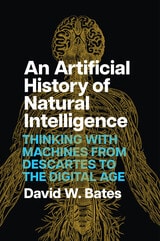
An Artificial History of Natural Intelligence
Thinking with Machines from Descartes to the Digital AgeDavid W. Bates
University of Chicago Press, 2024
We imagine that we are both in control of and controlled by our bodies—autonomous and yet automatic. This entanglement, according to David W. Bates, emerged in the seventeenth century when humans first built and compared themselves with machines. Reading varied thinkers from Descartes to Kant to Turing, Bates reveals how time and time again technological developments offered new ways to imagine how the body’s automaticity worked alongside the mind’s autonomy. Tracing these evolving lines of thought, An Artificial History of Natural Intelligence offers a new theorization of the human as a being that is dependent on technology and produces itself as an artificial automaton without a natural, outside origin.
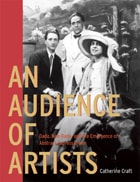
An Audience of Artists
Dada, Neo-Dada, and the Emergence of Abstract ExpressionismCatherine Craft
University of Chicago Press, 2012
The term Neo-Dada surfaced in New York in the late 1950s and was used to characterize young artists like Robert Rauschenberg and Jasper Johns whose art appeared at odds with the serious emotional and painterly interests of the then-dominant movement, Abstract Expressionism. Neo-Dada quickly became the word of choice in the early 1960s to designate experimental art, including assemblage, performance, Pop art, and nascent forms of minimal and conceptual art.

An Environmental History of Knowledge and Politics
Forestry in Nineteenth- and Twentieth-Century HungaryRobert Balogh
Central European University Press, 2026
An Epistemology of the Concrete
Twentieth-Century Histories of LifeHans-Jörg Rheinberger
Duke University Press, 2010
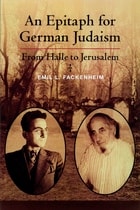
An Epitaph for German Judaism
From Halle to JerusalemEmil Fackenheim
University of Wisconsin Press, 2007
“An ‘epoch-making’ autobiography.”—Arnold Ages, Jewish Tribune
An Epitaph for Little Rock
A Fiftieth Anniversary Retrospective on the Central High CrisisJohn A. Kirk
University of Arkansas Press, 2008

An Equal Share of Freedom
American Jews, Zionism, and World War IEdited by Mark Raider, Zohar Segev, and Gary Phillip Zola
University of Minnesota Press, 2024
An Equal Share of Freedom sheds new light on several important and interrelated dimensions of American, Jewish, and world history in the World War I era. Paying close attention to the Balfour Declaration as a hub around which to explore the period’s unfolding and turbulent social, cultural, and political developments, this collection of essays covers a diverse range of topics including Jewish doughboys, Zionist women authors, and political elites such as Golda Meir and Woodrow Wilson. The volume demonstrates the complex nature of Jewish ethnonational consciousness in the American setting and the impact of Zionism on US wartime and postwar activity.
The essays in this volume overturn timeworn assumptions that have long shaped the fields of American history and modern Jewish history. Taken as a whole, they demonstrate the war’s profound impact on American Jewish life and the transformation of American Jewry’s relationship with wider American society. These essays also illustrate the centrality of Zionism to the American Jewish experience and the extent to which American Jewry’s national consciousness and the future direction of the Zionist project were forged in the crucible of the Great War. An Equal Share of Freedom is the first volume in the Jacob Rader Marcus Series on the American Jewish Experience. In this series, Raider, Segev, and Zola highlight the myriad possibilities for expanding and deepening scholarly understanding of American Jews and the shared history of American society and the Jewish people in the twentieth century, starting with a look at World War I.

An Era of Disruption and Violence
The FBI and the Shattering of the Sixties New LeftAaron J. Leonard
Rutgers University Press, 2027
Throughout the decade of the sixties, the FBI and other elements of the government undertook a massive effort to contain the movement against the American apartheid system and the war in Vietnam. The prime focus of these increasingly repressive efforts was the young radicals of the New Left, residing in the Students for a Democratic Society. Utilizing thousands of pages of unexamined FBI files, voluminous reports from Congress, and the author’s files obtained through Freedom of Information filings, this book will tell the story of the massive repression set loose against SDS, the group’s breakup due to internecine factionalism, and how this was encouraged and amplified at every turn by secret measures deployed by the FBI.
An Exaltation of Forms
Contemporary Poets Celebrate the Diversity of Their ArtAnnie Finch and Kathrine Varnes, Editors
University of Michigan Press, 2002
The forms range from hendecasyllabics to prose poetry, haiku to procedural poetry, sonnets to blues, rap to fractal verse. The range of poets included is equally impressive--from Amiri Baraka to John Frederick Nims, from Maxine Kumin to Marilyn Hacker, from Agha Shahid Ali to Pat Mora, from W. D. Snodgrass to Charles Bernstein. Achieving this level of eclecticism is a remarkable feat, especially given the strong opinions held by members of the various camps (e.g., the New Formalists, LANGUAGE poets, feminist and multicultural poets) that exist within today's poetry community. Poets who might never occupy the same room here occupy the same pages, perhaps for the first time. The net effect is a book that will surprise, inform, and delight a wide range of readers, whether as reference book, pleasure reading, or classroom text.
Poet, translator, and critic Annie Finch is director of the Stonecoast low-residency MFA program at the University of Southern Maine. She is author of The Ghost of Meter: Culture and Prosody in American Free Verse, Eve, and Calendars. She is the winner of the eleventh annual Robert Fitzgerald Prosody Award for scholars who have made a lasting contribution to the art and science of versification.
Kathrine Varnes teaches English at the University of Missouri-Columbia. She is the author of the book of poems, The Paragon. Her poems and essays have appeared in many books and journals.
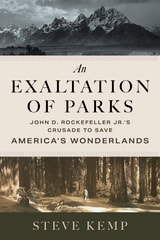
An Exaltation of Parks
John D. Rockefeller Jr.'s Crusade to Save America's WonderlandsSteve Kemp
University of Utah Press, 2025
America’s national parks are facing unprecedented challenges. With visitation pressures mounting and the National Park Service struggling to keep up, author and former park ranger Steve Kemp looks toward one exceptionally effective historical example of conservation philanthropy and park building—the collaboration between John D. Rockefeller Jr. and NPS legends Stephen Mather, Horace Albright, and Arno Cammerer.
An Exaltation of Parks reveals the inspiring story of this collaboration, showing how the partnership transformed some of America's most cherished national parks, including Acadia, Grand Teton, Great Smoky Mountains, Yellowstone, and Yosemite. It recounts Rockefeller’s lifelong dedication to conservation, digging into his own pockets and toiling as a volunteer to achieve his goals for converting private land into public use. Bringing to life the history and significance of America’s most magnificent landscapes, this volume is both a tribute to past conservation victories and a call to action for the future, emphasizing the need for continued vigilance to preserve these national treasures for generations to come.
An Extraordinary Year of Ordinary Days
By Susan Wittig Albert
University of Texas Press, 2010
From Eudora Welty's memoir of childhood to May Sarton's reflections on her seventieth year, writers' journals offer an irresistible opportunity to join a creative thinker in musing on the events—whether in daily life or on a global scale—that shape our lives. In An Extraordinary Year of Ordinary Days, best-selling mystery novelist Susan Wittig Albert invites us to revisit one of the most tumultuous years in recent memory, 2008, through the lens of 365 ordinary days in which her reading, writing, and thinking about issues in the wider world—from wars and economic recession to climate change—caused her to reconsider and reshape daily practices in her personal life.
Albert's journal provides an engaging account of how the business of being a successful working writer blends with her rural life in the Texas Hill Country and the Sangre de Cristo Mountains of New Mexico. As her eclectic daily reading ranges across topics from economics, food production, and oil and energy policy to poetry, place, and the writing life, Albert becomes increasingly concerned about the natural world and the threats facing it, especially climate change and resource depletion. Asking herself, "What does it mean? And what ought I do about it?", she determines practical steps to take, such as growing more food in her garden, and also helps us as readers make sense of these issues and consider what our own responses might be.
An Image of God
The Catholic Struggle with EugenicsSharon M. Leon
University of Chicago Press, 2013
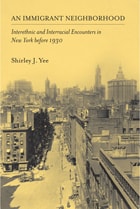
An Immigrant Neighborhood
Interethnic and Interracial Encounters in New York before 1930Shirley Yee
Temple University Press, 2011
Examining race and ethnic relations through an intersectional lens, Shirley Yee's An Immigrant Neighborhoodinvestigates the ways that race, class, and gender together shaped concepts of integration and assimilation as well as whiteness and citizenship in lower Manhattan during the late nineteenth and early twentieth-centuries.
In contrast to accounts of insulated neighborhoods and ethnic enclaves, Yee unearths the story of working class urban dwellers of various ethnic groups—Chinese, Jews, Italians, and Irish—routinely interacting in social and economic settings.
Yee's numerous, fascinating anecdotes—such as one about an Irishman who served as the only funeral director for Chinese for many years—recount the lived experiences of these neighborhoods, detailing friendships, business relationships, and sexual relationships that vividly counter the prevailing idea that different ethnic groups did not mix except in ways marked by violence and hostility.
An Index to Reproductions of Paintings by Twentieth-Century Chinese Artists
Ellen Johnston Laing
University of Michigan Press, 1998
An Infuriating American
The Incendiary Arts of H. L. MenckenHal Crowther
University of Iowa Press, 2014
Nearly 60 years after his death, Mencken’s memory and monumental verbal legacy rest largely in the hands of literary scholars and historians, to whom he will always be a curious figure, unchecked and alien and not a little distasteful. No faculty would have voted him tenure. Hal Crowther, who followed in many of Mencken’s footsteps as a reporter, magazine editor, literary critic, and political columnist, focuses on Mencken the creator, the observer who turned his impressions and prejudices into an inimitable group portrait of America, painted in prose that charms and glowers and endures. Crowther, himself a working polemicist who was awarded the Baltimore Sun’s Mencken prize for truculent commentary, examines the origin of Mencken’s thunderbolts—where and how they were manufactured, rather than where and on whom they landed.
Mencken was such an outrageous original that contemporary writers have made him a political shuttlecock, defaming or defending him according to modern conventions he never encountered. Crowther argues that loving or hating him, admiring or despising him are scarcely relevant. Mencken can inspire and he can appall. The point is that he mattered, at one time enormously, and had a lasting effect on the national conversation. No writer can afford to ignore his craftsmanship or success, or fail to be fascinated by his strange mind and the world that produced it. This book is a tribute—though by no means a loving one—to a giant from one of his bastard sons.
An Intellectual History of Turkish Nationalism
Between Turkish Ethnicity and Islamic IdentityUmut Uzer
University of Utah Press, 2016
While predominantly a textual analysis of the primary sources written by the nationalists, this volume takes into account how political developments influenced Turkish nationalism and also tackles the question of how an ideology that began as a revolutionary, progressive, forward-looking ideal eventually transformed into one that is conservative, patriarchal, and nostalgic to the Ottoman and Islamic past. Between Islamic and Turkish Identity is the first book in any language to comprehensively analyze Turkish nationalism with such scope and engagement with primary sources; it aims to dissect the phenomenon in all its manifestations.
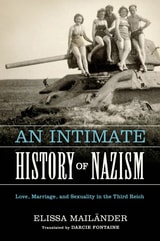
An Intimate History of Nazism
Love, Marriage, and Sexuality in the Third ReichElissa Mailänder
University of Wisconsin Press, 2027
Published to great acclaim in French and now available for the first time in English, this groundbreaking book explores how the Nazi regime used sexuality to promote political loyalty, conformity, and cohesion among “ordinary” Germans. Beginning before the collapse of the Weimar Republic and continuing through the postwar American occupation of Germany, Elissa Mailänder’s study highlights the complex and conflicted ways that sexual “liberation,” repression, and violence were used and experienced in the everyday lives of citizens of the Reich. Her analysis draws on a vast array of sources, from legal dossiers to private photographs and letters, as well as public archives, magazines, and movies. Mailänder’s findings are often uncomfortable; she demonstrates, for example, that a significant number of women who were not persecuted by the regime saw shifts in gender and sexual norms as positive developments—ones that some felt were lost under the American occupation, with its own routines of military sexual exploitation. What emerges is a portrait of a regime that was less interested in repressing sexuality than in reinventing it according to a racist, elitist, and homophobic agenda.

An Iowa Schoolma’am
Letters of Elizabeth “Bess” Corey, 1904–1908Philip L. Gerber
University of Iowa Press, 2011
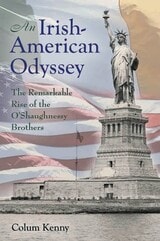
An Irish-American Odyssey
The Remarkable Rise of the O'Shaughnessy BrothersColum Kenny
University of Missouri Press, 2014
An Italian Journey
Jean Giono
Northwestern University Press, 1998
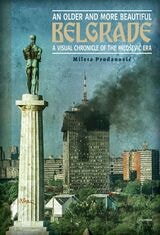
An Older and More Beautiful Belgrade
A Visual Chronicle of the Milo.evic EraMileta Prodanovic
Central European University Press, 2023
This substantial essay depicts urban collapse in an exceptionally difficult period of the Serbian capital. The author has marshalled facts, reflections, photographs and other imagesto demonstrate the transformation of Belgrade during the Milošević years. With the theoretical grounding of cultural anthropology, history studies, culture of memory, history of art, and urbanism, Mileta Prodanović considers changes to the built environment and urban landscape in the city in the 1990s. He covers many visual aspects of life with great ingenuity: shopping centers, unregulated construction and “wild” modifications of buildings, new buildings (broadcasting studios, shops, homes) that do not fit the surroundings, bad taste in home furnishings (camp, kitsch), boondoggles such as the international art center, problematic historical markers like the obelisk of the eternal flame, billboards, store displays, electoral propaganda, graffiti, grave-markers and cemetery memorials, coins and paper money, calendars, beer labels, and even religious icons (and more). All this information is provided with some critique and much implied comparison to past standards.
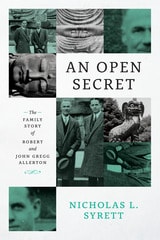
An Open Secret
The Family Story of Robert and John Gregg AllertonNicholas L. Syrett
University of Chicago Press, 2021
An Open Secret tells the striking story of these two iconoclasts, locating them among their queer contemporaries and exploring why becoming father and son made a surprising kind of sense for a twentieth-century couple who had every monetary advantage but one glaring problem: they wanted to be together publicly in a society that did not tolerate their love. Deftly exploring the nature of their design, domestic, and philanthropic projects, Nicholas L. Syrett illuminates how viewing the Allertons as both a same-sex couple and an adopted family is crucial to understanding their relationship’s profound queerness. By digging deep into the lives of two men who operated largely as ciphers in their own time, he opens up provocative new lanes to consider the diversity of kinship ties in modern US history.
An Open Secret
The Family Story of Robert and John Gregg AllertonNicholas L. Syrett
University of Chicago Press, 2021
This is an auto-narrated audiobook edition of this book.
In 1922 Robert Allerton—described by the Chicago Tribune as the “richest bachelor in Chicago”—met a twenty-two-year-old University of Illinois architecture student named John Gregg, who was twenty-six years his junior. Virtually inseparable from then on, they began publicly referring to one another as father and son within a couple years of meeting. In 1960, after nearly four decades together, and with Robert Allerton nearing ninety, they embarked on a daringly nonconformist move: Allerton legally adopted the sixty-year-old Gregg as his son, the first such adoption of an adult in Illinois history.
An Open Secret tells the striking story of these two iconoclasts, locating them among their queer contemporaries and exploring why becoming father and son made a surprising kind of sense for a twentieth-century couple who had every monetary advantage but one glaring problem: they wanted to be together publicly in a society that did not tolerate their love. Deftly exploring the nature of their design, domestic, and philanthropic projects, Nicholas L. Syrett illuminates how viewing the Allertons as both a same-sex couple and an adopted family is crucial to understanding their relationship’s profound queerness. By digging deep into the lives of two men who operated largely as ciphers in their own time, he opens up provocative new lanes to consider the diversity of kinship ties in modern US history.
An Opportunity Lost
The Truman Administration and the Farm Policy DebateVirgil W. Dean
University of Missouri Press, 2006
An Ordinary Life?
The Journeys of Tonia Lechtman, 1918–1996Anna Müller
Ohio University Press, 2024
One woman’s national, political, ethnic, social, and personal identities impart an extraordinary perspective on the histories of Europe, Polish Jews, Communism, activism, and survival during the twentieth century.
Tonia Lechtman was a Jew, a loving mother and wife, a Polish patriot, a committed Communist, and a Holocaust survivor. Throughout her life these identities brought her to multiple countries—Poland, Palestine, Spain, France, Germany, Switzerland, and Israel—during some of the most pivotal and cataclysmic decades of the twentieth century. In most of those places, she lived on the margins of society while working to promote Communism and trying to create a safe space for her small children.
Born in Łódź in 1918, Lechtman became fascinated with Communism in her early youth. In 1935, to avoid the consequences of her political activism during an increasingly antisemitic and hostile political environment, the family moved to Palestine, where Tonia met her future husband, Sioma. In 1937, the couple traveled to Spain to participate in the Spanish Civil War. After discovering she was pregnant, Lechtman relocated to France while Sioma joined the International Brigades. She spent the Second World War in Europe, traveling with two small children between France, Germany, and Switzerland, at times only miraculously avoiding arrest and being transported east to Nazi camps. After the war, she returned to Poland, where she planned to (re)build Communist Poland. However, soon after her arrival she was imprisoned for six years. In 1971, under pressure from her children, Lechtman emigrated from Poland to Israel, where she died in 1996.
In writing Lechtman’s biography, Anna Müller has consulted a rich collection of primary source material, including archival documentation, private documents and photographs, interviews from different periods of Lechtman’s life, and personal correspondence. Despite this intimacy, Müller also acknowledges key historiographical questions arising from the lacunae of lost materials, the selective preservation of others, and her own interpretive work translating a life into a life story.
An Unassuming Heroism
The Life of Robert Russa MotonBrian McGovern and Kevin McGovern
University of Alabama Press, 2026
The story of a Tuskegee Institute visionary who advised US presidents and led unprecedented advances in American Civil Rights
An Unassuming Heroism: The Life of Robert Russa Moton is a landmark biography that reveals the previously overlooked story of one of the most influential African American leaders of the twentieth century. Brian and Kevin McGovern trace Robert Moton’s life: from his birth as the son of freed people through his tenure as the leader of Tuskegee Institute directly after Booker T. Washington. Moton guided Tuskegee to new levels of excellence and international prominence, became an advisor to seven US presidents, and won their cooperation in the establishment of greater minority rights.
Rejecting conventional portrayals of Moton as a mere follower of Washington, the authors reveal an astute and increasingly independent leader who worked to bridge competing visions of Black advancement while championing broader African American rights, educational opportunities, and social justice. Through his investigations of issues such as racial discrimination in World War I, inequitable minority treatment during the Mississippi River flood of 1927, and Black people’s struggles to access healthcare and public accommodation, Moton helped shape national conversations on race and equality and advanced many arguments utilized by later Civil Rights leaders.
This biography offers a compelling reassessment of a courageous and visionary civic pioneer whose historical impact calls for renewed recognition. It is essential reading for scholars, students, and any reader interested in African American history, education, or progressive political leadership.
An Uncertain Age
The Politics of Manhood in KenyaPaul Ocobock
Ohio University Press, 2017
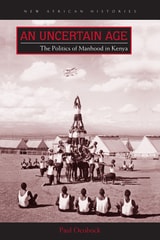
In twentieth-century Kenya, age and gender were powerful cultural and political forces that animated household and generational relationships. They also shaped East Africans’ contact with and influence on emergent colonial and global ideas about age and masculinity. Kenyan men and boys came of age achieving their manhood through changing rites of passage and access to new outlets such as town life, crime, anticolonial violence, and nationalism. And as they did, the colonial government appropriated masculinity and maturity as means of statecraft and control.
In An Uncertain Age, Paul Ocobock positions age and gender at the heart of everyday life and state building in Kenya. He excavates in unprecedented ways how the evolving concept of “youth” motivated and energized colonial power and the movements against it, exploring the masculinities boys and young men debated and performed as they crisscrossed the colony in search of wages or took the Mau Mau oath. Yet he also considers how British officials’ own ideas about masculinity shaped not only young African men’s ideas about manhood but the very nature of colonial rule.
An Uncertain Age joins a growing number of histories that have begun to break down monolithic male identities to push the historiographies of Kenya and empire into new territory.
An Unnatural Attitude
Phenomenology in Weimar Musical ThoughtBenjamin Steege
University of Chicago Press, 2021
An Unnatural Attitude traces a style of musical thought that coalesced in the intellectual milieu of the Weimar Republic—a phenomenological style that sought to renew contact with music as a worldly circumstance. Deeply critical of the influence of naturalism in aesthetics and ethics, proponents of this new style argued for the description of music as something accessible neither through introspection nor through experimental research, but rather in an attitude of outward, open orientation toward the world. With this approach, music acquires meaning in particular when the act of listening is understood to be shared with others.
Benjamin Steege interprets this discourse as the response of a young, post–World War I generation amid a virtually uninterrupted experience of war, actual or imminent—a cohort for whom disenchantment with scientific achievement was to be answered by reasserting the value of imaginative thought. Steege draws on a wide range of published and unpublished texts from music theory, pedagogy, criticism, and philosophy of music, some of which appear for the first time in English translation in the book’s appendixes. An Unnatural Attitude considers the question: What are we thinking about when we think about music in non-naturalistic terms?
An Unplanned Life
A MemoirGeorge McKee Elsey
University of Missouri Press, 2005
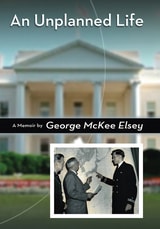
Elsey’s duties continued with Harry Truman’s succession to the presidency. He decoded the famous message from Secretary of War Henry Stimson reporting the dropping of the atomic bomb on Hiroshima and carried it to President Truman. In 1947, he shed his Naval Reserve uniform and joined the White House’s civilian staff as assistant to the special counsel to the president. In 1949, he became administrative assistant to the president, and, in 1952, he became a member of the Mutual Security Agency staff. During those years, he grew very close to Harry Truman, and thus, a major portion of An Unplanned Life relates to his experiences then.
In the first postwar winter, Elsey was frequently the only staff member who accompanied President Truman on the USS Williamsburg. In September 1946, Elsey submitted a report to Truman on U.S.-Soviet relations, which came to be well known as the “Clifford-Elsey Report.” Providing Truman with notes for some two hundred of his “back-of-the-train” informal talks, Elsey played a part in the best remembered feature of the “Whistle-Stop Campaign” that resulted in “the political upset of the century.” In addition to his years at the White House, Elsey also touches on his post–White House years—his time in private industry, his months with Clark Clifford when Clifford was trying unsuccessfully to extricate America from Vietnam, and his long association with the American Red Cross.
An Unplanned Life is a fascinating look at the life of an extraordinary individual who played an important and unprecedented part in two different presidents’ decisions and affected the course of our nation. Anyone with an interest in history will find this memoir fascinating and invaluable.
An Unseen Unheard Minority
Asian American Students at the University of IllinoisSharon S. Lee
Rutgers University Press, 2022
An Unsentimental Education
Writers and ChicagoMolly McQuade
University of Chicago Press, 1995
Interviews with:Saul Bellow, Paul Carroll, Hayden Carruth, Robert Coover, Leon Forrest, June Jordan, Janet Kauffman, Morris Philipson, M. L. Rosenthal, Philip Roth, Susan Fromberg Shaeffer, Charles Simic, Susan Sontag, George Starbuck, George Steiner, Richard Stern, Nathaniel Tarn, Douglas Unger, Kurt Vonnegut, and Marguerite Young.
Anaconda
Labor, Community, and Culture in Montana's Smelter CityLaurie Mercier
University of Illinois Press, 2001
Laurie Mercier's look at "community unionism" examines the distinctive culture of cooperation and activism fostered by residents in Anaconda, Montana, home to the world's largest copper smelter and the namesake of the Anaconda Copper Mining Company.
Mercier depicts the vibrant life of the smelter city at full steam, incorporating the candid commentary of the locals ("the company furnished three pair of leather gloves . . . and all the arsenic [dust] you could eat"). During five decades of devoted unionism, locals embraced an "alternative Americanism" that championed improved living standards for working people as the best defense against communism. Mercier also explores how gender limits on women's political, economic, and social roles shaped the nature and outcome of labor struggles, and traces how union rivalries, environmental concerns, and the 1980 closing of the Anaconda smelter transformed the town.
A fascinating portrait of how community molds working class consciousness, Anaconda offers important insights about the changing nature of working class culture and collective action.
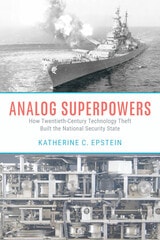
Analog Superpowers
How Twentieth-Century Technology Theft Built the National Security StateKatherine C. Epstein
University of Chicago Press, 2024
At the beginning of the twentieth century, two British inventors, Arthur Pollen and Harold Isherwood, became fascinated by a major military question: how to aim the big guns of battleships. These warships—of enormous geopolitical import before the advent of intercontinental missiles or drones—had to shoot in poor light and choppy seas at distant moving targets, conditions that impeded accurate gunfire. Seeing the need to account for a plethora of variables, Pollen and Isherwood built an integrated system for gathering data, calculating predictions, and transmitting the results to the gunners. At the heart of their invention was the most advanced analog computer of the day, a technological breakthrough that anticipated the famous Norden bombsight of World War II, the inertial guidance systems of nuclear missiles, and the networked “smart” systems that dominate combat today. Recognizing the value of Pollen and Isherwood’s invention, the British Royal Navy and the United States Navy pirated it, one after the other. When the inventors sued, both the British and US governments invoked secrecy, citing national security concerns.
Drawing on a wealth of archival evidence, Analog Superpowers analyzes these and related legal battles over naval technology, exploring how national defense tested the two countries’ commitment to individual rights and the free market. Katherine C. Epstein deftly sets out Pollen’s and Isherwood’s pioneering achievements, the patent questions raised, the geopolitical rivalry between Britain and the United States, and the legal precedents each country developed to control military tools built by private contractors.
Epstein’s account reveals that long before the US national security state sought to restrict information about atomic energy, it was already embroiled in another contest between innovation and secrecy. The America portrayed in this sweeping and accessible history isn’t yet a global hegemon but a rising superpower ready to acquire foreign technology by fair means or foul—much as it accuses China of doing today.

Analog Superpowers
How Twentieth-Century Technology Theft Built the National Security StateKatherine C. Epstein
University of Chicago Press, 2024
A gripping history that spans law, international affairs, and top-secret technology to unmask the tension between intellectual property rights and national security.
At the beginning of the twentieth century, two British inventors, Arthur Pollen and Harold Isherwood, became fascinated by a major military question: how to aim the big guns of battleships. These warships—of enormous geopolitical import before the advent of intercontinental missiles or drones—had to shoot in poor light and choppy seas at distant moving targets, conditions that impeded accurate gunfire. Seeing the need to account for a plethora of variables, Pollen and Isherwood built an integrated system for gathering data, calculating predictions, and transmitting the results to the gunners. At the heart of their invention was the most advanced analog computer of the day, a technological breakthrough that anticipated the famous Norden bombsight of World War II, the inertial guidance systems of nuclear missiles, and the networked “smart” systems that dominate combat today. Recognizing the value of Pollen and Isherwood’s invention, the British Royal Navy and the United States Navy pirated it, one after the other. When the inventors sued, both the British and US governments invoked secrecy, citing national security concerns.
Drawing on a wealth of archival evidence, Analog Superpowers analyzes these and related legal battles over naval technology, exploring how national defense tested the two countries’ commitment to individual rights and the free market. Katherine C. Epstein deftly sets out Pollen’s and Isherwood’s pioneering achievements, the patent questions raised, the geopolitical rivalry between Britain and the United States, and the legal precedents each country developed to control military tools built by private contractors.
Epstein’s account reveals that long before the US national security state sought to restrict information about atomic energy, it was already embroiled in another contest between innovation and secrecy. The America portrayed in this sweeping and accessible history isn’t yet a global hegemon but a rising superpower ready to acquire foreign technology by fair means or foul—much as it accuses China of doing today.
Analogical Thinking
Post-Enlightenment Understanding in Language, Collaboration, and InterpretationRonald Schleifer
University of Michigan Press, 2001
The book traces this mode of thinking in linguistics, collaborative intellectual work in the arts and sciences, and interpretations of literary and sacred texts, concluding with a reading of the concept of Enlightenment in a comparison of Descartes and Foucault. The book examines the poststructuralism of Derrida; the collaborations of information theory and modern science as opposed to the individualism of Adam Smith and others, and analogical interpretations of Yeats, Dinesen, the Bible, Dreiser, and Mailer. Its overall aim is to present an interdisciplinary examination of a particular kind of understanding that responds to the experiences of our time.
Ronald Schleifer is Professor of English, University of Oklahoma. His books include Rhetoric and Death: The Language of Modernism and Postmodern Discourse Theory, Criticism and Culture; and Culture and Cognition: The Boundaries of Literary and Scientific Inquiry.
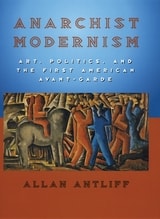
Anarchist Modernism
Art, Politics, and the First American Avant-GardeAllan Antliff
University of Chicago Press, 2001
By situating American art's evolution in the progressive politics of the time, Antliff offers a richly illustrated chronicle of the anarchist movement and also revives the creative agency of those who shaped and implemented modernism for radical ends.
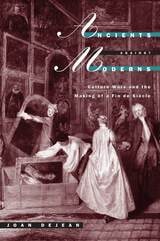
Ancients against Moderns
Culture Wars and the Making of a Fin de SiecleJoan DeJean
University of Chicago Press, 1996
DeJean brilliantly reassesses our current culture wars from the perspective of that earlier fin de siècle (the first to think of itself as such), and rereads the seventeenth-century Quarrel from the vantage of our own warring "ancients" and "moderns." In so doing, DeJean shows that a fin de siècle taking place in the shadow of culture wars can be more a source of constructive cultural revolution than of apocalyptic gloom and doom. Just as the first fin de siècle's battle of the books served as the spark that set off the Enlightenment, introducing radically new sexual and social politics that laid the groundwork for modernity, so can our current culture wars result in radical, liberating changes—if we take an active stand against our own "ancients" who seek to stifle such reforms.
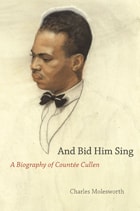
And Bid Him Sing
A Biography of Countée CullenCharles Molesworth
University of Chicago Press, 2012
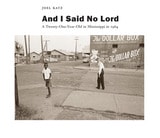
And I Said No Lord
A Twenty-One-Year-Old in Mississippi in 1964Joel Katz
University of Alabama Press, 2014
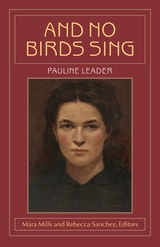
And No Birds Sing
Pauline Leader
Gallaudet University Press, 2016
This edition is accompanied by a new introduction and afterword that provide a scholarly framework for understanding Leader and her times. She persevered and became a published poet and novelist, often drawing on the experiences offered up here. Compelling and evocative, And No Birds Sing deftly reveals a complex, intelligent spirit toiling in a brutal world.
From the book:
I insisted to myself that I could still hear. I heard in my mind the sounds of streams as I passed them. I knew the sound the river made, that river that I had known always, the river by the marble house. In my mind the river washed with a low intimate sound. I had no need to hear as the people heard. True intimacy needs no ears. I knew the sound of birds; I heard them as they hopped about. I knew the sound of words also. It was words that I most intensely heard. I had not always the river and the birds—they appeared far away at times. I did not always want river and birds, but I always wanted words, and I always had them. I would have been terribly lonely without them. With them always in my mind, I could not be truly lonely. I played with them; I set them to music; I achieved endless variations with them. They were never weary, as other things could sometimes be weary.
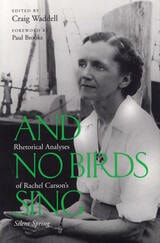
And No Birds Sing
Rhetorical Analyses of Rachel Carson's Silent SpringEdited by Craig Waddell. Foreword by Paul Brooks. Afterword by Linda Lear
Southern Illinois University Press, 2000
Craig Waddell presents essays investigating Rachel Carson’s influential 1962 book, Silent Spring. In his foreword, Paul Brooks, Carson’s editor at Houghton Mifflin, describes the process that resulted in Silent Spring. In an afterword, Linda Lear, Carson’s recent biographer, recalls the end of Carson’s life and outlines the attention that Carson’s book and Carson herself received from scholars and biographers, attention that focused so minutely on her life that it detracted from a focus on her work. The foreword by Brooks and the afterword by Lear frame this exploration within the context of Carson’s life and work.
Contributors are Edward P. J. Corbett, Carol B, Gartner, Cheryll Glotfelty, Randy Harris, M. Jimmie Killingsworth, Linda Lear, Ralph H. Lutts, Christine Oravec, Jacqueline S. Palmer, Markus J. Peterson, Tarla Rai Peterson, and Craig Waddell. Together, these essays explore Silent Spring’seffectiveness in conveying its disturbing message and the rhetorical strategies that helped create its wide influence.
And Other Stories
Georgi Gospodinov
Northwestern University Press, 2007
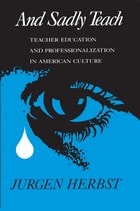
And Sadly Teach
Teacher Education and Professionalization in American CultureJurgen Herbst
University of Wisconsin Press, 1991
To lend weight to his charge that the public school teacher has been betrayed and gravity to his indictment of the educational establishment for that betrayal, Jurgen Herbst goes back to the beginnings of teacher education in America in the 1830s and traces its evolution up to the 1920s, by which time the essential damage had been done.
Initially, attempts were made to upgrade public school teaching to a genuine profession, but that ideal was gradually abandoned. In its stead, with the advent of newly emerging graduate schools of education in the early decades of the twentieth century, came the so-called professionalization of public education. At the expense of the training of elementary school teachers (mostly women), teacher educators shifted their attention to the turning out of educational "specialists" (mostly men)—administrators, faculty members at normal schools and teachers colleges, adult education teachers, and educational researchers.
Ultimately a history of the neglect of the American public school teacher, And Sadly Teach ends with a plea and a message that ring loud and clear. The plea: that the current reform proposals for American teacher education—the Carnegie and the Holmes reports—be heeded. The message: that the key to successful school reform lies in educating teacher’s true professionals and in acknowledging them as such in their classrooms.

And Then There Were Nine. . .
More Women of MysteryUniversity of Wisconsin Press, 1985
And Yet I Still Have Dreams
A Story of Certain LonelinessJoanna Wiszniewicz
Northwestern University Press, 2004
The book provides a connection to seldom discussed aspects of the Holocaust: the gulf between rich and poor Jews and how this translated into everyday survival; the refusal by Alex to see himself or Jews in general as heroes or victims; his own self-absorption as a teen in the ghetto; and his "priviliged" family's near-indifference to the suffering of those around them. Alex paints a picture of complex and diverse Jewish society in prewar Poland, revealing how, many years later and despite his determine to leave it in the past, the burdens of memory--and the dreams--linger.

And the War Is Over . . .
Shmuel T. Meyer
Seagull Books, 2024
Sharp as a razor and as subtle as gossamer, Shmuel T. Meyer’s masterfully crafted stories evoke unique individual sensibilities and destinies, resonating with the sensual details, smells, tastes, music, and sounds of a specific time and place. And the War Is Over brings together three collections of short stories set on three continents in the aftermath of war: World War II and the Shoah in Grand European Express, the Korean War in The Great American Disaster, and the Arab-Israeli conflict in Kibbutz.
Characters both real and imagined run through a fabric so tightly woven that the threads of history and fiction can barely be separated: the Roman poet Clara who will never write again; Saul, a New York City police detective haunted by memories of the Pusan Perimeter; a brother out to avenge his sister’s murder; the son of a former Nazi who joins the Red Army Faction. Tracing moments of encounter, their paths cross those of Allen Ginsberg, Albert Cossery, John Coltrane, and Duke Ellington. Characters travel by train from Venice to Paris, hike up the Val d’Annivers, listen to jazz in Greenwich Village, and ride a motorcycle along the sandy road to Haifa. Under the shadow of war, with death lurking, these multifaceted, evocative lives move in a space between coincidence and fate.

And the World Stood Silent
SEPHARDIC POETRY OF THE HOLOCAUSTTranslated and with Commentaries by Isaac Jack Lévy
University of Illinois Press, 1989
And the World Stood Silent gathers the Sephardim's French, Greek, Italian, and Judeo-Spanish poems, accompanied by English translations, about their long journey to the concentration and extermination camps. Isaac Jack Lévy also surveys the 2,000-year history of the Sephardim and discusses their poetry in relation to major religious, historical, and philosophical questions.
Wrenchingly conveying the pathos and suffering of the Jewish community during World War II, And the World Stood Silent is invaluable as a historical account and as a documentary source.
Andy Warhol, Poetry, and Gossip in the 1960s
Reva Wolf
University of Chicago Press, 1997
Wolf investigates the underground culture of poets, artists, and filmmakers who interacted with Warhol regularly. She claims that Warhol understood the literary imagination of his generation and that recognizing Warhol's literary activities is essential to understanding his art. Drawing on a wealth of unpublished material, including interviews, personal and public archives, tape recordings, documentary photographs, and works of art, Wolf offers dramatic evidence that Warhol's interactions with writers functioned like an extended conversation and details how this process impacted his work. This highly original and fascinating study gives us fresh insight into Warhol's art as practice and reformulates the myth that surrounds this popular American artist.