Results by title
8642 books match the query '20th Century' and 836 start with a
At the President's Side
The Vice Presidency in the Twentieth CenturyEdited by Timothy Walch
University of Missouri Press, 1997
The nation's first vice president, John Adams, called his job "the most insignificant office ever the invention of man contrived or his imagination conceived." And many of the forty-four men who succeeded him in the office have said much worse. Perhaps the biggest problem is that the job has a fancy title, but few responsibilities. Other than presiding over the Senate, the vice president of the United States has no constitutional duties. In fact, it is not even clear that the founders of the republic ever intended that the vice president would succeed to the presidency upon the death of an incumbent.
Yet, despite the relative obscurity of the position, few politicians turn down the opportunity to serve as vice president of the United States. Being elected vice president is often a stepping-stone to the presidency. Since World War II, five vice presidents—Harry Truman, Richard Nixon, Lyndon Johnson, Gerald Ford, and George Bush—have gone on to become president. While it may not be glamorous, the vice presidency is an important training ground for national leadership.
The essays in this book trace the evolution of the vice presidency in the twentieth century from Theodore Roosevelt to Dan Quayle. The first five chapters tell the stories of a colorful collection of the men chosen because of their native states or their political acumen, but not their leadership abilities. The next four chapters form a mosaic of tragedy. Richard Nixon rose from the vice presidency to the presidency only to be forced from office. Lyndon Johnson's tenure ended unhappily because of the prolonged fighting in Vietnam. Hubert Humphrey was humiliated as vice president by a man who should have known better. And Spiro Agnew was rousted from the office by petty greed.
The following four chapters tell the story of a new vice presidency. Nelson Rockefeller, Walter Mondale, George Bush, and Dan Quayle redefined the job that not many people wanted but that few could refuse. In a particularly valuable essay, Quayle reflects on the checkered past of his predecessors, gives credit to Walter Mondale for rehabilitating the vice presidency, and tells of his working relationship with George Bushþoffering a unique glimpse of an office that is quickly becoming the second most powerful in the nation.
Addressing the future of the office, Richard E. Neustadt provides a detailed analysis of the nucleus of vice presidential powerþproximity to the president. To whit, we have Neustadt's maxim: "The power and influence of a vice president is inversely proportional to the political distance between that vice president and his president. The greater the distance the less the power."
At the President's Side includes anecdotal and informative essays by presidential scholars John Milton Cooper Jr., Robert H. Ferrell, Elliot A. Rosen, Richard S. Kirkendall, Richard Norton Smith, Robert Dallek, Joel K. Goldstein, John Robert Greene, and Steven M. Gillon. Also included are incisive commentaries by such Washington insiders as Hugh Sidey, R. W. Apple Jr., James Cannon, and Chase Untermeyer. This book will inform and entertain general readers and also challenge scholars interested in the presidency and the vice presidency.

At the Vanguard of Vinyl
A Cultural History of the Long-Playing Record in JazzDarren Mueller
Duke University Press, 2024
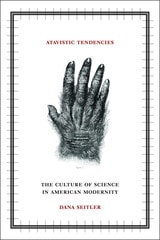
Atavistic Tendencies
The Culture of Science in American ModernityDana Seitler
University of Minnesota Press, 2008
A provocative exploration of the impact of the human sciences on literature, politics, and culture
The post-Darwinian theory of atavism forecasted obstacles to human progress in the reappearance of throwback physical or cultural traits after several generations of absence. In this original and stimulating work, Dana Seitler explores the ways in which modernity itself is an atavism, shaping a historical and theoretical account of its dramatic rise and impact on Western culture and imagination.
Examining late nineteenth- and early twentieth-century science, fiction, and photography, Seitler discovers how modern thought oriented itself around this paradigm of obsolescence and return—one that served to sustain ideologies of gender, sexuality, and race. She argues that atavism was not only a discourse of violence—mapping racial and sexual divisions onto the boundary between human and animal—but was also an illustration of how modern science understood human being as a temporal category. On one hand, atavism positioned some humans as more advanced than others on an evolutionary scale. On the other, it undermined such progressivism by suggesting that because all humans had evolved from animals they were therefore not purely human. Atavism thus reveals how scientific theories of a recurrent past were a significant feature of modernity.At the beginning of the twentieth century, atavistic theory had widespread social and economic effects on the taxonomies of medicine, the logic of the welfare state, conceptions of the modern family, and images of the abnormal. Investigating the cultural logic of science in conjunction with naturalist, feminist, and popular narratives, Seitler exposes the influence of atavism: a fundamental shift in ways of knowing—and telling stories about—the modern human.
Atlantic Isles
Travel and Identity in the British and Irish West, 1880–1940Gareth Roddy
University of London Press, 2025
The west has long gripped the imagination. In Atlantic Isles, Gareth Roddy examines the cultural and political prominence of the "westward gaze," which flourished in late-nineteenth century Britain and Ireland. From Cornish cliffs and Welsh mountains to Hebridean islands and the Connemara highlands, the west was an imagined geography that transcended the national territories of these isles. In the west, geologists uncovered ancient layers of rock, ethnologists described older racial "types," philologists looked for the survival of Celtic languages, and antiquarians and archaeologists marveled at megalithic monuments at the Atlantic coastline.
This book draws on wide-ranging contemporary sources, including works of geology, philology, ethnology, history, geography, archaeology, folklore, literature, sociology, and an extensive collection of travel writing that popularized western landscapes among readers and tourists who explored the increasingly accessible west by road, rail, and steamer. Atlantic Isles reveals that western landscapes were especially powerful spaces of modern enchantment, where stories of sunken lands and mythical islands produced a sense of mystery and wonder in a supposedly disenchanted world. The significance of western landscapes for national identities is well known, but this book demonstrates that the west was also central to debates about Britishness and to the bold attempt to construct a narrative of multinational union that claimed deep historical roots at a time when the subject of Home Rule periodically dominated political debate.

Atomic Bombshells
How Plastics Shaped Postwar BodiesIsabelle Held
Duke University Press, 2026
Atomic Comics
Cartoonists Confront the Nuclear WorldFerenc Morton Szasz
University of Nevada Press, 2013
The advent of the Atomic Age challenged purveyors of popular culture to explain to the general public the complex scientific and social issues of atomic power. Atomic Comics examines how comic books, comic strips, and other cartoon media represented the Atomic Age from the early 1920s to the present. Through the exploits of superhero figures such as Atomic Man and Spiderman, as well as an array of nuclear adversaries and atomic-themed adventures, the public acquired a new scientific vocabulary and discovered the major controversies surrounding nuclear science. Ferenc Morton Szasz’s thoughtful analysis of the themes, content, and imagery of scores of comics that appeared largely in the United States and Japan offers a fascinating perspective on the way popular culture shaped American comprehension of the fissioned atom for more than three generations.
Atomic Culture
How We Learned to Stop Worrying and Love the BombMichael A. Amundson
University Press of Colorado, 2004
Despite the growing interest in atomic culture and history, the body of relevant scholarship is relatively sparse. Atomic Culture opens new doors into the field by providing a substantive, engaging, and historically based consideration of the topic that will appeal to students and scholars of the Atomic Age as well as general readers.
Contributors include Michael A. Amundson, Mick Broderick, Peter Goin, John Hunner, Ferenc M. Szasz, A. Costandina Titus, Peter C. van Wyck, and Scott C. Zeman.
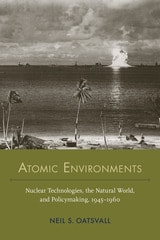
Atomic Environments
Nuclear Technologies, the Natural World, and Policymaking, 1945–1960Neil S. Oatsvall
University of Alabama Press, 2023
Demonstrates how policymakers influenced environmental science during the early nuclear age
In Atomic Environments: Nuclear Technologies, the Natural World, and Policymaking, 1945–1960, Neil S. Oatsvall examines how top officials in the Truman and Eisenhower administrations used environmental science to develop nuclear strategy at the beginning of the Cold War. While many people were involved in research and analysis during the period in question, it was at highest levels of executive decision-making where environmental science and nuclear science most clearly combined to shape the nation’s policies.
Oatsvall clearly demonstrates how the natural world and the scientific disciplines that study it became integral parts of nuclear science rather than adversarial fields of knowledge. But while nuclear technologies heavily depended on environmental science to develop, those same technologies frequently caused great harm to the natural world. Moreover, while some individuals expressed real anxieties about the damage wrought by nuclear technologies, policymakers as a class consistently made choices that privileged nuclear boosterism and secrecy, prioritizing institutional values over the lives and living systems that they were ostensibly charged to protect.
By scrutinizing institutional policymaking practices and agendas at the birth of the nuclear age, a constant set of values becomes clear. Oatsvall reveals an emerging technocratic class that routinely valued knowledge about the environment to help create and maintain a nuclear arsenal, despite its existential threat to life on earth and the negative effects many nuclear technologies had on ecosystems and the American people alike. Although policymakers took their charge to protect and advance the welfare of the United States and its people seriously, Atomic Environments demonstrates how they often failed to do so because their allegiance to the US nuclear hierarchy blinded them to the real risks and dangers of the nuclear age.
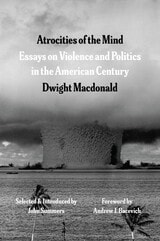
Atrocities of the Mind
Essays on Violence and Politics in the American CenturyDwight Macdonald
University of Chicago Press, 2026
An essential collection of Dwight Macdonald’s prophetic essays on politics, art, and violence in twentieth-century America.
What does extreme violence do to human values? Does the concept of collective guilt make sense in assessing responsibility for genocide? Has modern mechanized society forever destroyed the possibility of peaceful resistance through art and civil disobedience? Atrocities of the Mind presents anew Dwight Macdonald, one of America’s foremost literary journalists and political activists, grappling with the hard questions of his time—and ours.
In this collection, Macdonald writes about major events—the Holocaust, the atomic bombing of Hiroshima, Gandhi’s assassination, the Vietnam War, and social phenomena such as mass shootings, campus protests, and police brutality—with clear-sighted and buoyant prose. He writes incisively about the cinema of Alfred Hitchcock and Roman Polanski, praises Dorothy Day’s pacifism, and reports circulating an antiwar petition in the White House Rose Garden. And not without effect: his essay “Our Invisible Poor” is said to have spurred the Johnson administration’s War on Poverty.
Norman Mailer memorably called Macdonald “a man with whom one might seldom agree but could never disrespect because he always told the truth as he saw the truth—a man therefore of the most incorruptible integrity.” In our America, reeling from political violence, Macdonald’s truth-telling reminds us how we got here and who we might still become.

Attorney for the Damned
Clarence Darrow in the CourtroomClarence Darrow
University of Chicago Press, 2012
Published for the first time in 1957, Attorney for the Damned collects Darrow’s most influential summations and supplements them with scene-setting explanations and comprehensive notes by Arthur Weinberg. Darrow confronts issues that remain relevant over half a century after his death: First Amendment rights, capital punishment, and the separation of church and state. With an insightful forward by Justice William O. Douglas, this volume serves as a powerful reminder of Darrow’s relevance today.
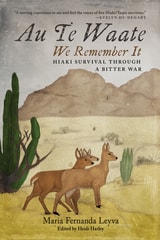
Au Te Waate / We Remember It
Hiaki Survival Through a Bitter WarMaria Fernanda Leyva; Edited by Heidi Harley
University of Arizona Press, 2025
This compelling work delves into the personal narratives of Hiaki (Yaqui) individuals who endured the tumultuous period from 1900 to 1930, when they faced systematic attacks, conscription, deportation, and enslavement under Mexican government policies. Presented in both the original Hiaki language and English translation, these accounts offer an unparalleled glimpse into the lives of those who resisted and survived the era’s harsh realities. The narratives describe military engagements, the struggles of refugee life, forced labor, and the resilience of families under extreme duress. This work provides a unique and unvarnished account of the impacts of Mexican colonialism and aggression on individuals and families, completely from the Hiaki perspective.
Au Te Waate / We Remember It is not just a historical account but a linguistic treasure, preserving the naturally produced speech of five Hiaki speakers from a previous era. Transcriptions of interviews recorded by author Maria Fernanda Leyva with family members and friends provide invaluable insights into the Hiaki language. The interviews document and preserve the narrative styles, vocabulary, and grammatical constructions of the time.
This work also serves as a crucial resource for scholars of linguistics and history alike, capturing dialect variation and illustrating the linguistic evolution of the Hiaki community. Additionally, for Hiaki people studying their own language, this book stands as a rich repository of cultural and linguistic heritage, meticulously maintained through side-by-side translations and contextual historical introductions.
The narratives in this book are anchored by the experiences of five Hiaki speakers, whose stories of displacement, survival, and resistance provide a deeply personal perspective on the broader historical events of the Porfirio Díaz dictatorship and the early years of the Mexican Revolution. Au Te Waate / We Remember It stands as an important record, preserving these critical voices for future generations and offering profound insights into the resilience of the Hiaki people.
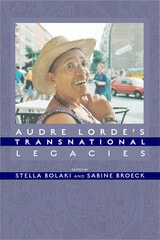
Audre Lorde’s Transnational Legacies
Stella Bolaki
University of Massachusetts Press, 2015
Audre Lorde's Transnational Legacies is the first book to systematically document and thoroughly investigate Lorde's influence beyond the United States. Arranged in three thematically interrelated sections—Archives, Connections, and Work—the volume brings together scholarly essays, interviews, Lorde's unpublished speech about Europe, and personal reflections and testimonials from key figures throughout the world. Using a range of interdisciplinary approaches, contributors assess the reception, translation, and circulation of Lorde's writing and activism within different communities, audiences, and circles. They also shed new light on the work Lorde inspired across disciplinary borders.
In addition the volume editors, contributors include Sarah Cefai, Cassandra Ellerbe-Dueck, Paul M. Farber, Tiffany N. Florvil, Katharina Gerund, Alexis Pauline Gumbs, Gloria Joseph, Jackie Kay, Marion Kraft, Christiana Lambrinidis, Zeedah Meierhofer-Mangeli, Rina Nissim, Chantal Oakes, Lester C. Olson, Pratibha Parmar, Peggy Piesche, Dagmar Schultz, Tamara Lea Spira, and Gloria Wekker.
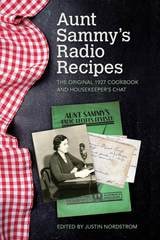
Aunt Sammy's Radio Recipes
The Original 1927 Cookbook and Housekeeper's ChatJustin Nordstrom
University of Arkansas Press, 2018
From the 1920s through the 1940s, American kitchens had a welcome guest in “Aunt Sammy,” a creation of the US Department of Agriculture and its Bureau of Home Economics. Through the radio program Housekeeper’s Chat, Aunt Sammy gave lively advice on food preparation, household chores, parenting and children, and gender dynamics as she encouraged women to embrace the radio and a host of modern consumer household products. The recipes she shared were gathered, in 1927, into a cookbook that became a valuable household manual for tens of thousands of Americans.
Aunt Sammy’s Radio Recipes revives the famous cookbook and joins it with extensive excerpts from the accompanying radio broadcasts, providing a fascinating study of how a witty and charming fictionalized personae became one of the early celebrity chefs of the radio age.
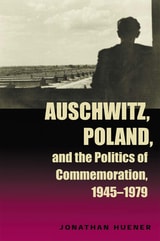
Auschwitz, Poland, and the Politics of Commemoration, 1945–1979
Jonathan Huener
Ohio University Press, 2003
Few places in the world carry as heavy a burden of history as Auschwitz. Recognized and remembered as the most prominent site of Nazi crimes, Auschwitz has had tremendous symbolic weight in the postwar world.
Auschwitz, Poland, and the Politics of Commemoration is a history of the Auschwitz memorial site in the years of the Polish People’s Republic. Since 1945, Auschwitz has functioned as a memorial and museum. Its monuments, exhibitions, and public spaces have attracted politicians, pilgrims, and countless participants in public demonstrations and commemorative events.
Jonathan Huener’s study begins with the liberation of the camp and traces the history of the State Museum at Auschwitz from its origins immediately after the war until the 1980s, analyzing the landscape, exhibitions, and public events at the site.
Based on extensive research and illustrated with archival photographs, Auschwitz, Poland, and the Politics of Commemoration accounts for the development and durability of a Polish commemorative idiom at Auschwitz. Emphasis on Polish national “martyrdom” at Auschwitz, neglect of the Shoah as the most prominent element of the camp’s history, political instrumentalization of the grounds and exhibitions—these were some of the more controversial aspects of the camp’s postwar landscape.
Professor Huener locates these and other public manifestations of memory at Auschwitz in the broad scope of Polish history, in the specific context of postwar Polish politics and culture, and against the background of Polish-Jewish relations. Auschwitz, Poland, and the Politics of Commemoration will be of interest to scholars, students, and general readers of the history of modern Poland and the Holocaust.
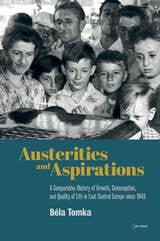
Austerities and Aspirations
A Comparative History of Growth, Consumption, and Quality of Life in East Central Europe since 1945Béla Tomka
Central European University Press, 2020
This monograph provides an analysis of the economic performance and living standard in Czechoslovakia and its successor states, Hungary, and Poland since 1945. The novelty of the book lies in its broad comparative perspective: it places East Central Europe in a wider European framework that underlines the themes of regional disparities and European commonalities. Going beyond the traditional growth paradigm, the author systematically studies the historical patterns of consumption, leisure, and quality of life—aspects that Tomka argues can best be considered in relation to one other. By adopting this “triple approach,” he undertakes a truly interdisciplinary research drawing from history, economics, sociology, and demography.
As a result of Tomka’s three-pillar comparative analysis, the book makes a major contribution to the debates on the dynamics of economic growth in communist and postcommunist East Central Europe, on the socialist consumer culture along with its transformation after 1990, and on how the accounts on East Central Europe can be integrated into the emerging field of historical quality of life research.
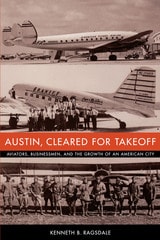
Austin, Cleared for Takeoff
Aviators, Businessmen, and the Growth of an American CityBy Kenneth B. Ragsdale
University of Texas Press, 2004
Austin, Texas, entered the aviation age on October 29, 1911, when Calbraith Perry Rodgers landed his Wright EX Flyer in a vacant field near the present-day intersection of Duval and 45th Streets. Some 3,000 excited people rushed out to see the pilot and his plane, much like the hundreds of thousands who mobbed Charles A. Lindbergh and The Spirit of St. Louis in Paris sixteen years later. Though no one that day in Austin could foresee all the changes that would result from manned flight, people here—as in cities and towns across the United States—realized that a new era was opening, and they greeted it with all-out enthusiasm.
This popularly written history tells the story of aviation in Austin from 1911 to the opening of Austin-Bergstrom International Airport in 1999. Kenneth Ragsdale covers all the significant developments, beginning with military aviation activities during World War I and continuing through the barnstorming era of the 1920s, the inauguration of airmail service in 1928 and airline service in 1929, and the dedication of the first municipal airport in 1930. He also looks at the University of Texas's role in training pilots during World War II, the growth of commercial and military aviation in the postwar period, and the struggle over airport expansion that occupied the last decades of the twentieth century. Throughout, he shows how aviation and the city grew together and supported each other, which makes the Austin aviation experience a case study of the impact of aviation on urban communities nationwide.

Australia, New Zealand, and the Pacific Islands since the First World War
Edited by William S. Livingston and Wm. Roger Louis
University of Texas Press, 1979
Three forces—dwindling British power, rising American influence, and nationalism in a variety of forms—have transformed Australia, New Zealand, and the adjacent islands since 1919. In this volume, some of the most distinguished scholars of the Pacific region assess these significant historical changes.
These essays deal with international relations, politics, changing social structures, and literature since World War I. The themes of the volume as a whole are social and humanistic; they concern the evolution of both a regional identity and separate national identities in the Southwest Pacific. The unique areal and thematic concentration of this book makes it essential reading for all those interested in the history, politics, and culture of the Pacific.
Australian Voices
Writers and Their WorkBy Ray Willbanks
University of Texas Press, 1991
Contemporary Australian fiction is attracting a world audience, particularly in the United States, where a growing readership eagerly awaits new works. In Australian Voices, Ray Willbanks goes beyond the books to their authors, using sixteen interviews to reveal the state of fiction writing in Australia—what nags from the past, what engages the imagination for the future.
Willbanks engages the writers in lively discussions of their own work, as well as topics of collective interest such as the past, including convict times; the nature of the land; the treatment of Aborigines; national identity and national flaws; Australian-British antipathy; sexuality and feminism; drama and film; writing, publishing, and criticism in Australia; and the continuous and pervasive influence of the United States on Australia.
The interviews in Australian Voices are gossipy, often funny, and always informative, as Willbanks builds a structured conversation that reveals biography, personality, and significant insight into the works of each writer. They will be important for both scholars and the reading public.
Authentic Blackness
The Folk in the New Negro RenaissanceJ. Martin Favor
Duke University Press, 1999
Authentic Blackness looks at the place of the “folk”—those African Americans “furthest down,” in the words of Alain Locke—and how the representation of the folk and the black middle class both spurred the New Negro Movement and became one of its most serious points of contention. Drawing on vernacular theories of African American literature from such figures as Henry Louis Gates Jr. and Houston Baker as well as theorists Judith Butler and Stuart Hall, Favor looks closely at the work of four Harlem Renaissance fiction writers: James Weldon Johnson, Nella Larsen, George Schuyler, and Jean Toomer. Arguing that each of these writers had, at best, an ambiguous relationship to African American folk culture, Favor demonstrates how they each sought to redress the notion of a fixed black identity. Authentic Blackness illustrates how “race” has functioned as a type of performative discourse, a subjectivity that simultaneously builds and conceals its connections with such factors as class, gender, sexuality, and geography.
Authorizing Superhero Comics
On the Evolution of a Popular Serial GenreDaniel Stein
The Ohio State University Press, 2021
Autobiography and Decolonization
Modernity, Masculinity, and the Nation-StatePhilip Holden
University of Wisconsin Press, 2008

Autobiography and Postmodernism
Kathleen Ashley
University of Massachusetts Press, 1994
In contrast to those critics of postmodernism who fear the dissolution of the active subject, the contributors here demonstrate that autobiography gives postmodernism a discourse through which to theorize human agency. The autobiographical subject that emerges is not the decentered human agent of so many versions of postmodernism but the producer of texts that call attention to the contradictions in dominant modes of self-representation and demonstrate the possibilities of writing from from other locations.
Contributors are Betty Bergland, Andrei Codrescu, Michael M. J. Fischer, Leigh Gilmore, David P. Haney, Paul Jay, Shirley Neuman, Christopher Ortiz, Sidonie Smith, Kirsten Wasson, and Hertha D. Wong.

Autobiography of My Hungers
Rigoberto González
University of Wisconsin Press, 2019
Bill Whitehead Award for Lifetime Literary Achievement, Publishing Triangle
“Told in a series of revealing vignettes and poems, González’s Autobiography of my Hungers turns moments of need and want into revelations of truth and self-awareness, creating the portrait of an artist that is complex if not entirely complete.”—El Paso Times
“Through his provocative vignettes, González communicates a lifetime of struggle for affirmation and self-acceptance.”—Make/Shift
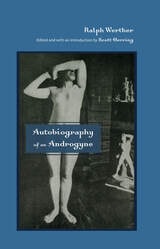
Autobiography of an Androgyne
Ralph Werther and Edited by Scott Herring
Rutgers University Press, 2008
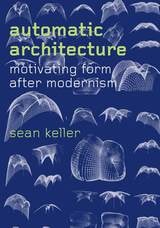
Automatic Architecture
Motivating Form after ModernismSean Keller
University of Chicago Press, 2017
The quixotic attempts to formulate such design processes extended modernist principles and tried to draw architecture closer to mathematics and the sciences. By focusing on design methods, and by examining evidence at a range of scales—from institutions to individual buildings—Automatic Architecture offers an alternative to narratives of this period that have presented postmodernism as a question of style, as the methods and techniques traced here have been more deeply consequential than the many stylistic shifts of the past half century. Sean Keller closes the book with an analysis of the contemporary condition, suggesting future paths for architectural practice that work through, but also beyond, the merely automatic.
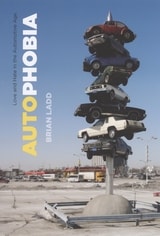
Autophobia
Love and Hate in the Automotive AgeBrian Ladd
University of Chicago Press, 2008
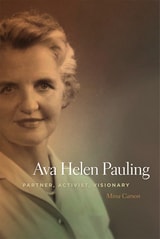
Ava Helen Pauling
Partner, Activist, VisionaryMina Carson
Oregon State University Press, 2013
Though she began her public career in the shadow of her spouse, Ava Helen soon found herself tugged between her ardor to support Linus in his career and her desire that he embrace the social and political causes she felt passionate about. She believed it was her destiny to accept duties as a mother and homemaker, but neither of those roles was fully satisfying. Her more complete identity emerged over decades, as she evolved as an influential activist.
Ava Helen Pauling’s story is significant because so many aspects of it were shared with countless American women of her generation and the generations surrounding her. They had new educational opportunities but were expected to conform to the same limited social roles dictated by the gender ideology of the nineteenth century. When second wave feminism erupted in the 1960s, its force did not come solely from the young women rebelling against their elders’ rules and limitations, but also from the frustrated dreams of those elders themselves.
Ava Helen did not experience overt oppression by her husband or community; she even asserted some very non-feminist positions as a young woman. This, combined with a structural lack of opportunity, contributed to the strength and persistence of role expectations in her life. At the same time, she was feisty and willful. Her personality both created her marital loyalty and eventually took her down an openly feminist path.
Ava Helen Pauling: Partner, Activist, Visionary is an important complement to writings about Linus Pauling and a welcome addition to the literature on women’s and family history. It will also appeal to students and scholars of peace and reform movements and the social history of science.
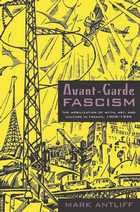
Avant-Garde Fascism
The Mobilization of Myth, Art, and Culture in France, 1909–1939Mark Antliff
Duke University Press, 2007
Antliff considers three French fascists: Georges Valois, Philippe Lamour, and Thierry Maulnier, demonstrating how they appropriated the avant-garde aesthetics of cubism, futurism, surrealism, and the so-called Retour à l’Ordre (“Return to Order”), and, in one instance, even defined the “dynamism” of fascist ideology in terms of Soviet filmmaker Sergei Eisenstein’s theory of montage. For these fascists, modern art was the mythic harbinger of a regenerative revolution that would overthrow existing governmental institutions, inaugurate an anticapitalist new order, and awaken the creative and artistic potential of the fascist “new man.”
In formulating the nexus of fascist ideology, aesthetics, and violence, Valois, Lamour, and Maulnier drew primarily on the writings of the French political theorist Georges Sorel, whose concept of revolutionary myth proved central to fascist theories of cultural and national regeneration in France. Antliff analyzes the impact of Sorel’s theory of myth on Valois, Lamour, and Maulnier. Valois created the first fascist movement in France; Lamour, a follower of Valois, established the short-lived Parti Fasciste Révolutionnaire in 1928 before founding two fascist-oriented journals; Maulnier forged a theory of fascism under the auspices of the journals Combat and Insurgé.

Avant-Garde Performance and the Limits of Criticism
Approaching the Living Theatre, Happenings/Fluxus, and the Black Arts MovementMike Sell
University of Michigan Press, 2005
Mike Sell's study is groundbreaking in its consideration of the avant-garde in relationship to a crucial but rarely considered agent: the scholar and critic. The book examines the role of the scholar and critic in the cultural struggles of radical artists and activists and reveals how avant-garde performance identifies the very limits of critical consideration. The book also explores the popularization of the avant-garde: how formerly subversive art is eventually discovered by the mass media, is gobbled up by the marketplace, and eventually finds its way onto the syllabi of college and university courses. Avant-Garde Performance and the Limits of Criticism is a timely and significant book that will become a standard reference for scholars in the fields of avant-garde literary criticism, theater history, critical theory, and performance studies.
"A provocative exploration of relations between the historical avant-garde and Cold War vanguard art and theatre. Sell's compelling historical and cultural narrative shows how the connections between the two exist at a very deep level of radical politics and aesthetics--an amazing concoction of rigorous scholarship, interdisciplinary learning, and progressive theorizing."
--Michael Vanden Heuvel, University of Wisconsin, Madison
"One of the most sophisticated, engaged, and engaging studies of the avant-garde in the United States that I've read-an important study that will raise the bar not only on scholarship of the Black Arts Movement, but on U.S. avant-gardism generally."
--James Smethurst, University of Massachusetts
A volume in the series Theater: Theory/Text/Performance. A list of recent titles in the series appears at the front of this volume.
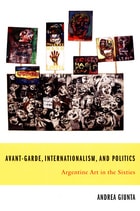
Avant-Garde, Internationalism, and Politics
Argentine Art in the SixtiesAndrea Giunta
Duke University Press, 2007
The renowned Argentine art historian and critic Andrea Giunta analyzes projects specifically designed to internationalize Argentina’s art and avant-garde during the 1960s: the importation of exhibitions of contemporary international art, the sending of Argentine artists abroad to study, the organization of prize competitions involving prestigious international art critics, and the export of exhibitions of Argentine art to Europe and the United States. She looks at the conditions that made these projects possible—not least the Alliance for Progress, a U.S. program of “exchange” and “cooperation” meant to prevent the spread of communism through Latin America in the wake of the Cuban Revolution—as well as the strategies formulated to promote them. She describes the influence of Romero Brest, prominent art critic, supporter of abstract art, and director of the Centro de Artes Visuales del Instituto Tocuato Di Tella (an experimental art center in Buenos Aires); various group programs such as Nueva Figuración and Arte Destructivo; and individual artists including Antonio Berni, Alberto Greco, León Ferrari, Marta Minujin, and Luis Felipe Noé. Giunta’s rich narrative illuminates the contentious postwar relationships between art and politics, Latin America and the United States, and local identity and global recognition.
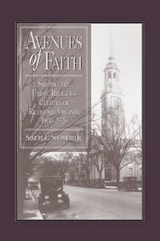
Avenues of Faith
Shaping the Urban Religious Culture of Richmond, Virginia, 1900–1929Samuel C. Shepherd Jr
University of Alabama Press, 2001
By examining six mainline white denominations—Episcopalians, Methodists, Presbyterians, Baptists, Disciples of Christ, and Lutherans—Samuel C. Shepherd Jr. emphasizes the extent to which the city fostered religious diversity, even as “blind spots” remained regarding Catholics, African Americans, Mormons, and Jews. Shepherd explores such topics as evangelism, interdenominational cooperation, the temperance campaign, the Sunday school movement, the international peace initiatives, and the expanding role of lay people of both sexes. He also notes the community’s widespread rejection of fundamentalism, a religious phenomenon almost automatically associated with the South, and shows how it nurtured social reform to combat a host of urban problems associated with public health, education, housing, women’s suffrage, prohibition, children, and prisons.
In lucid prose and with excellent use of primary sources, Shepherd delivers a fresh portrait of Richmond Protestants who embraced change and transformed their community, making it an active, progressive religious center of the New South.
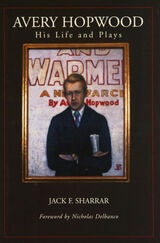
Avery Hopwood
His Life and PlaysJack F. Sharrar
University of Michigan Press, 1998
Awakening to Equality
A Young White Pastor at the Dawn of Civil RightsKarl E. Lutze
University of Missouri Press, 2006
Axiomatics
Mathematical Thought and High ModernismAlma Steingart
University of Chicago Press, 2023
Why did abstraction dominate American art, social science, and natural science in the mid-twentieth century? Why, despite opposition, did abstraction and theoretical knowledge flourish across a diverse set of intellectual pursuits during the Cold War? In recovering the centrality of abstraction across a range of modernist projects in the United States, Alma Steingart brings mathematics back into the conversation about midcentury American intellectual thought. The expansion of mathematics in the aftermath of World War II, she demonstrates, was characterized by two opposing tendencies: research in pure mathematics became increasingly abstract and rarified, while research in applied mathematics and mathematical applications grew in prominence as new fields like operations research and game theory brought mathematical knowledge to bear on more domains of knowledge. Both were predicated on the same abstractionist conception of mathematics and were rooted in the same approach: modern axiomatics.
For American mathematicians, the humanities and the sciences did not compete with one another, but instead were two complementary sides of the same epistemological commitment. Steingart further reveals how this mathematical epistemology influenced the sciences and humanities, particularly the postwar social sciences. As mathematics changed, so did the meaning of mathematization.
Axiomatics focuses on American mathematicians during a transformative time, following a series of controversies among mathematicians about the nature of mathematics as a field of study and as a body of knowledge. The ensuing debates offer a window onto the postwar development of mathematics band Cold War epistemology writ large. As Steingart’s history ably demonstrates, mathematics is the social activity in which styles of truth—here, abstraction—become synonymous with ways of knowing.
Aztlán Arizona
Mexican American Educational Empowerment, 1968–1978Darius V. Echeverría
University of Arizona Press, 2014
The word Aztlán, originally meaning the legendary ancestral home of the Nahua peoples of Mesoamerica, was adopted as a symbol of independence by Chicano/a activists during the movement of the 1960s and 1970s. In an era when poverty, prejudice, and considerable oppositional forces blighted the lives of roughly one-fifth of Arizonans, the author argues that understanding those societal realities is essential to defining the rise and power of the Chicano Movement.
The book illustrates how Mexican American communities fostered a togetherness that ultimately modified larger Arizona society by revamping the educational history of the region. The concluding chapter outlines key Mexican American individuals and organizations that became politically active in order to address Chicano educational concerns. This Chicano unity, reflected in student, parent, and community leadership organizations, helped break barriers, dispel the Mexican American inferiority concept, and create educational change that benefited all Arizonans.
No other scholar has examined the emergence of Chicano Movement politics and its related school reform efforts in Arizona. Echeverría’s thorough research, rich in scope and interpretation, is coupled with detailed and exact endnotes. The book helps readers understand the issues surrounding the Chicano Movement educational reform and ethnic identity. Equally important, the author shows how residual effects of these dynamics are still pertinent today in places such as Tucson.

an other
a black feminist consideration of animal lifeSharon Patricia Holland
Duke University Press, 2023