Results by title
805 books match the query '18th century' and 57 start with a
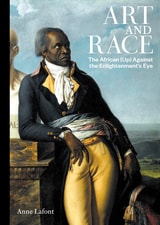
Art and Race
The African (Up) Against the Enlightenment’s EyeAnne Lafont
J. Paul Getty Trust, The, 2026
This groundbreaking study investigates the close and paradoxical relationship of art and race during the Enlightenment.
In this text, French art historian Anne Lafont examines the complexities and contradictions in Enlightenment-era ideas about race, focusing on the figurations of Africans and other people of color. Through studies of a wide range of eighteenth-century art, Lafont grounds her analysis in the objects themselves and, by doing so, highlights how visual works can reveal the values of the culture that produced them.
While Lafont locates—unsurprisingly—instances of the marginalization and objectification of Black people, she also draws attention to depictions that present African sitters as subjects in their own right. For example, Anne-Louis Girodet’s Portrait of Jean-Baptiste Belley (1797) offers a dignified, individualized representation of this formerly enslaved French politician from Saint-Domingue; and portraits of anonymous sitters show them as actual persons whose costumes and poses demonstrate their agency.
Ultimately, Lafont moves beyond artworks to consider the broader intellectual context of the Enlightenment, particularly ideas about freedom, equality, and universal human rights, which were anchored in visual culture and indexed by it. She reveals how these ideals often conflicted with the realities of colonialism and the shifting status of Black people during this era.
[more]
Art of Darkness
A Poetics of GothicAnne Williams
University of Chicago Press, 1995
Art of Darkness is an ambitious attempt to describe the principles governing Gothic literature. Ranging across five centuries of fiction, drama, and verse—including tales as diverse as Horace Walpole's The Castle of Otranto, Shelley's Frankenstein, Coleridge's The Rime of the Ancient Mariner, and Freud's The Mysteries of Enlightenment—Anne Williams proposes three new premises: that Gothic is "poetic," not novelistic, in nature; that there are two parallel Gothic traditions, Male and Female; and that the Gothic and the Romantic represent a single literary tradition.
Building on the psychoanalytic and feminist theory of Julia Kristeva, Williams argues that Gothic conventions such as the haunted castle and the family curse signify the fall of the patriarchal family; Gothic is therefore "poetic" in Kristeva's sense because it reveals those "others" most often identified with the female. Williams identifies distinct Male and Female Gothic traditions: In the Male plot, the protagonist faces a cruel, violent, and supernatural world, without hope of salvation. The Female plot, by contrast, asserts the power of the mind to comprehend a world which, though mysterious, is ultimately sensible. By showing how Coleridge and Keats used both Male and Female Gothic, Williams challenges accepted notions about gender and authorship among the Romantics. Lucidly and gracefully written, Art of Darkness alters our understanding of the Gothic tradition, of Romanticism, and of the relations between gender and genre in literary history.
Building on the psychoanalytic and feminist theory of Julia Kristeva, Williams argues that Gothic conventions such as the haunted castle and the family curse signify the fall of the patriarchal family; Gothic is therefore "poetic" in Kristeva's sense because it reveals those "others" most often identified with the female. Williams identifies distinct Male and Female Gothic traditions: In the Male plot, the protagonist faces a cruel, violent, and supernatural world, without hope of salvation. The Female plot, by contrast, asserts the power of the mind to comprehend a world which, though mysterious, is ultimately sensible. By showing how Coleridge and Keats used both Male and Female Gothic, Williams challenges accepted notions about gender and authorship among the Romantics. Lucidly and gracefully written, Art of Darkness alters our understanding of the Gothic tradition, of Romanticism, and of the relations between gender and genre in literary history.
[more]
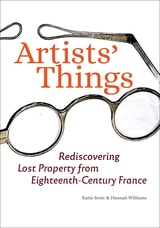
Artists' Things
Rediscovering Lost Property from Eighteenth-Century FranceKatie Scott
J. Paul Getty Trust, The, 2024
Histories of artists’ personal possessions shed new light on the lives of their owners.
Artists are makers of things. Yet it is a measure of the disembodied manner in which we generally think about artists that we rarely consider the everyday items they own. This innovative book looks at objects that once belonged to artists, revealing not only the fabric of the eighteenth-century art world in France but also unfamiliar—and sometimes unexpected—insights into the individuals who populated it, including Jean-Antoine Watteau, François Boucher, Jean-Baptiste Greuze, and Elisabeth Vigée-LeBrun.
From the curious to the mundane, from the useful to the symbolic, these items have one thing in common: they have all been eclipsed from historical view. Some of the objects still exist, like Jean-Honoré Fragonard’s color box and Jacques-Louis David’s table. Others survive only in paintings, such as Jean-Siméon Chardin’s cistern in his Copper Drinking Fountain, or in documents, like François Lemoyne’s sword, the instrument of his suicide. Several were literally lost, including pastelist Jean-Baptiste Perronneau’s pencil case. In this fascinating book, the authors engage with fundamental historical debates about production, consumption, and sociability through the lens of material goods owned by artists.
The free online edition of this open-access publication is at www.getty.edu/publications/artists-things/ and includes zoomable illustrations. Free PDF and EPUB downloads of the book are also available.
[more]
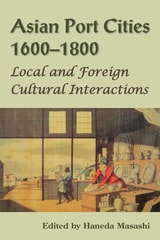
Asian Port Cities, 1600-1800
Local and Foreign Cultural InteractionsHaneda Masashi
National University of Singapore Press, 2009
Asian port cities in the seventeenth and eighteenth centuries were the site of intensive cultural contact involving a broad spectrum of participants from across the world. These interactions raised questions of communication for merchants who conducted business in the port cities and of regulation and control for the officials who governed them. By drawing comparisons among the port cities of East, Southeast and South Asia where European East India Companies maintained trading centers, this volume goes beyond national histories to examine cultural interactions on a regional basis. The authors draw on the rich literature relating to cross-cultural interactions between the Dutch and the Japanese in Nagasaki in discussing issues that range from architecture, mercantile and artistic communication, business transactions and dispute settlement to family issues, clothing, housing, and social relations associated with food. Their work yields intriguing new interpretations of the Asian maritime world that will interest historians concerned with Europe or Asia during the early modern period, as well as students of material culture.
[more]
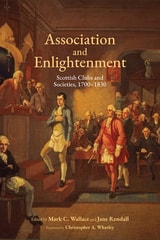
Association and Enlightenment
Scottish Clubs and Societies, 1700-1830Mark C. Wallace
Bucknell University Press, 2021
Social clubs as they existed in eighteenth- and early nineteenth-century Scotland were varied: they could be convivial, sporting, or scholarly, or they could be a significant and dynamic social force, committed to improvement and national regeneration as well as to sociability. The essays in this volume examine the complex history of clubs and societies in Scotland from 1700 to 1830. Contributors address attitudes toward associations, their meeting places and rituals, their links with the growth of the professions and with literary culture, and the ways in which they were structured by both class and gender. By widening the context in which clubs and societies are set, the collection offers a new framework for understanding them, bringing together the inheritance of the Scottish past, the unique and cohesive polite culture of the Scottish Enlightenment, and the broader context of associational patterns common to Britain, Ireland, and beyond.
[more]
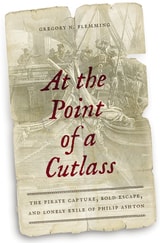
At the Point of a Cutlass
The Pirate Capture, Bold Escape, and Lonely Exile of Philip AshtonGregory N. Flemming
University Press of New England, 2015
A handful of sea stories define the American maritime narrative. Stories of whaling, fishing, exploration, naval adventure, and piracy have always captured our imaginations, and the most colorful of these are the tales of piracy. Called America’s real-life Robinson Crusoe, the true story of Philip Ashton—a nineteen-year-old fisherman captured by pirates, impressed as a crewman, subjected to torture and hardship, who eventually escaped and lived as a castaway and scavenger on a deserted island in the Caribbean—was at one time as well known as the tales of Cooper, Hawthorne, and Defoe. Based on a rare copy of Ashton’s 1725 account, Gregory N. Flemming’s vivid portrait recounts this maritime world during the golden age of piracy. Fishing vessels and merchantmen plied the coastal waters and crisscrossed the Atlantic and Caribbean. It was a hard, dangerous life, made more so by both the depredations and temptations of piracy. Chased by the British Royal Navy, blown out of the water or summarily hung when caught, pirate captains such as Edward Low kidnapped, cajoled, beat, and bribed men like Ashton into the rich—but also vile, brutal, and often short—life of the pirate. In the tradition of Nathaniel Philbrick, At the Point of a Cutlass expands on a lost classic narrative of America and the sea, and brings to life a forgotten world of ships and men on both sides of maritime law.
[more]
Authorship in the Long Eighteenth Century
Dustin Griffin
University of Delaware Press, 2014
This book deals with changing conditions and conceptions of authorship in the long eighteenth century, a period often said to have witnessed the birth of the modern author. It focuses not on authorial self-presentation or self-revelation but on an author’s interactions with booksellers, collaborators, rivals, correspondents, patrons, and audiences. Challenging older accounts of the development of authorship in the period as well as newer claims about the “public sphere” and the “professional writer,” it engages with recent work on print culture and the history of the book. Methodologically eclectic, it moves from close readings to strategic contextualization. The book is organized both chronologically and topically. Early chapters deal with writers – notably Milton and Dryden – at the beginning of the long eighteenth century, and later chapters focus more on writers — among them Johnson, Gray, and Gibbon — toward its end. Looking beyond the traditional canon, it considers a number of little-known or little-studied writers, including Richard Bentley, Thomas Birch, William Oldys, James Ralph, and Thomas Ruddiman. Some of the essays are organized around a single writer, but most deal with a broad topic – literary collaboration, literary careers, the republic of letters, the alleged rise of the “professional writer,” and the rather different figure of the “author by profession.”
Published by University of Delaware Press. Distributed worldwide by Rutgers University Press.
Published by University of Delaware Press. Distributed worldwide by Rutgers University Press.
[more]